Airbus-style PFD tapes
A speed tape with a trend arrow and an altitude tape, with cyan bugs marking your selected targets — the visual language of an Airbus flight deck.
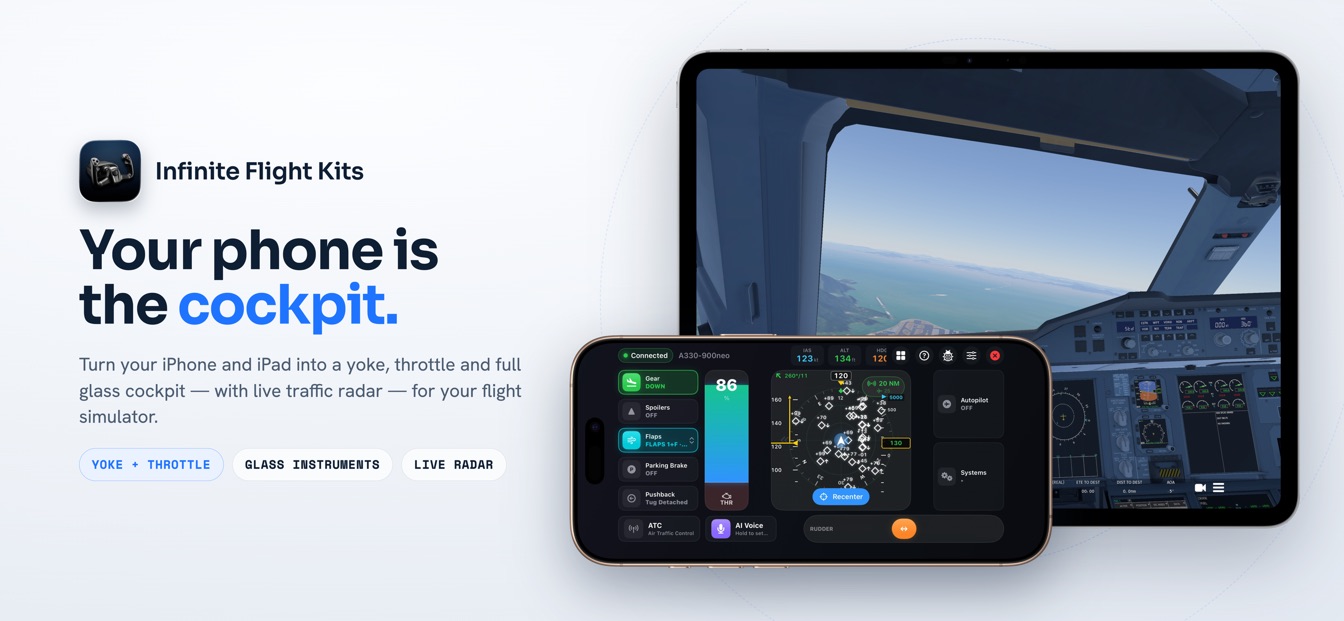
The real A320 traded the yoke for a sidestick — your simulator setup should too. SkyYoke turns an iPhone into a wireless A320 joystick for Infinite Flight, gated Airbus thrust lever included.
An Airbus A320 joystick for Infinite Flight is a handheld sidestick control for the simulator's A320, and SkyYoke makes one from your iPhone: tilt the phone (or drag an on-screen pad) to fly roll and pitch over your own Wi-Fi, while the thrust lever runs through REV, IDLE, CLIMB, FLX·MCT and TOGA gates with a haptic tick at each — no hardware required.
Hold your phone in one hand, thumb resting lightly on the glass. That grip — relaxed, one-handed, the wrist doing the work — is closer to how a real A320 is flown than any control column ever was. When the A320 entered service in 1988 it carried digital fly-by-wire and the sidestick into mainline airline cockpits, and the industry never went back. Which is why an Airbus A320 joystick for Infinite Flight is not a gimmick: it is the control style this airplane was designed around. SkyYoke builds that joystick from the iPhone already in your pocket, streaming roll and pitch to the simulator over your own Wi-Fi while the device running Infinite Flight stays a clean, full-screen view of the flight.
The payoff shows up on the very first departure. Rotation becomes a measured tilt of the wrist instead of a swipe across a tablet, and that one change makes the whole jet feel calmer under your hands.
Few airplanes have reshaped the industry the way this one did. After pioneering the sidestick and digital fly-by-wire in mainline service, the A320 grew into the definitive 150-to-180-seat narrowbody — one of the best-selling airliners in history and the backbone of short-haul fleets worldwide. Two wing-mounted turbofans, a single aisle, and a cockpit philosophy built on consistency rather than muscle: if you have boarded a short-haul flight almost anywhere on earth, odds are it was one of these.
In Infinite Flight's fleet the A320 plays the same part it plays at the airport — the dependable everyday jet. It rewards tidy energy management and small, smooth corrections, which is precisely the kind of flying a handheld sidestick encourages. It also anchors a whole family: once the controls feel right here, the stretched A321 and the rest of the Airbus stable come along for free.
SkyYoke gives the A320 two stick options, switchable whenever you like:
Every axis — pitch, roll, yaw and brake — carries its own sensitivity, dead zone, expo curve, inversion, trim and smoothing. On an Airbus that tuning earns its keep: set a soft expo curve and the region around neutral becomes a fingertip zone for the constant one- and two-degree corrections of a stabilized approach. Underneath, a 60 Hz control loop with change-detection and rate limiting keeps inputs immediate without flooding your network, and a link watchdog reconnects automatically if the Wi-Fi blips.
An Airbus without thrust detents is only half an Airbus, so SkyYoke never makes you ask for them. Select any Airbus type and the single smart-throttle lever automatically becomes a gated quadrant — REV FULL / REV / IDLE / CLIMB / FLX·MCT / TOGA — with a haptic tick each time the lever crosses a gate. Setting takeoff power stops being a guess at a percentage: you push until the click says FLX·MCT, then pull back one gate to CLIMB as the speed tape comes alive.
The lever stays clever at the other end of the flight, too. Pull into the red zone on the rollout at 40 knots or faster and SkyYoke engages held reverse thrust — Infinite Flight requires reverse to be held, and the lever holds it for you. Below 40 knots the same zone turns into proportional wheel braking, and in the air reverse is simply blocked, with a warning banner and a repeating haptic so it cannot happen by accident. The lever even recolors with its role: blue and green for forward thrust, amber for braking, red for reverse.
The essentials of the airplane, and how SkyYoke maps itself onto them:
| Manufacturer | Airbus |
|---|---|
| Family | A320 family (single-aisle narrowbody) |
| Control style | Sidestick with digital fly-by-wire — the first mainline airliner so equipped (1988) |
| Engines | 2 × wing-mounted turbofans |
| Typical role | Short- and medium-haul workhorse, 150–180 seats |
| Stick in SkyYoke | iPhone motion tilt or on-screen touch joystick → roll and pitch |
| Throttle in SkyYoke | Airbus detent lever: REV FULL / REV / IDLE / CLIMB / FLX·MCT / TOGA with haptic gates |
| Rudder in SkyYoke | Self-centering rudder bar along the bottom of the screen |
Flying the stick is half the job; reading the airplane is the other half. SkyYoke surrounds the controls with live IAS, altitude, heading and vertical-speed chips, a ground/air phase chip and a spoiler annunciator — and three aids that feel especially at home on this jet:
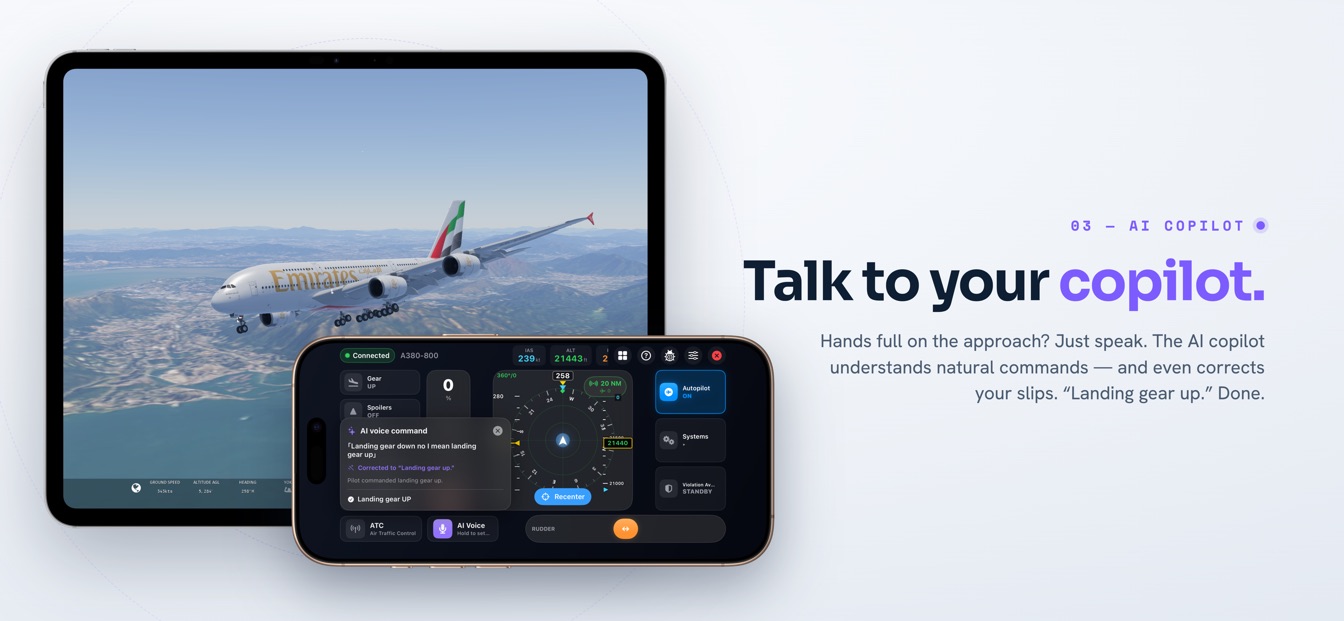
A speed tape with a trend arrow and an altitude tape, with cyan bugs marking your selected targets — the visual language of an Airbus flight deck.
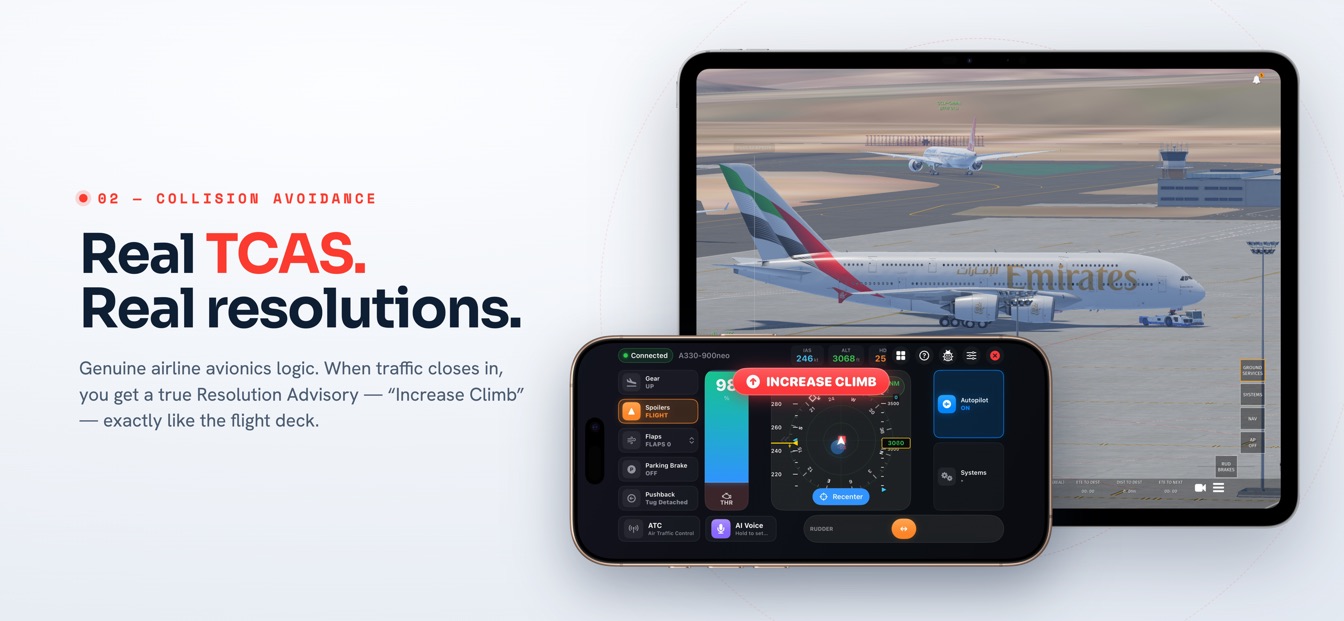
An Airbus navigation-display-style scope drawn over the yoke pad, painting live multiplayer traffic with TCAS II v7.1-style categories and spoken advisories.
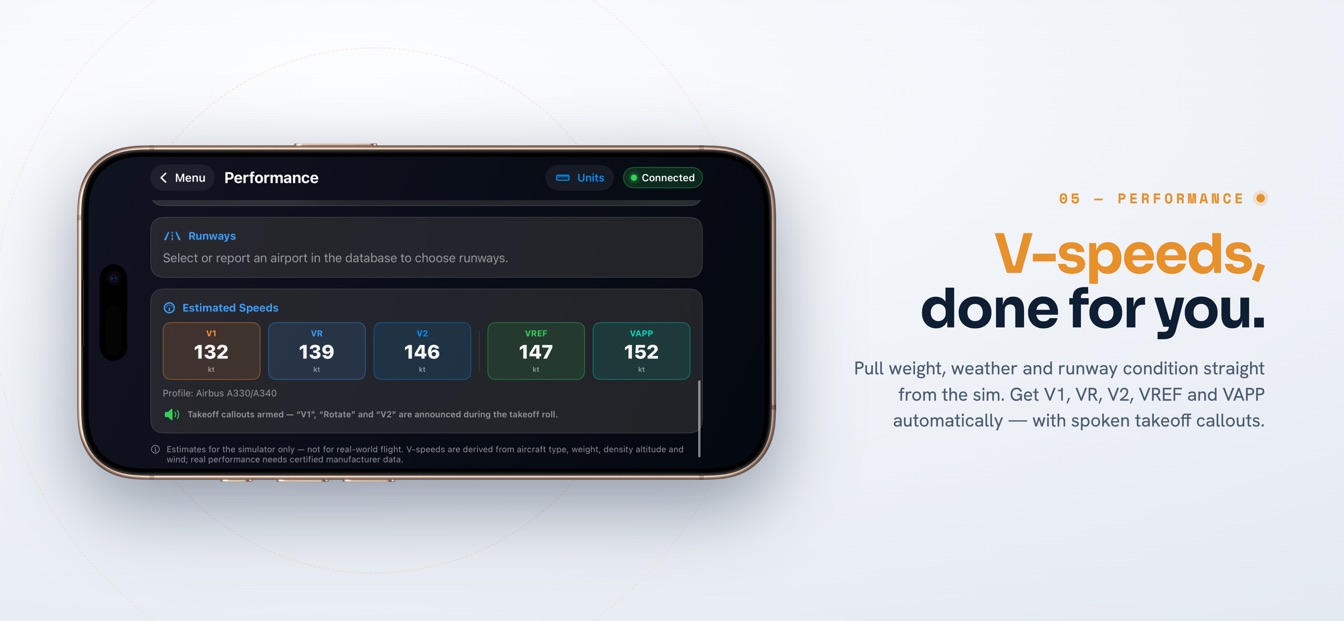
Arm them from the Performance screen and the cockpit speaks "V1", "Rotate" and "V2" on the roll — estimates scaled by weight and density altitude.
Two more systems wear the Airbus badge honestly. The windshear warning is modeled on the A320's own FAC reactive windshear system, announcing "Windshear, windshear, windshear" if a sharp headwind loss is detected close to the ground. And the Violation Avoidance System watches the 250-knot limit below 10,000 feet while the autopilot flies, clamping the speed target — or idling the thrust and shallowing the descent — before an overspeed turns into a violation. Both are simulator aids rather than certified avionics, and the TCAS scope carries the same caveat: helpful, never a guarantee.
Short answers on flying Infinite Flight's A320 from your iPhone.
It is a handheld control for flying Infinite Flight's A320 instead of using the tablet's on-screen controls. SkyYoke creates one from your iPhone: tilt the phone like a sidestick, or drag an on-screen self-centering pad, while Infinite Flight runs on a second device on the same Wi-Fi network. Control inputs stream wirelessly in real time, and no physical joystick hardware is required.
Because the A320 is the airplane that brought the sidestick to mainline airliners in 1988. Its pilots fly with one hand and small wrist movements rather than a two-handed yoke, and a phone held in one hand mirrors that style naturally. Gentle tilts become gentle stick deflections, and per-axis expo curves give you the fine control near neutral that smooth Airbus flying rewards.
When you fly an Airbus type, SkyYoke automatically replaces its standard throttle with a gated quadrant: REV FULL, REV, IDLE, CLIMB, FLX·MCT and TOGA. A haptic tick fires each time the lever crosses a gate, so you can set takeoff or climb thrust by feel without looking away from the runway. No setup is needed — the detents simply appear on Airbus aircraft.
An iPhone on iOS 17.2 or later for SkyYoke, plus a second device running Infinite Flight with Infinite Flight Connect enabled, both on the same Wi-Fi network. You bind the control axes once in Infinite Flight's Controllers settings — an in-app setup guide walks you through it. After that, pick the A320 from Infinite Flight's fleet and fly.
No. SkyYoke is an independent, unofficial app and is not affiliated with, sponsored by, or endorsed by Airbus or Infinite Flight LLC. Aircraft names are used for identification only. Aircraft availability and features inside Infinite Flight are determined by Infinite Flight itself, and every performance figure or callout SkyYoke produces is a simulator estimate, never real-world guidance.
SkyYoke is available now — download it on the App Store and turn your iPhone into a full flight-sim cockpit.
Download on the App Store Get it on Google Play