A Real Airbus Feel for Infinite Flight
Gated detents under your thumb, a sidestick made of motion, windshear and traffic advisories in your ears — SkyYoke brings a real Airbus feel to Infinite Flight, straight from the iPhone in your hand.
A real Airbus for Infinite Flight is what SkyYoke makes of your iPhone: the throttle becomes a gated quadrant with TOGA, FLX·MCT, CLIMB, IDLE and reverse detents that tick in your hand, tilt becomes your sidestick, and the display adds an A320-FAC-style windshear warning, an ND-style TCAS scope and PFD speed and altitude tapes — for every Airbus type in Infinite Flight, over Wi-Fi.
What makes a real Airbus for Infinite Flight
Ask an A320 captain what the airplane feels like and the answer is rarely the sidestick — it's the thrust levers. Click into FLX for a reduced-thrust departure, back to CLIMB at thrust reduction, into IDLE over the numbers. Those gates set the cadence of every Airbus flight, and they are exactly what a flat touchscreen erases. SkyYoke builds a real Airbus for Infinite Flight by putting the cadence back: a gated thrust quadrant that ticks against your thumb, envelope-style speed protection, a navigation-display traffic scope, PFD-style tapes and a windshear voice — all on the iPhone in your pocket, over your own Wi-Fi.
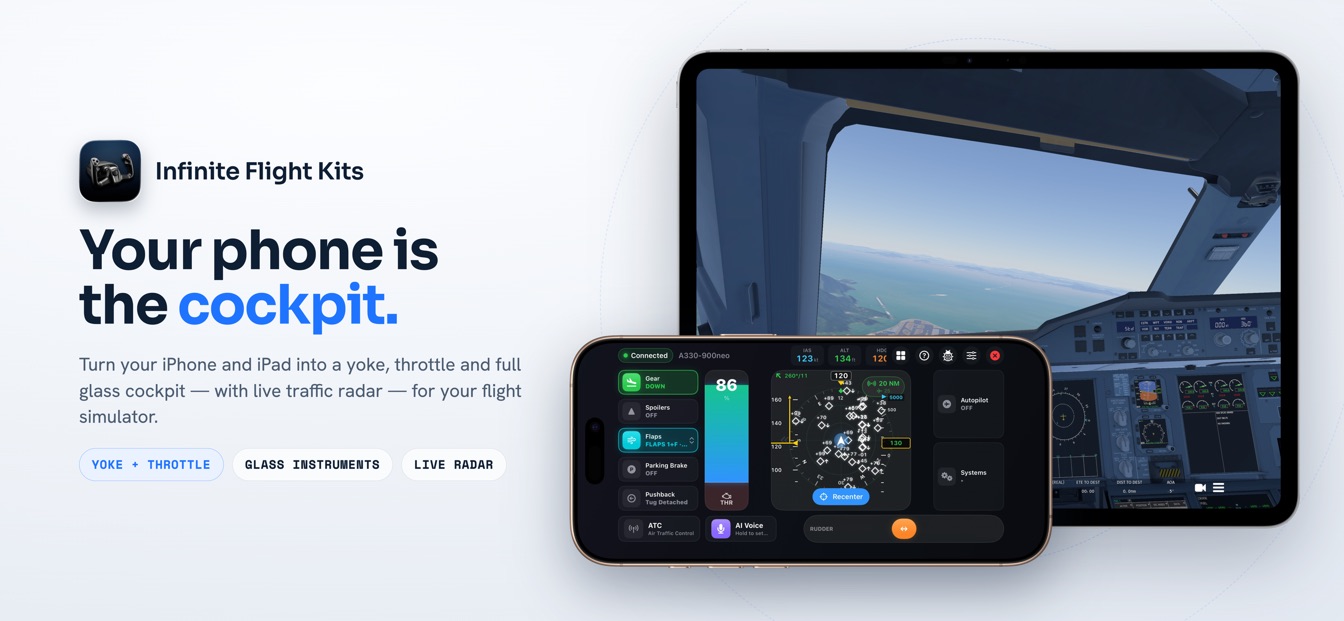
The rule is the same throughout: where the real airplane gives its crew a system, SkyYoke gives you an honest simulator counterpart.
| On the flight deck | On your iPhone |
|---|---|
| Gated thrust quadrant (TOGA, FLX·MCT, CLIMB, IDLE, reverse) | A detented lever with a haptic tick at every gate, engaged automatically on Airbus types |
| Sidestick | Motion tilt or a self-centering touch pad, tuned per axis with expo, trim and smoothing |
| FAC reactive windshear | A spoken “Windshear” warning on a large headwind loss between 50 and 1,300 ft |
| TCAS on the navigation display | An ND-style traffic scope with TCAS II v7.1-style logic and spoken advisories |
| PFD speed and altitude tapes | Live tapes with a speed trend arrow, cyan selected-value bugs and a green altitude readout |
| Flight-envelope protections | The Violation Avoidance System, which manages the autopilot to respect the 250-kt limit below 10,000 ft |
That last row matters more than it sounds. Infinite Flight issues overspeed violations below 10,000 ft; the Violation Avoidance System arms about 2,000 ft before the band, clamps the autopilot speed target to 250 kt when it must (restoring the speed you dialed later) and, in a steep descent, manages energy by idling the throttle or leveling off. It's SkyYoke's tribute to the way a real Airbus quietly refuses to let you hurt yourself: an aid, never a guarantee.
Through the gates: a takeoff on the detents
- TOGAFull takeoff / go-around thrust at the top gate.
- FLX / MCTReduced-thrust takeoff and maximum continuous.
- CLBThe climb detent — set it and leave it.
- IDLEBack to idle; every gate buzzes a haptic click.
- REVPull past idle for reverse thrust on the runway.
On most aircraft, SkyYoke's smart throttle is a smooth 0–100% slide. Select any Airbus type and the same lever silently becomes a gated quadrant — REV FULL, REV, IDLE, CLIMB, FLX·MCT and TOGA — with a crisp buzz at every gate crossing. Nothing to configure; the quadrant follows the airplane. Here is one full flight through the gates:
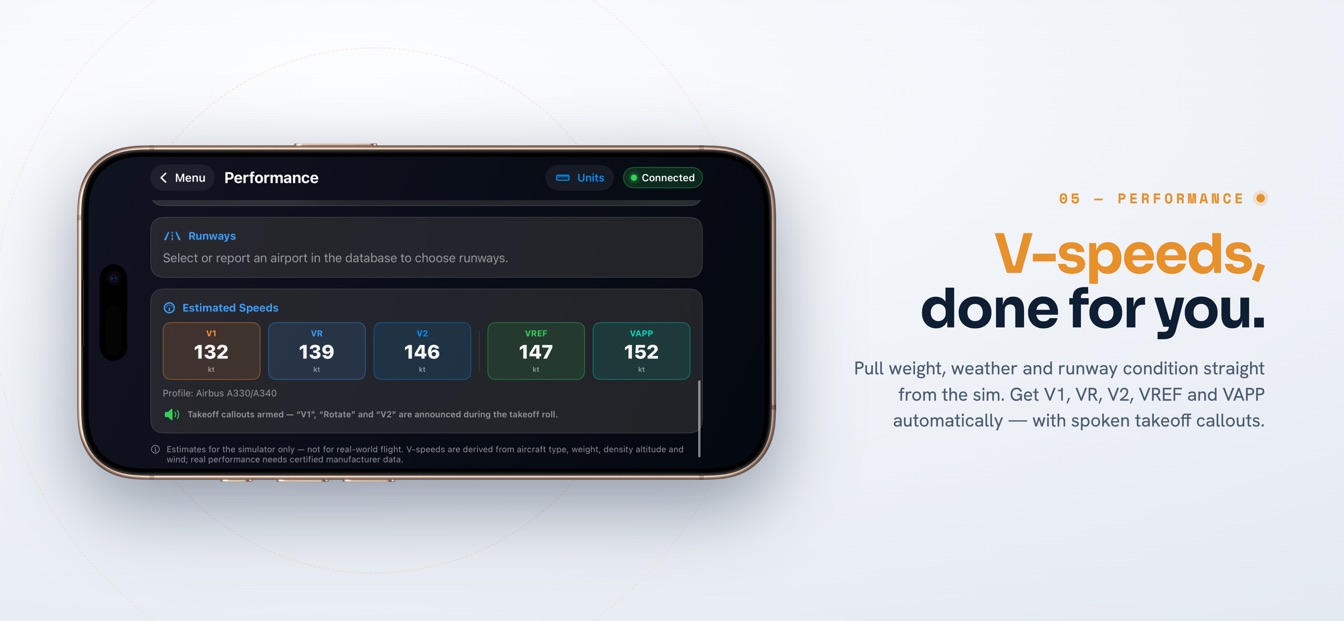
- Set takeoff thrust. Stand the lever up into FLX·MCT for a reduced-thrust departure, or push through to the TOGA stop when the runway is short or the wind is ugly. Each gate pulses under your thumb on the way up, so you can set thrust without looking at the phone.
- Thrust reduction. Passing acceleration altitude, ease back until the CLIMB gate ticks. That single pulse is your confirmation — the same tactile cue real crews rely on instead of staring at the quadrant.
- Touchdown. Close the lever to IDLE over the threshold and feel the detent confirm the levers are closed.
- Rollout. At 40 kts or above on the runway, pull into REV and REV FULL. Infinite Flight requires reverse thrust to be held — SkyYoke holds it for you until you push back out of the gate. Below 40 kts the same travel becomes proportional wheel braking for the turnoff.
The gates sit on top of everything the remote throttle already does, so nothing is lost on the days you fly something without detents.
A sidestick made of motion
- Hold & centreOne tap captures your grip as wings-level neutral.
- Tilt leftRoll the phone left and the aircraft banks left.
- Tilt rightRoll the other way to bank right — 1:1, smoothly.
- Tilt backEase the top toward you to pitch up and climb.
An Airbus is flown with the wrist, not the shoulders, and SkyYoke's Motion Yoke captures that economy. It reads the gravity vector relative to a neutral you choose, so your grip doesn't matter — rest the phone flat on your lap like a sidestick on an armrest, or hold it upright; both fly identically, with no gimbal lock to fight. A configurable tilt range from 15° to 60° decides how far you lean for full deflection, and a one-tap recenter captures a new neutral whenever you shift in your seat. Prefer a thumb? The Touch Joystick is a self-centering on-screen pad that maps 1:1 and springs back to center the instant you let go — the closest a piece of glass gets to a sprung sidestick.
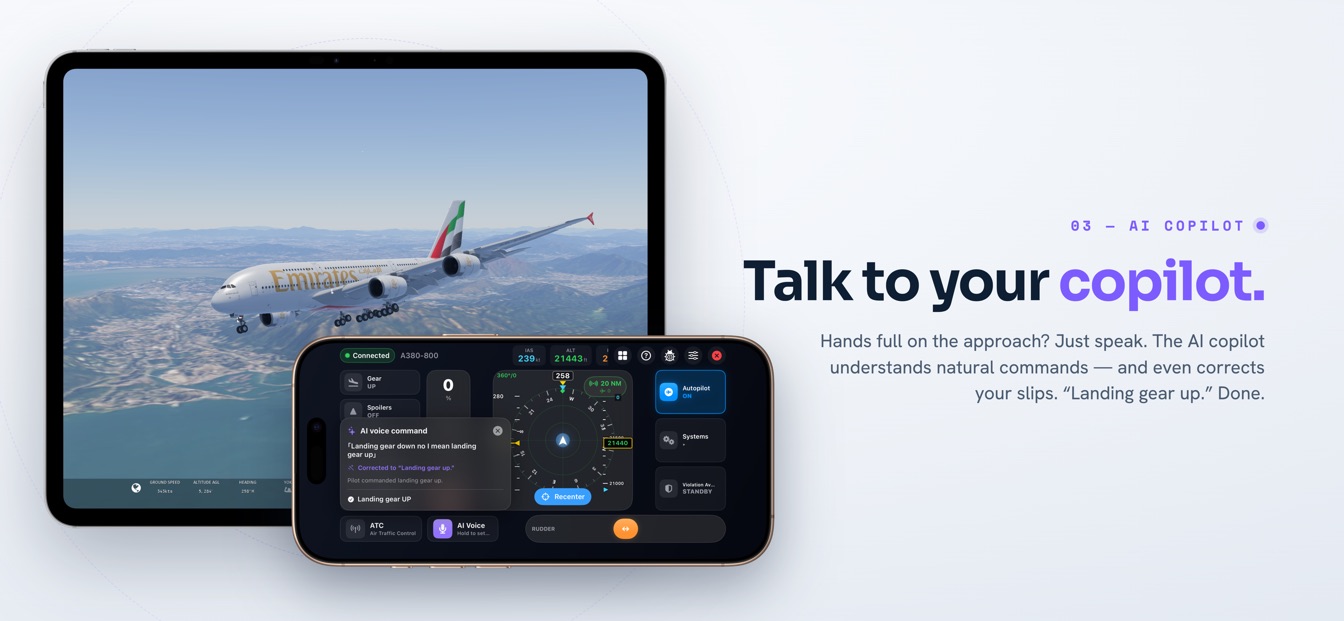
Each axis — pitch, roll, yaw and brake — carries its own conditioning chain, so the airplane answers the way you want it to:
- Expo curves keep the center fine for one-degree flare corrections while preserving full authority at the stops.
- Smoothing low-pass filters hand tremor out of the signal before it ever reaches a control surface.
- Sensitivity, dead zone, trim and inversion round out the per-axis toolkit.
Commands stream at 60 Hz with change detection and rate limiting, and a link watchdog reconnects automatically if your Wi-Fi hiccups.
“Windshear, windshear, windshear”
On the real A320, the Flight Augmentation Computer watches for the energy signature of a microburst and barks a triple warning when it finds one. SkyYoke models that reactive system for Infinite Flight: when it detects a large headwind loss — roughly 15 knots bleeding away over about five seconds — while you are between 50 and 1,300 feet above the ground, the phone speaks “Windshear, windshear, windshear.” The window mirrors the original's philosophy: low enough that shear is dangerous, high enough that runway gusts don't cry wolf. Like its inspiration, it is reactive rather than predictive — it announces the shear you are in, not the one ahead — and it is a simulator aid, not certified equipment.
Traffic painted like a navigation display
- Other trafficDistant contacts show as open white diamonds.
- ProximateWithin 6 NM and 1,200 ft it fills in solid.
- Traffic advisoryAn amber circle and a spoken “Traffic, traffic.”
- Resolution advisoryA red square with a spoken “Climb, climb.”
- Clear of conflictThreat resolved — the callout stands you down.
Glance down mid-cruise and the yoke pad doubles as a traffic scope drawn in the language of an Airbus ND. Other traffic appears as open diamonds; proximate traffic — within 6 NM and ±1,200 ft — fills in; a traffic advisory turns amber and circular; a resolution advisory becomes the red square no pilot wants to see. Contacts carry relative-altitude tags and climb or descent arrows, range rings cycle from 5 out to 80 NM, and every target is a real player in Infinite Flight's multiplayer airspace.
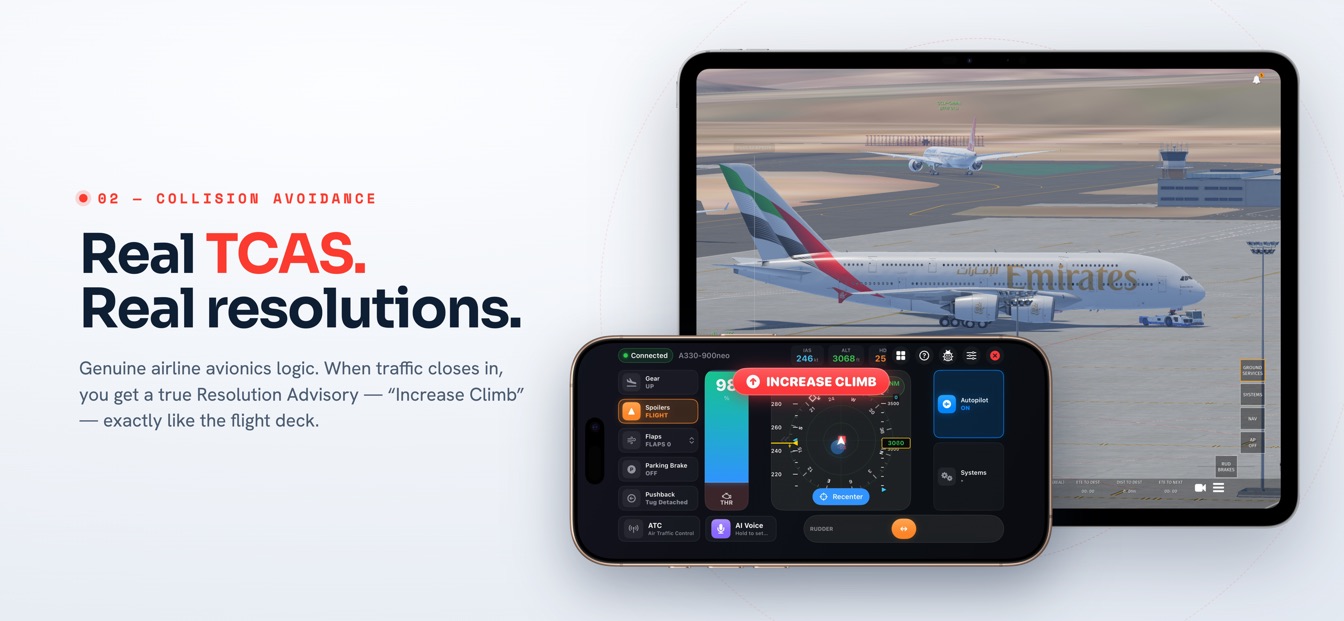
The voice is independent of the picture. Sensitivity levels scale from SL3 to SL7 with altitude, “Traffic, traffic” precedes “Climb, climb” or “Descend, descend” (with crossing and reversal variants), and “Clear of conflict” closes the encounter — with advisories inhibited near the ground so short final stays quiet. The TCAS for Infinite Flight page walks through the full logic.
Tapes that read like a PFD
Above the controls, SkyYoke draws its primary flight data the Airbus way. The speed tape carries a trend arrow that points where your airspeed is headed, the altitude tape scrolls past a green readout, and selected values — the speed and altitude you've dialed into the autopilot — ride the tapes as cyan bugs, exactly the color discipline an Airbus PFD teaches. Around them sit live IAS, ALT, HDG and V-S chips, a ground/air phase chip and a spoiler annunciator, so the phone reads like an instrument rather than a remote control.
Eleven Airbus types, one controller
- Plan itV1, VR and V2 are computed on the Performance screen.
- V1Spoken at decision speed as you accelerate.
- RotatePull back at VR — the callout cues the rotation.
- V2Safety speed called as you climb away.
Everything on this page applies across Infinite Flight's whole Airbus stable. The detented quadrant, the callouts and the displays follow you from the A220-300 through the narrow-body family — A318, A319, A320 and A321 — into the wide-bodies: the A330-200 and A330-300, their modern siblings the A330-800neo and A330-900neo, the A350-900, and the double-deck A380-800. Pick a type below for a model-specific guide, or — if your loyalties lie with control columns — cross the aisle to the Boeing side.
SkyYoke is available now, free to download on the App Store. It needs an iPhone on iOS 17.2 or later, a second device running Infinite Flight, and the same Wi-Fi network between them — bind the control axes once in Infinite Flight's Controllers settings and the in-app setup guide handles the rest.
Frequently asked questions
The Airbus details — detents, warnings and displays — answered.
What makes SkyYoke a real Airbus for Infinite Flight?+
SkyYoke turns an iPhone into an Airbus-style controller for Infinite Flight. The throttle becomes a gated quadrant with REV FULL, REV, IDLE, CLIMB, FLX·MCT and TOGA detents and a haptic tick at every gate, motion tilt works like a sidestick, and the display adds PFD-style speed and altitude tapes, an ND-style TCAS scope and a reactive windshear warning modeled on the A320 FAC. It connects over Wi-Fi with no extra hardware.
Do the Airbus thrust detents work on every Airbus in Infinite Flight?+
Yes. The gated quadrant engages automatically whenever you fly an Airbus type — from the A220-300 and the A318, A319, A320 and A321 family to the A330-200, A330-300, A330-800neo, A330-900neo, A350-900 and A380-800. On non-Airbus aircraft the lever returns to SkyYoke's standard smart-throttle behavior, so there is never a setting to change when you switch fleets.
When does the windshear warning actually fire?+
The warning models the Airbus A320's FAC reactive windshear system. When SkyYoke detects a large headwind loss — roughly 15 knots over about five seconds — while the aircraft is between 50 and 1,300 feet above the ground, it speaks “Windshear, windshear, windshear.” It is reactive rather than predictive, works with Infinite Flight, and is a simulator aid rather than certified avionics.
How close is the TCAS scope to a real Airbus navigation display?+
It borrows the ND's visual language: open diamonds for other traffic, filled diamonds for proximate contacts within 6 NM and ±1,200 feet, amber circles for traffic advisories and red squares for resolution advisories, plus relative-altitude tags, trend arrows and range rings from 5 to 80 NM. It is driven by Infinite Flight's live multiplayer traffic and uses TCAS II v7.1-style logic, but it is a display aid — not certified equipment.
Is SkyYoke affiliated with Airbus or Infinite Flight?+
No. SkyYoke is an independent iPhone app and is not affiliated with, sponsored by, or endorsed by Airbus, Infinite Flight LLC or any manufacturer. Aircraft names are used only to describe which Infinite Flight models the app's features are inspired by. The app is available now on the App Store — download it on the App Store / Google Play and turn your iPhone into an Airbus-style controller.
Now on the App Store.
SkyYoke is available now — download it on the App Store and turn your iPhone into a full flight-sim cockpit.
Download on the App Store Get it on Google Play