AI Voice Copilot
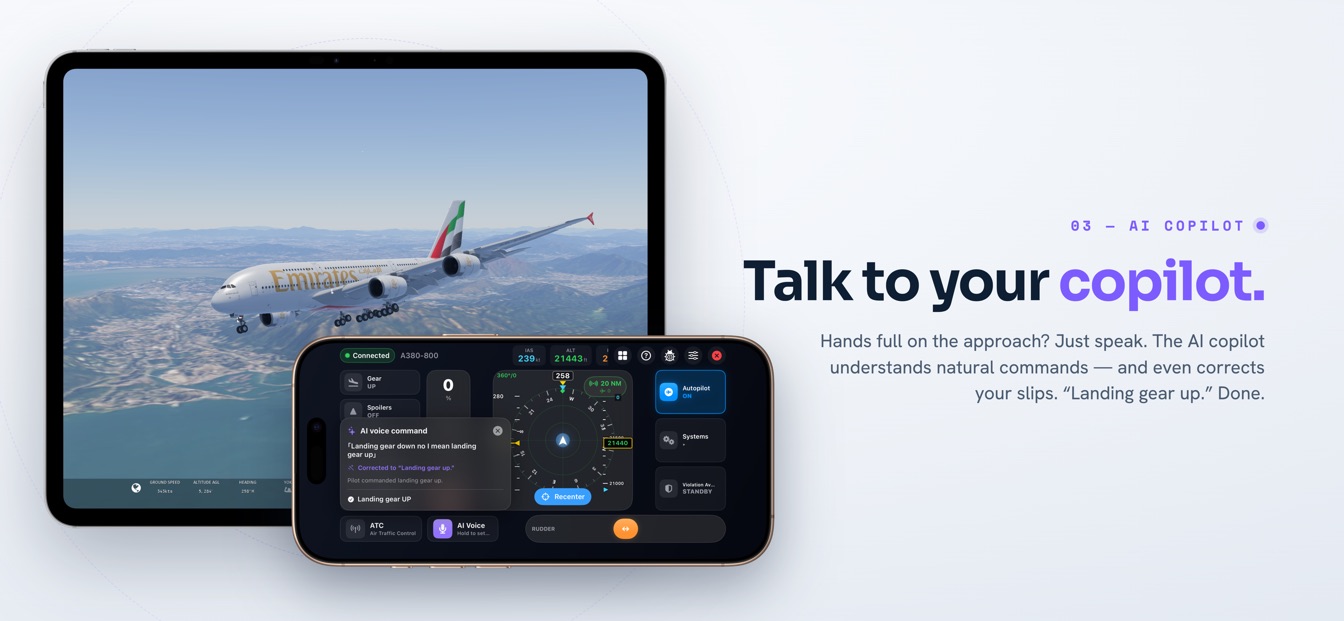
Push to talk and say "climb two thousand feet" or "landing lights on." Speech is transcribed and parsed entirely on-device. Requires an Apple-Intelligence-capable iPhone on iOS 26.
One screen flies the scenery; the other flies the aircraft. SkyYoke lets you fly Infinite Flight remotely from your iPhone — yoke, throttle, rudder, autopilot, systems, ATC and more — over your own Wi-Fi, with nothing to buy and nothing to plug in.
To control Infinite Flight remotely is to fly the simulator from a second device instead of the screen it runs on. SkyYoke turns an iPhone into a wireless yoke, throttle, rudder and full control panel for Infinite Flight: both devices join the same Wi-Fi network, the app discovers the simulator automatically, and every input reaches the aircraft in real time through the built-in Connect API.
Strip the phrase down and it sounds simple: the simulator runs on one screen, and a different device tells it what to do. The interesting question is how much of the flight you can actually hand over. SkyYoke's answer is nearly all of it. When you control Infinite Flight remotely with the app, the iPhone in your hands is not a gamepad bolted onto a sim — it is the working side of the flight deck, holding a live two-way conversation with Infinite Flight while your iPad stays dedicated to the out-the-window view.
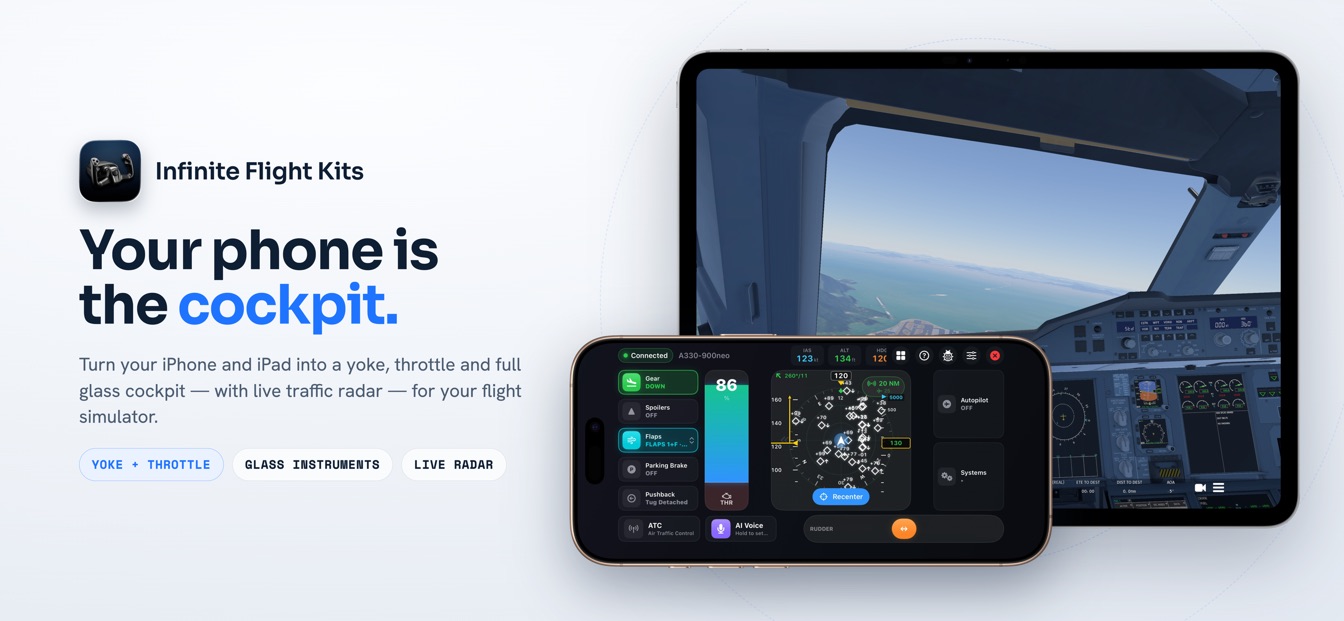
Here is the territory the phone covers:
There is no pairing ritual and no cable. Infinite Flight ships with a built-in network interface called the Connect API; switch it on and the simulator quietly announces itself to other devices on the same Wi-Fi network. SkyYoke listens for that announcement, lists the simulator it found, and joins with one tap. If your router filters those announcements — some guest networks and mesh setups do — you can type the simulator's IP address in manually and connect just the same.
From that moment the two devices hold a direct, device-to-device conversation. Your inputs flow one way; the aircraft's state — speed, altitude, heading, nearby traffic — streams back the other, feeding the instruments on the phone. And because Infinite Flight describes exactly what the loaded aircraft supports, SkyYoke's panels adapt to match: a switch the current airframe does not expose simply never appears, so you are never tapping dead buttons.
Latency is the difference between flying an aircraft and negotiating with one, so the link is built around a 60 Hz control loop: sixty times a second, SkyYoke checks what changed and sends exactly that. Change-detection and rate limiting keep the traffic lean — an axis you are not moving costs the network nothing — which is why the response feels immediate even on a busy household network.
The link also assumes Wi-Fi will misbehave eventually. A watchdog monitors the connection continuously and reconnects on its own the moment the network returns, so you keep flying instead of digging through menus. The safety net goes further: an optional fail-safe engages the autopilot if the app disconnects or gets backgrounded, every control locks automatically while the simulator is paused, and leaving the cockpit screen releases anything you were holding.
The flying itself starts with the yoke. Motion mode reads gravity rather than raw rotation, so the controls behave the same whether the phone lies flat on your lap or stands upright in your grip, with a tilt range adjustable from 15° to 60° and a one-tap recenter. Prefer to keep the phone still? A self-centering touch joystick tracks your thumb 1:1 and springs home the instant you let go. The remote yoke page tells the full story.
Beside it sits the smart throttle: one lever that pushes forward for thrust, holds reverse for you on a landing rollout — Infinite Flight normally makes you hold it yourself — and becomes a proportional wheel brake below taxi speed, plus a rudder bar running along the bottom edge of the screen. The remote throttle page covers the detents, the haptics and the Airbus gated quadrant.
Around the controls sit the panels. The autopilot panel uses swipe-to-scrub value strips that accelerate with your finger, one-tap altitude presets and a turn-180 helper. The systems panel gathers batteries, APU, external power, every exterior light, cabin signs, autobrake and engine start. The ATC keypad numbers Infinite Flight's radio options 1 through 10 and keeps a timestamped message log with an unread badge. And a glass-cockpit HUD shows live IAS, altitude, heading and vertical-speed readouts beside an Airbus-style speed tape and altitude tape with cyan selected-value bugs.
Hardware controllers stop at axes and buttons. Software on a phone — with a microphone, a speaker and a live data feed — can go further. SkyYoke layers on spoken takeoff callouts, a reactive windshear warning, a TCAS-style traffic system, and a violation avoidance system that watches the 250-knot limit so your grade does not pay for a moment's distraction. Three highlights:
Push to talk and say "climb two thousand feet" or "landing lights on." Speech is transcribed and parsed entirely on-device. Requires an Apple-Intelligence-capable iPhone on iOS 26.
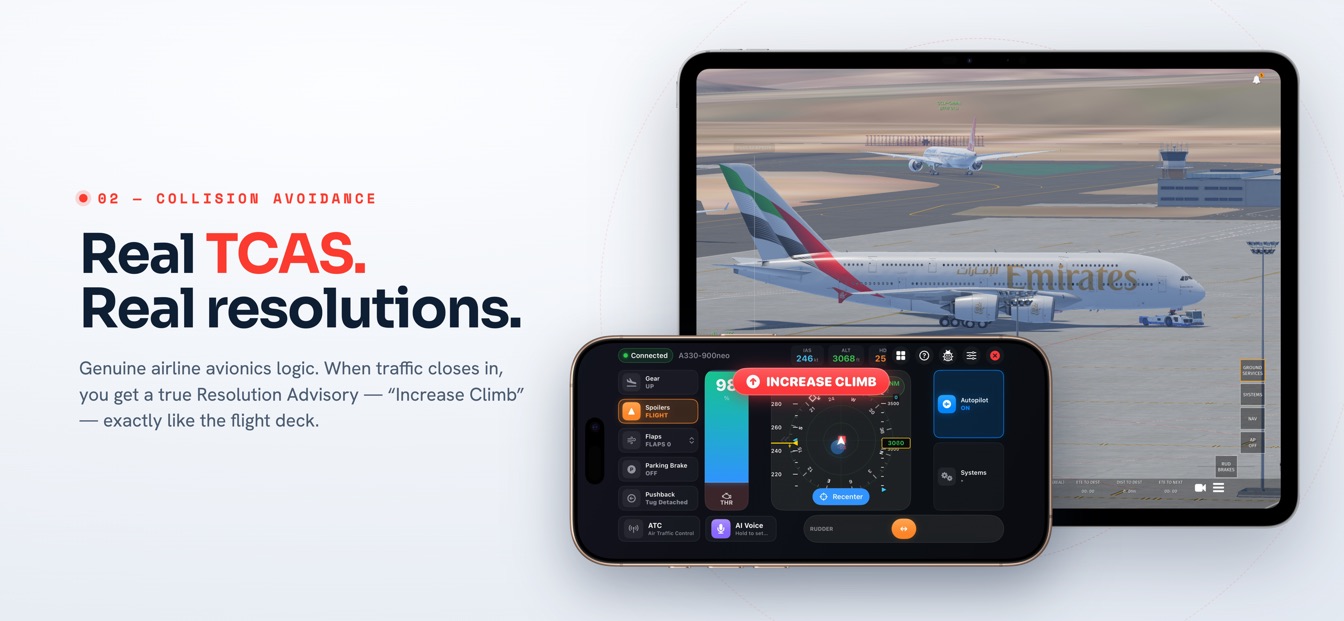
An Airbus-style traffic display fed by Infinite Flight's live multiplayer traffic, with TCAS II v7.1-style advisories and spoken callouts. A simulator display aid — not certified avionics.
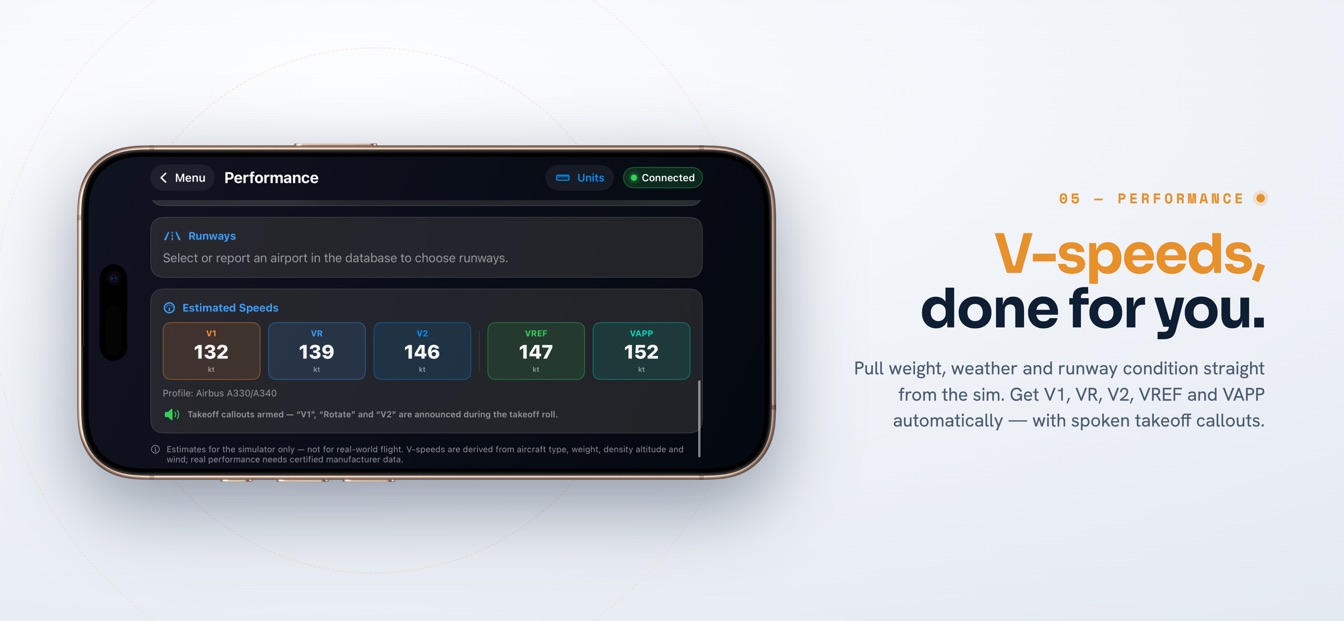
Live weights, an offline airport database, runway winds from in-sim weather and estimated V-speeds from 17 aircraft profiles — with V1, Rotate and V2 called out on the roll. Estimates for the simulator only.
| Controller | iPhone on iOS 17.2 or later running SkyYoke (available now on the App Store) |
|---|---|
| Simulator device | A second device — typically an iPad — running Infinite Flight |
| Network | Both devices on the same Wi-Fi network; the link stays entirely local |
| Simulator settings | Enable Infinite Flight Connect, then bind SkyYoke's axes once in Controllers |
| Optional voice control | AI Voice Copilot needs an Apple-Intelligence-capable iPhone on iOS 26 |
SkyYoke is an independent project — not affiliated with, sponsored by, or endorsed by Infinite Flight LLC — and it is available now on the App Store. If a full wireless cockpit sounds like your kind of flying, you can download it on the App Store / Google Play today.
Everything you need to know about remote control of Infinite Flight.
It means flying the simulator from a second device instead of the screen it runs on. SkyYoke turns an iPhone into a wireless cockpit for Infinite Flight: flight controls, throttle, rudder, camera, autopilot, aircraft systems and ATC replies, all sent live over your home Wi-Fi through Infinite Flight's built-in Connect API. The device running the simulator becomes your view; the phone becomes your hands.
Yes. SkyYoke talks to Infinite Flight directly across your local network, so the iPhone and the device running the simulator must share one Wi-Fi network. Once they do, the app discovers the simulator automatically and connects with a single tap. If your router blocks the discovery broadcast, you can enter the simulator's IP address manually instead.
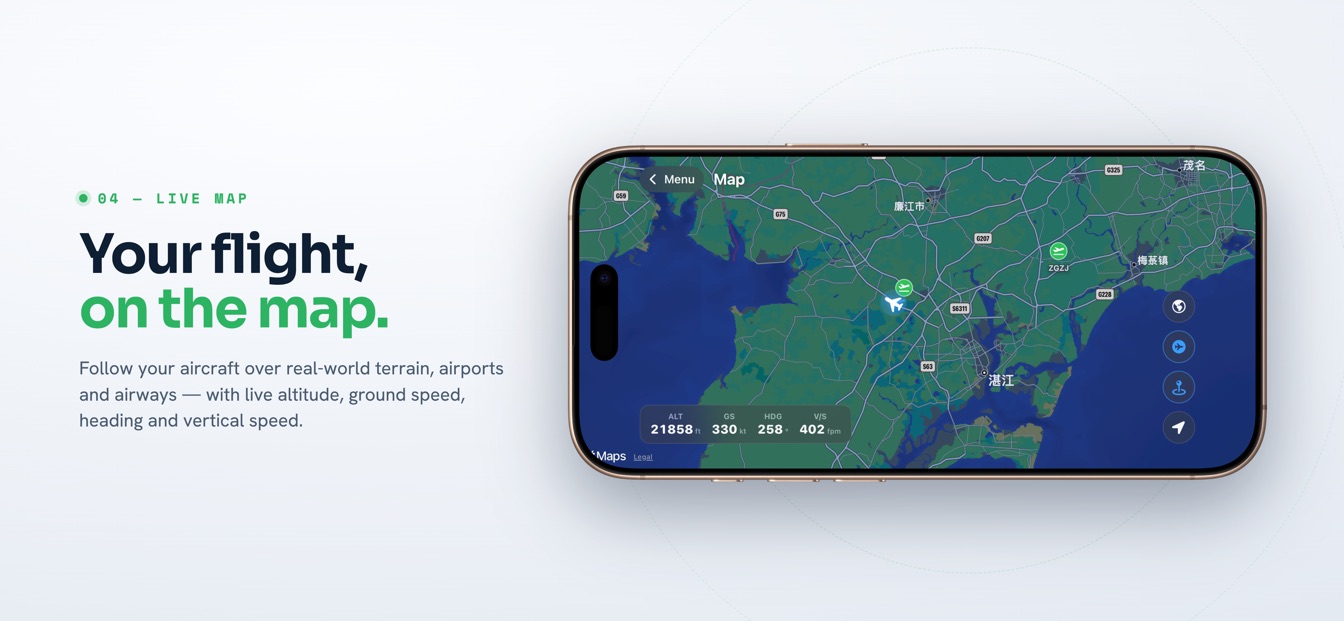
Nearly the whole flight deck. Beyond pitch, roll, yaw, thrust and braking, the phone drives the autopilot panel with ALT, V-S, SPD and HDG targets, aircraft systems such as lights, APU, autobrake and engine start, the ATC keypad, and the camera. Optional extras include a TCAS-style traffic scope, a moving map, a takeoff performance planner and on-device voice commands on supported iPhones.
SkyYoke streams inputs on a 60 Hz control loop and sends only values that actually changed, so the link stays light and quick on an ordinary home network. A watchdog monitors the connection and reconnects automatically if Wi-Fi drops, and an optional fail-safe can engage the autopilot if the app ever disconnects mid-flight.
No. Control inputs and telemetry travel directly between your iPhone and the device running Infinite Flight over your local Wi-Fi network — there is no cloud relay and nothing is routed through the internet. Even the optional AI Voice Copilot transcribes and interprets your speech entirely on the phone, so audio never leaves the device either.
SkyYoke is available now — download it on the App Store and turn your iPhone into a full flight-sim cockpit.
Download on the App Store Get it on Google Play