Surfaces and gear
Landing gear, flaps, spoilers and the parking brake, each one tap away in the middle of an approach.
The most faithful Airbus in Microsoft Flight Simulator deserves better than a keyboard. SkyYoke turns your iPhone into a remote joystick and gated thrust quadrant for the Fenix A320 — engineered around the add-on's famously stubborn levers.
Fenix A320 remote joysticks turn an iPhone into a wireless sidestick and Airbus thrust quadrant for the Fenix A320 in Microsoft Flight Simulator 2024. SkyYoke ships a dedicated Fenix preset that drives thrust through the one channel the add-on actually accepts — and, when the free MobiFlight WASM module is installed, moves the virtual cockpit levers themselves by writing the lever variable directly.
Every Fenix pilot learns the same lesson early: this airplane does not take orders the way other add-ons do. The Fenix A320 models its own flight computers, its own electrics — and, crucially, its own thrust lever logic. Which is why the hunt for Fenix A320 remote joysticks so often ends in a forum thread full of shrugs: most phone controllers transmit textbook throttle bindings, the simulator accepts them, and the Fenix calmly ignores them.
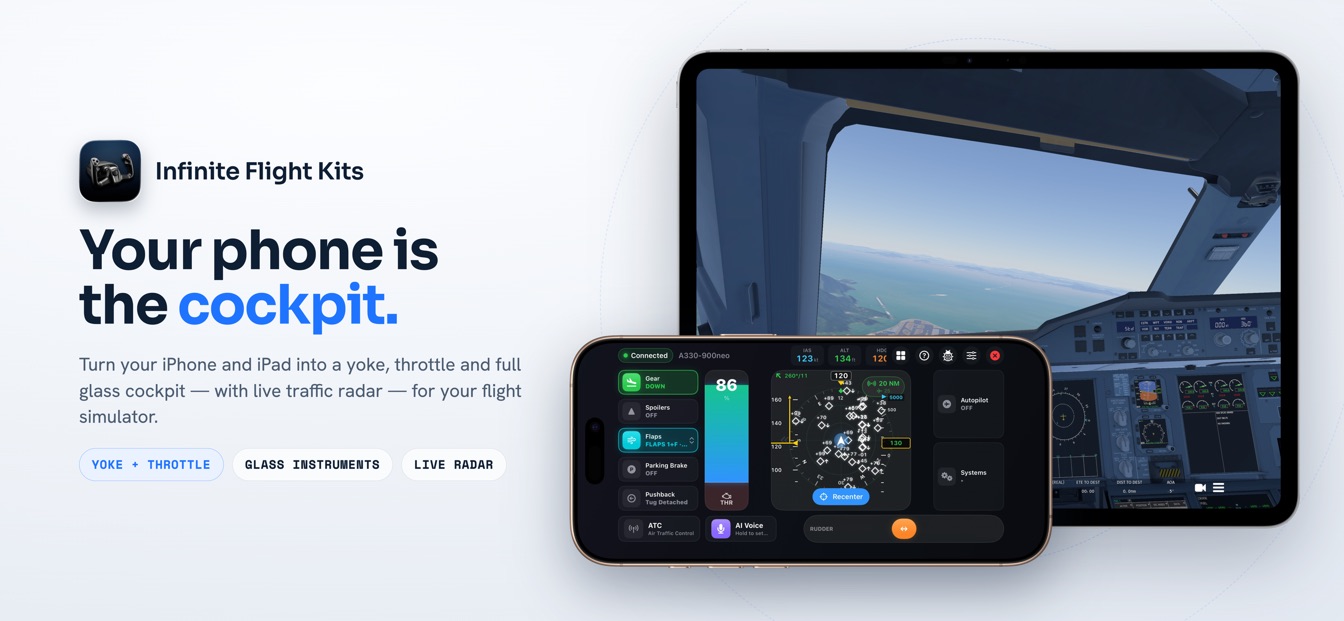
The failure modes are well documented. Standard axis commands push engine power around while the levers in the virtual cockpit stay frozen at idle — wrecking an autothrust system that cares deeply about lever position. Older event-style commands behave even more strangely: the Fenix treats a fixed input as a rate, so the levers crawl continuously instead of parking where you put them. Neither is flyable, and no amount of sensitivity tuning on the sending side helps. The problem is the channel, not the signal.
None of this is carelessness on Fenix Simulations' part — it is the price of depth. A study-level Airbus runs its quadrant from internal variables so detent logic and autothrust interplay can be modeled honestly. Any controller that wants a seat in that cockpit has to meet the airplane on its own terms.
SkyYoke's answer is a dedicated Fenix A320 preset built as two layers, so thrust control degrades gracefully instead of failing silently:
The split matters because it is honest about how this aircraft works. Layer one guarantees a flyable airplane; layer two restores the visual and systems fidelity a study-level airliner deserves. On a default aircraft, a single standard axis does the whole job — see the MSFS remote throttle page for that simpler story. The Fenix simply demands more, and the preset gives it more.
On Airbus types, SkyYoke's thrust lever stops being a smooth slider and becomes a gated quadrant. Each detent sits at a fixed mark, and a haptic tick fires the instant the lever crosses a gate — so you can set takeoff thrust with your eyes on the centerline, the way a hand resting on a real quadrant would.
| TOGA | Full takeoff and go-around thrust at the forward stop. |
|---|---|
| FLX/MCT | Reduced flex takeoff thrust, or max continuous in flight. |
| CLIMB | The lever's home for most of the flight — where the autothrust expects it from thrust reduction until the flare. |
| IDLE | The idle gate, marked by its own tick — your retard target in the flare. |
| REV / REV FULL | Two reverse gates aft of idle for the landing rollout. |
The flow matches the manuals. Push up to FLX/MCT or TOGA for the takeoff roll; at thrust reduction altitude, pull back two ticks into CLIMB and leave it there while the automatics do their work. After touchdown, snap to IDLE and then aft through the reverse gates. Every crossing buzzes in your hand, so you count detents instead of staring at a slider — which is the whole point of a gated quadrant.
Thrust is half the Airbus; the sidestick is the other half, and the phone plays that part two ways. Motion control reads the gravity vector against a neutral point you choose, which makes it grip-independent: rest the phone flat on your knee or hold it upright, and roll and pitch track your tilt with no gimbal lock. A configurable range sets how much lean — anywhere from 15° to 60° — equals full deflection, and a one-tap recenter captures a fresh neutral whenever you shift in your seat. Prefer the phone stationary? The touch joystick is an on-screen, self-centering pad that maps 1:1 and springs back to neutral the moment you let go.
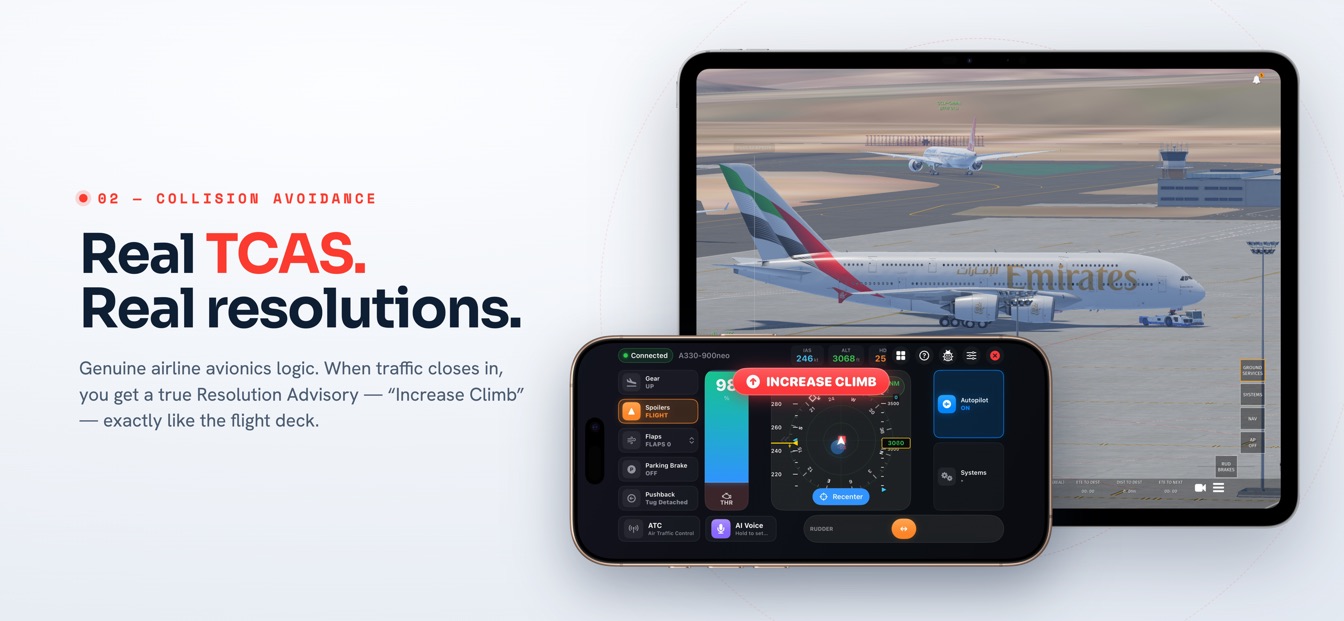
Each axis — pitch, roll, yaw and brakes — carries its own conditioning chain: sensitivity, dead zone, expo curve, inversion, trim and smoothing, all tuned independently. A self-centering rudder bar runs along the bottom edge for taxi steering and crosswind work, and braking on MSFS rides a true progressive axis rather than an on-off tap. Underneath, the bridge re-sends axis values continuously, so controls hold their position instead of snapping back to zero between updates.
The joystick and quadrant share the screen with the systems you actually touch on a normal sector:
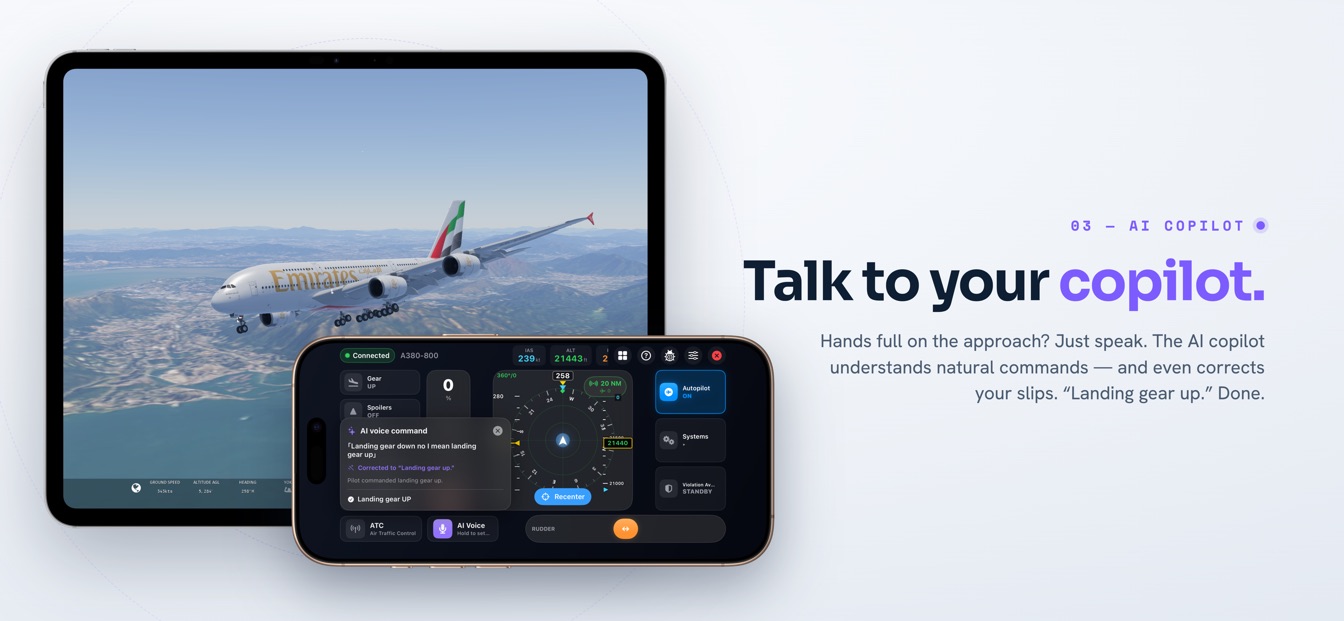
Landing gear, flaps, spoilers and the parking brake, each one tap away in the middle of an approach.
Exterior lights, pushback and pause, handled from the phone while your eyes stay on the airplane.
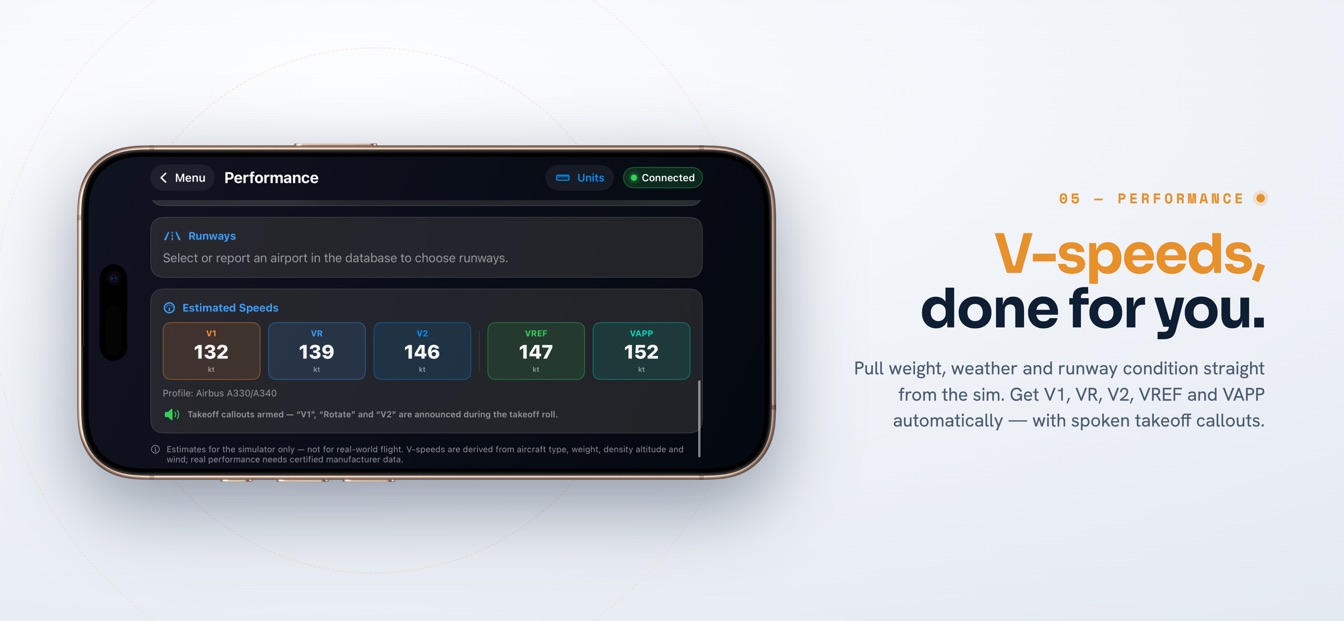
Altitude, vertical speed, airspeed and heading targets, plus NAV and approach modes.
If you also fly Airbus types in Infinite Flight, the same phone already covers that cockpit today with an even deeper feature set — the A320 joystick for Infinite Flight page tells that story. Either way, you skip the desk full of plastic entirely; it is the same argument we make against buying a dedicated joystick in the first place.
The first flight looks like this:
SkyYoke is an independent project — not affiliated with Fenix Simulations, Microsoft or Airbus — built by simmers who got tired of flying a masterpiece with a keyboard.
What Fenix pilots ask about flying from the phone.
It is an app that turns your iPhone into wireless flight controls for the Fenix A320 running in Microsoft Flight Simulator 2024 on your PC. SkyYoke connects over your home Wi-Fi through a free Windows companion app and gives you a motion or touch sidestick, a gated Airbus thrust lever, a rudder bar and key systems controls — with no physical hardware on the desk.
The Fenix drives its levers from internal variables instead of the standard throttle bindings most controllers send. Ordinary axis commands change engine power while the virtual levers stay frozen, and some legacy commands act as rates that creep the levers continuously. SkyYoke's Fenix preset was engineered around this behavior: thrust goes through the method that works, and lever animation comes from a direct variable write.
No. The detented thrust control and every other mapped function work without it. Installing the free MobiFlight WASM module adds one refinement: SkyYoke can then write the Fenix lever variable directly, so the thrust levers in the virtual cockpit physically move to match the gate you select on the phone.
On Airbus presets the lever becomes a gated quadrant with marks at REV FULL, REV, IDLE, CLIMB, FLX/MCT and TOGA, and a haptic tick fires each time the lever crosses a gate. That lets you set flex takeoff thrust or pull back to CLIMB at thrust reduction altitude entirely by feel, without looking away from the runway.
Yes. Microsoft Flight Simulator 2024 support, including the Fenix A320 preset, is available now, connecting through a free Windows companion app called IF Yoke Bridge. Infinite Flight is fully supported too. Download SkyYoke on the App Store to get started.
SkyYoke is available now — download it on the App Store and turn your iPhone into a full flight-sim cockpit.
Download on the App Store Get it on Google Play