The gear thunk
A five-second haptic sequence plays as the landing gear runs — the closest a phone gets to hydraulics working in the wheel well.
Boeing kept the control column when the rest of the industry went to sticks — and SkyYoke gives it back to you. Get a real Boeing feel in Infinite Flight by flying the 737, 777 or 747 with a yoke that lives in your iPhone.
A real Boeing for Infinite Flight means flying the simulator's yoke airplanes with an actual yoke: SkyYoke turns your iPhone into a wireless control column over Wi-Fi — roll your wrists to bank, pull to rotate — and layers on spoken V1/Rotate/V2 callouts, a V-speed planner, a TCAS scope and a full systems panel for all fifteen Boeing types in the simulator.
Airbus went to the sidestick in the late eighties. Boeing looked at the same technology and kept the column — the 777 and 787 fly by wire, yet there is still a wheel and a column in front of each pilot, moving through your hands as the airplane maneuvers. That stubborn choice is the personality of the brand. So when you fly a 777 in Infinite Flight by dragging a thumb across glass, the defining input of the type simply isn't there. A real Boeing for Infinite Flight needs a yoke between you and the airplane, and SkyYoke builds one out of the iPhone already in your pocket.
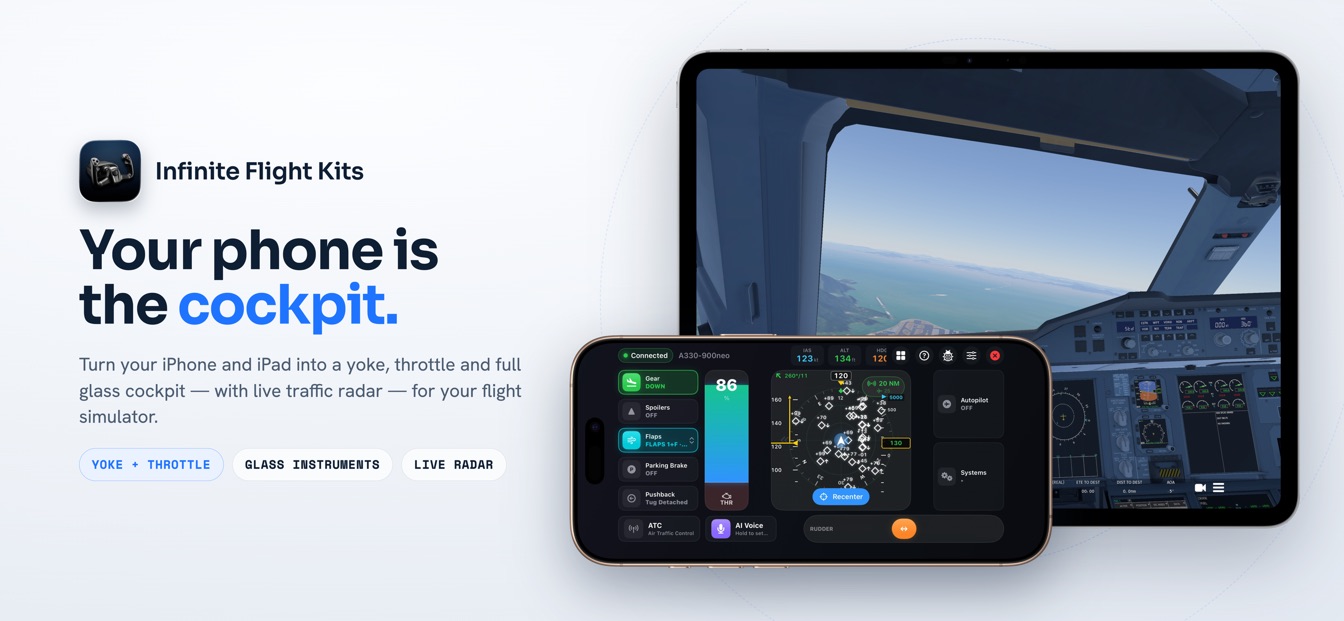
The Motion Yoke maps the phone straight onto the control column. It measures the gravity vector against a neutral point you choose — not raw gyro angles — which keeps the grammar honest: roll your wrists and the wings follow; pull the top edge toward you and the nose comes up. Because the reference is gravity, the mapping holds in any grip:
If you would rather keep the phone still, a self-centering Touch Joystick is one switch away, and both control models feed the same 60 Hz loop. The remote yoke guide goes deeper on how each one flies.
Nothing sounds more like a Boeing flight deck than a takeoff roll with callouts. SkyYoke's Performance screen — available when you fly Infinite Flight — reads your live aircraft weight, lets you run a what-if loadout against an MTOW bar, and pairs an offline airport database with runway selection that works out headwind and crosswind components from the in-sim weather. From all of that it estimates V1, VR, V2, VREF and VAPP for your weight and density altitude, and checks whether the runway you picked is actually long enough.
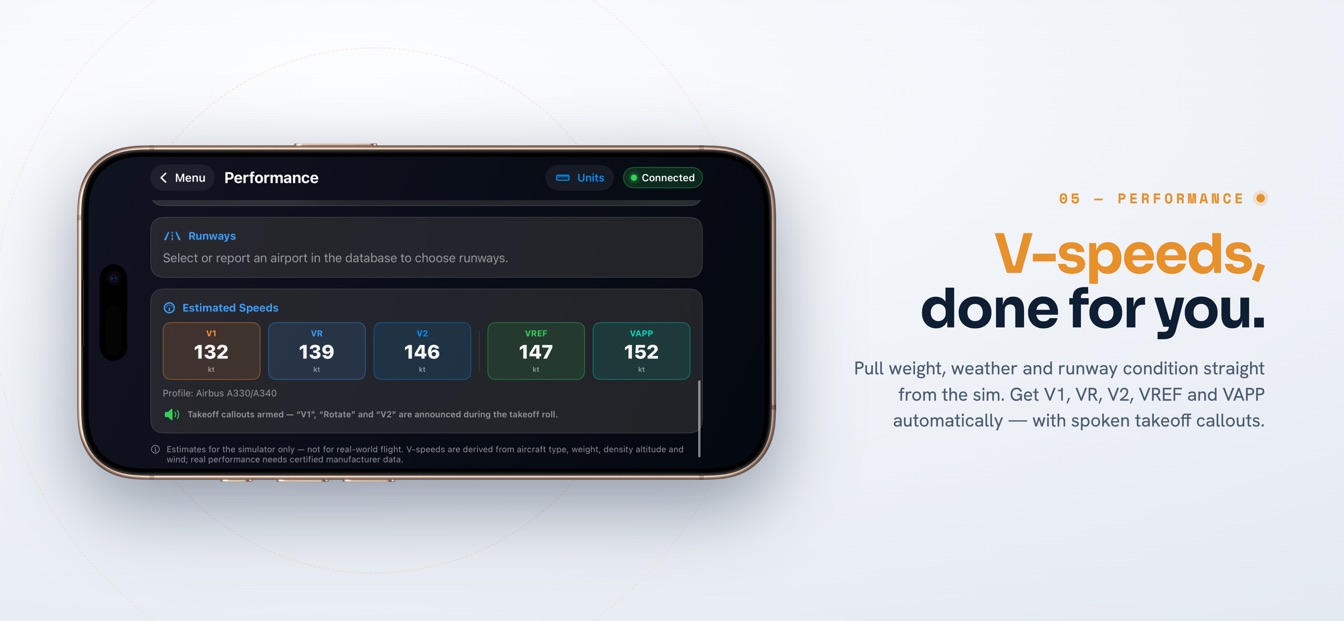
Arm the callouts there and the departure becomes a two-pilot operation. The jet accelerates, you hear "V1," then "Rotate" — and that word is your cue to do the most Boeing thing this app offers: pull the phone smoothly toward you and feel the nose track your wrists into the climb. "V2" follows as the safety speed passes. The callouts fire once per departure and quietly re-arm themselves for the next leg.
Boeing crews fly thrust with free-moving levers rather than gated detents, and SkyYoke's smart throttle keeps that character: a single lever from idle to the stop. Push it all the way forward and you have TOGA-style full thrust for the roll. The clever part waits at the other end of the flight. Touch down and pull through idle into the red zone — at 40 knots or above, that engages reverse thrust and holds it. Infinite Flight expects reverse to be held continuously, so the lever does the holding while your other hand keeps the jet on the centerline. Once the speed decays below 40 knots, the same red zone hands over to proportional wheel braking for the taxi off the runway.
The lever recolors as its job changes — blue and green for forward thrust, amber for braking, red for reverse — and a haptic tick marks the idle detent so you can find it by feel. Reach for reverse while airborne and the app flatly refuses, posting a warning banner with a repeating haptic. The remote throttle page covers the whole system in detail.
Real Boeing operations are flows and checklists, and SkyYoke's systems panel turns the first ten minutes of a session into exactly that. The panel only shows controls the current aircraft actually exposes, so every switch you see is live. A typical before-pushback flow in a 777 might run:
Strobes and landing lights wait for the runway, autobrake steps through OFF, LOW, MED and MAX, and the same panel carries the HUD, FPV and flight-data toggles once you're airborne.
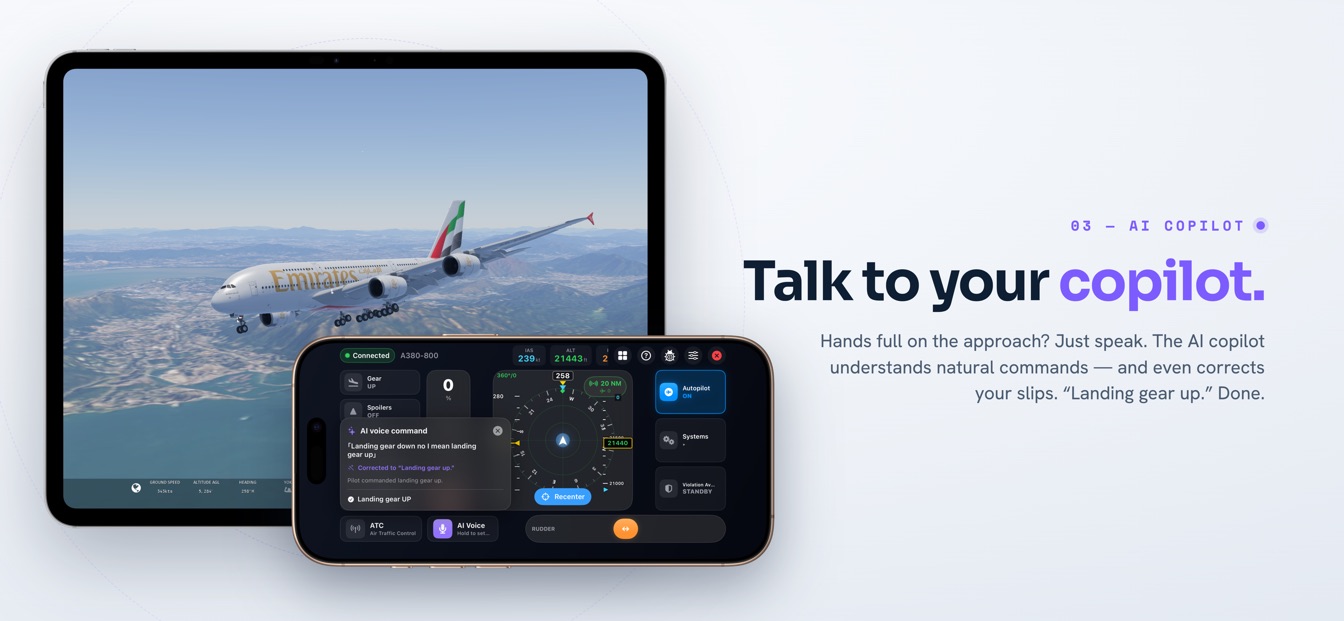
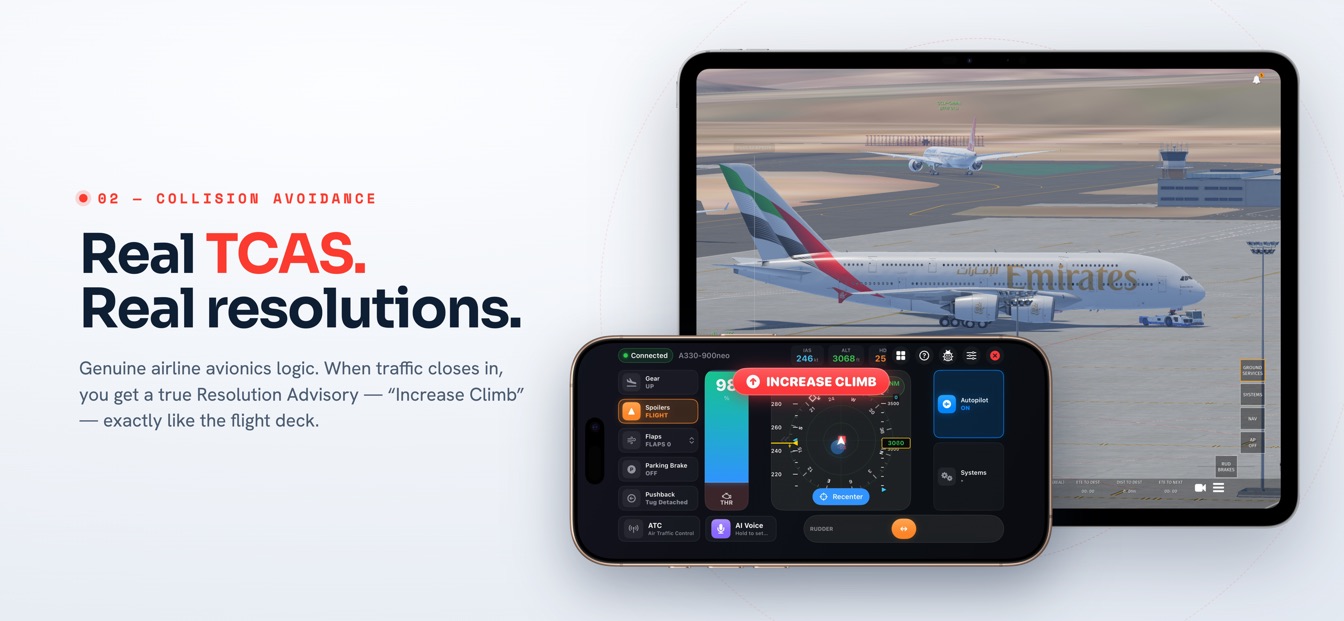
Two more layers separate a controller from a flight deck. The first is traffic awareness: a navigation-display-style TCAS scope drawn right over the yoke pad, fed by Infinite Flight's live multiplayer traffic and sorted with TCAS II v7.1-style logic — open diamonds for other traffic, filled diamonds for proximate contacts, amber circles for traffic advisories and red squares for resolution advisories, with range rings from 5 to 80 NM and spoken callouts that run from "Traffic, traffic" to "Clear of conflict." It is a simulator display aid rather than certified avionics, and the TCAS deep dive walks through every threshold.
The second is mass. A heavy should feel heavy, and SkyYoke leans on the iPhone's haptic engine to sell it:
A five-second haptic sequence plays as the landing gear runs — the closest a phone gets to hydraulics working in the wheel well.
A ground rumble that scales with ground speed and adds runway-seam bumps, so a brisk taxi in a 747 feels nothing like a crawl to the gate.
Crisp ticks confirm the throttle's idle detent and every flap selection — feedback you feel instead of having to look down for.
This page is the hub; each type below has its own guide. Infinite Flight's Boeing roster runs fifteen aircraft deep across six families: the 737-700, 737-800, 737-8 MAX and 737-900 for short- and medium-haul work; the 747-200, 747-400 and 747-8 for four-engine ceremony and freight; the 757-200, the hot rod of the lineup; the long-haul 777-200ER, 777-200LR and 777-300ER plus the 777F freighter; and the 787-8, 787-9 and 787-10 Dreamliners. SkyYoke flies all of them with the same yoke, the same callouts and the same panel — no per-aircraft setup required.
Getting started takes an iPhone on iOS 17.2 or later, a second device running Infinite Flight on the same Wi-Fi, and one pass through the in-app guide to bind the control axes; the app finds the simulator on the network by itself. And if your loyalties lie with the sidestick instead, the Airbus hub is waiting.
Quick answers about flying Infinite Flight's Boeing fleet with SkyYoke.
It means flying Infinite Flight's Boeing fleet with a yoke instead of a flat touchscreen. SkyYoke turns your iPhone into a motion control column over Wi-Fi: roll your wrists to bank, pull back to rotate — the inputs a Boeing flight deck is built around. Add spoken V1, Rotate and V2 callouts, a V-speed planner, a TCAS scope and a systems panel, and the 737 or 777 finally flies like the yoke airplane it is.
All of them. SkyYoke sends standard control-axis inputs through Infinite Flight's Connect API, so it flies every Boeing in the simulator: the 737-700, 737-800, 737-8 MAX, 737-900, 747-200, 747-400, 747-8, 757-200, 777-200ER, 777-200LR, 777-300ER, 777F, 787-8, 787-9 and 787-10. The systems panel adapts on its own, showing only the switches and selectors each aircraft actually exposes.
You arm them from the Performance screen, which estimates V1, VR and V2 for your current weight, chosen runway and density altitude. During the takeoff roll SkyYoke speaks each callout at the right speed, fires once per departure, and re-arms automatically for the next flight. The numbers come from built-in aircraft profiles and are simulator estimates only — never use them for real-world flying.
Yes — with one convenience built in. Infinite Flight requires reverse thrust to be held, so SkyYoke's lever holds it for you: on the ground at 40 knots or faster, pulling into the red zone engages held reverse, and as you slow below 40 knots the same zone becomes proportional wheel braking. In the air reverse is blocked entirely, with a warning banner and a repeating haptic, so you can't deploy it by accident.
No. SkyYoke is an independent, unofficial iPhone app built on Infinite Flight's public Connect API. It is not affiliated with, sponsored by, or endorsed by Boeing or Infinite Flight LLC, and aircraft names appear only to describe compatibility. The app is available now on the App Store.
SkyYoke is available now — download it on the App Store and turn your iPhone into a full flight-sim cockpit.
Download on the App Store Get it on Google Play