Spoken V-speed callouts
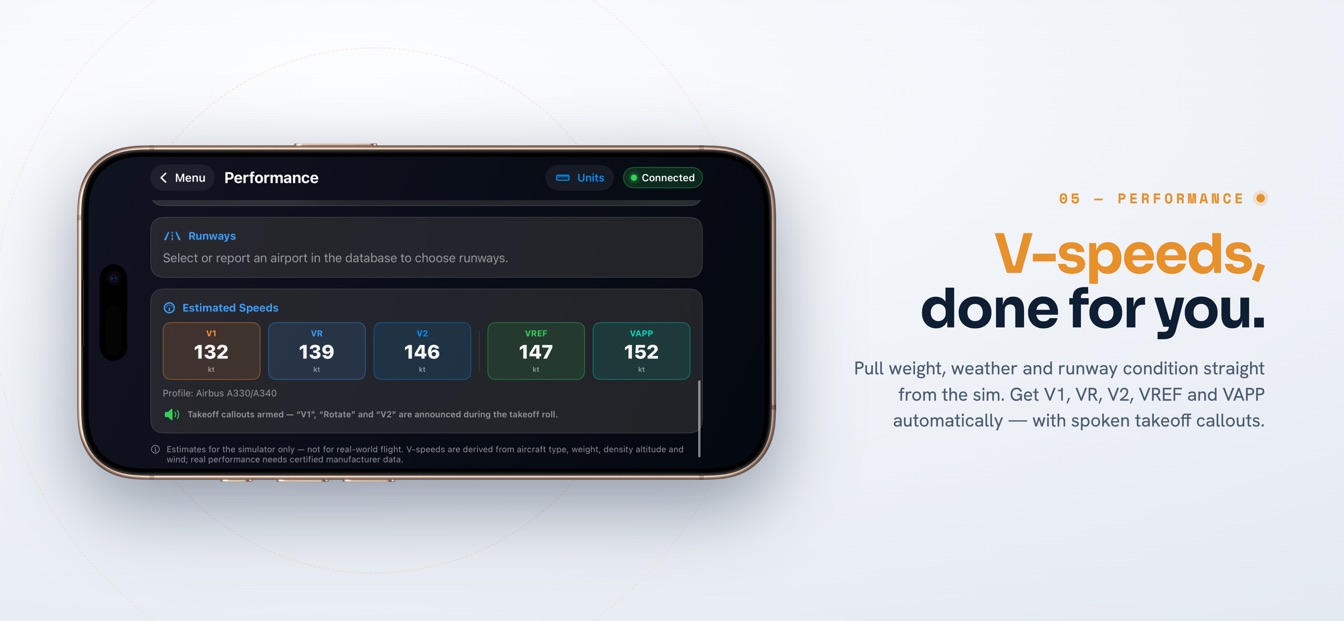
Armed from the Performance screen and fired once per departure: V1, Rotate and V2, estimated from your actual weight and runway.
Boeing kept a real control column on its biggest twin — so fly it with one. SkyYoke turns your iPhone into a wireless yoke for Infinite Flight's 777-200ER: roll your wrists to bank, pull to rotate, all over your own Wi-Fi.
A Boeing 777-200ER yoke for Infinite Flight is an iPhone app standing in for the airliner's control column: SkyYoke senses how you tilt the phone and flies the 777-200ER running on another device, live over your Wi-Fi network. Roll your wrists to bank the big twin, pull back to rotate — no plastic hardware, no cables, nothing to pair.
Every 777-200ER departure builds to the same moment: the pull. A loaded long-hauler does not hop off the pavement — the nose comes up slowly, the wings take the weight, and the runway lets go somewhere far down the centerline. Tapping a slider on glass flattens that moment into nothing. A Boeing 777-200ER yoke for Infinite Flight gives it back: with SkyYoke, your iPhone becomes the control column, and rotation becomes a real, deliberate pull toward your chest.
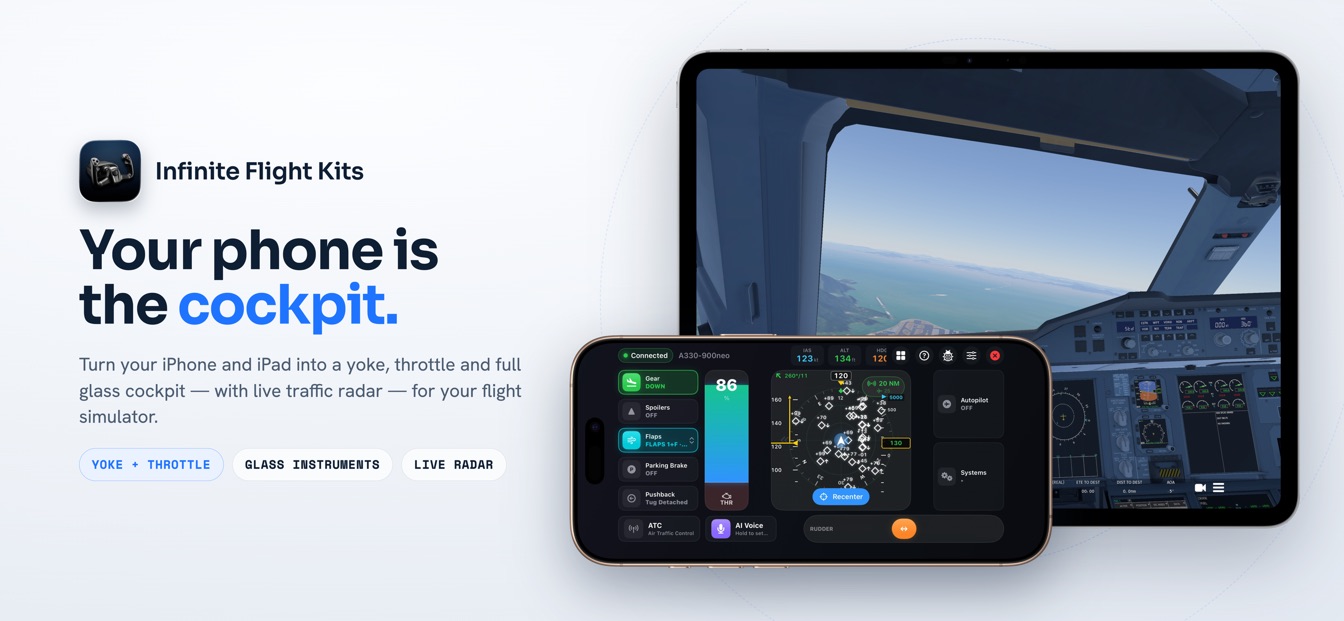
SkyYoke is an iPhone app that flies Infinite Flight running on a second device — typically an iPad — across your own Wi-Fi. There is no plastic to buy and no cable to find; the phone you already own supplies the grip, the travel and the feedback. And of all the types it can fly, the big Boeings reward it most, because Boeing never gave up the yoke.
Long-haul flying once defaulted to three or four engines; the 777-200ER is the airplane that rewrote the assumption. As the long-range twin that proved big-twin ETOPS long-haul flying, it carried intercontinental routes on a pair of engines — and what a pair. The giant GE90-class turbofans hanging under its wing became the type's calling card, the first thing anyone notices from the ramp.
It is also the foundation of the whole 777 family: every later stretch and freighter traces its lineage back to this airframe. A staple of intercontinental fleets since the late 1990s, the -200ER sits in Infinite Flight's fleet ready for exactly the work it was built for — long ocean tracks, heavy departures, and patient, stable arrivals at the far end.
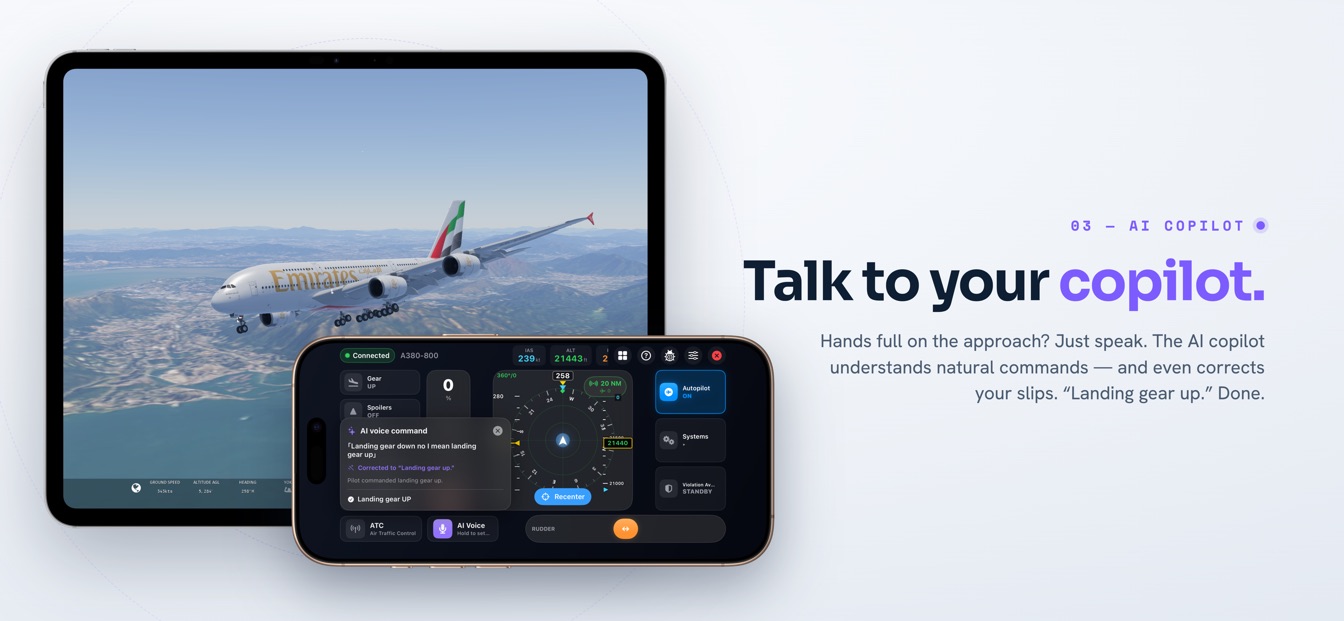
The real -200ER kept a conventional control column while much of the industry moved to sidesticks, and that choice is the whole point of flying it this way. SkyYoke's Motion Yoke reads the phone's gravity vector relative to a neutral position you choose — not raw rotation angles — so your grip never matters and gimbal lock never happens. Rest the phone flat on your lap or hold it upright like the column itself; either way, rolling your wrists banks the airplane and easing the top edge toward you brings the nose up.
A configurable tilt range from 15° to 60° decides how far you lean for full deflection, and a one-tap recenter captures a fresh neutral whenever you shift in your seat. Each axis then runs through its own conditioning chain:
Dial in a wide expo with extra smoothing and the -200ER flies the way it should: deliberate, planted, a little reluctant — in the best sense. Prefer to keep the phone still? The Touch Joystick swaps motion for an on-screen, self-centering pad that maps 1:1 and springs back to center the instant you let go.
Thrust on this airplane is an event, and SkyYoke's smart throttle treats it like one. It is a single lever with a haptic tick at the idle detent: stand it up for 0–100% of those two huge turbofans on the takeoff roll, and watch it recolor as its job changes — blue and green for forward thrust, amber for braking, red for reverse.
The clever part comes after touchdown. Infinite Flight requires reverse thrust to be held, which normally means pinning a finger to the screen during the busiest seconds of the flight. With SkyYoke, pulling the lever into the red zone on the ground at 40 knots or above engages held reverse — the lever keeps holding it for you while you steer the rollout with the rudder bar. As speed decays below 40 knots, the same red travel hands over to proportional wheel braking, so deceleration from main-gear touchdown to taxi speed is one continuous motion of one thumb. In the air, the red zone is locked out entirely, with a warning banner and a repeating haptic if you try.
The essentials of the airplane — and how SkyYoke maps your phone onto it:
| Manufacturer | Boeing |
|---|---|
| Family | 777 — the -200ER is the foundation the whole line grew from |
| Control style | Conventional yoke (control column) |
| Engines | 2 × giant GE90-class high-bypass turbofans |
| Typical role | Long-range intercontinental twin; the aircraft that proved big-twin ETOPS long-haul flying |
| Yoke in SkyYoke | Motion tilt (gravity-based, grip-independent) or 1:1 touch pad, tuned per axis |
| Throttle in SkyYoke | Smart lever — 0–100% thrust, held reverse on the ground, proportional braking below 40 kts |
| Rudder in SkyYoke | Self-centering rudder bar for crosswinds and centerline work |
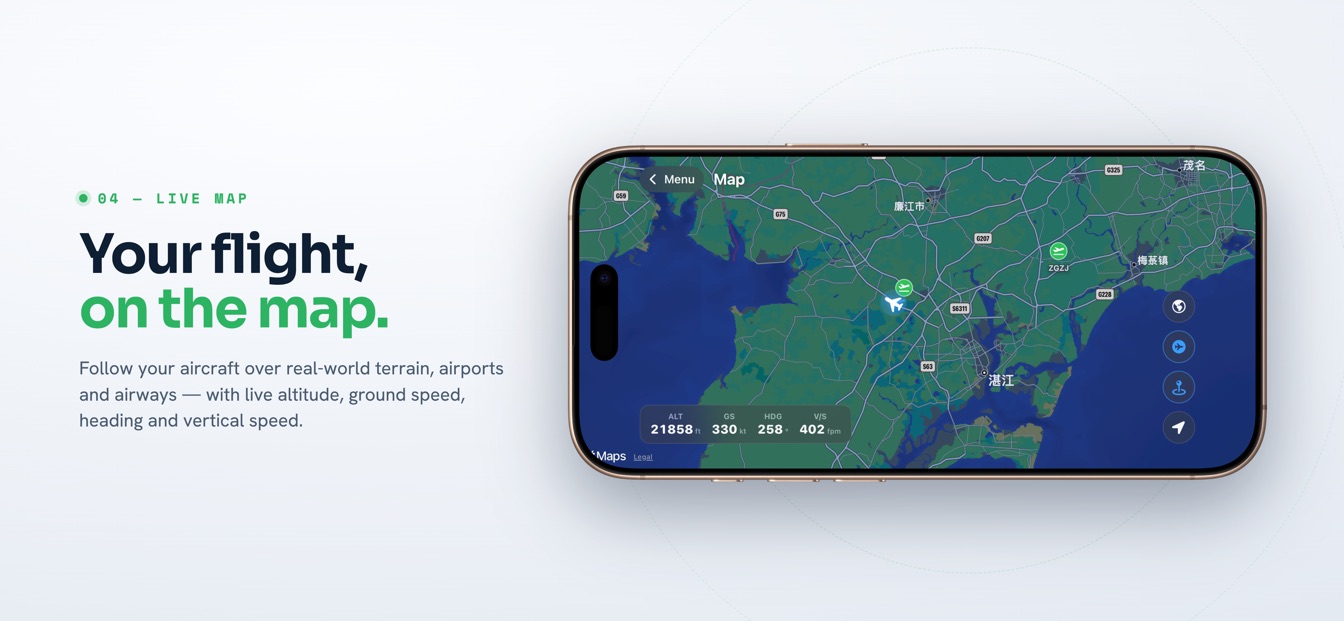
Long sectors are flown with the eyes more than the hands, so SkyYoke surrounds the yoke with the cues a widebody crew leans on. Before departure, the Performance screen reads your weight and the in-sim weather, estimates V1, VR, V2, VREF and VAPP for the runway you pick, and arms spoken callouts for the roll. While you fly, the HUD pins airspeed, altitude, heading and vertical speed beside the controls, and the TCAS traffic scope paints live multiplayer traffic right over the yoke pad.
Armed from the Performance screen and fired once per departure: V1, Rotate and V2, estimated from your actual weight and runway.
Live IAS, altitude, heading and vertical-speed chips, plus speed and altitude tapes with cyan bugs marking your selected targets.
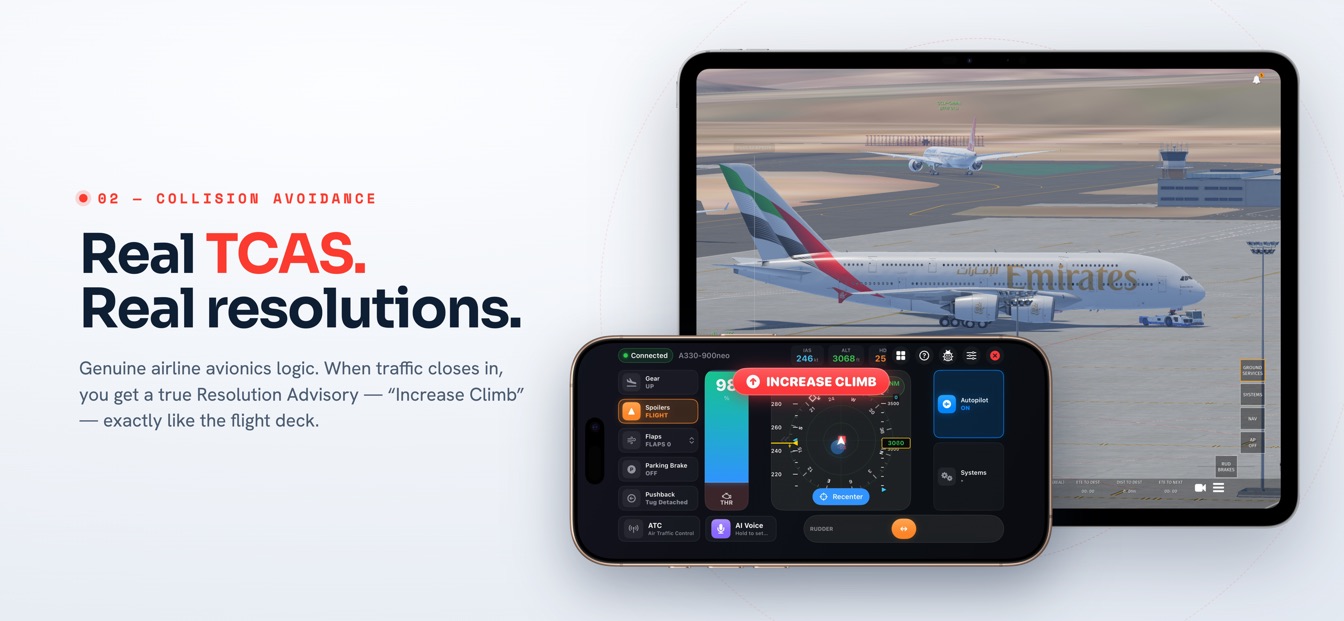
An ND-style scope drawn over the yoke pad, classifying nearby traffic and speaking advisories when another aircraft closes in.
The systems panel carries the rest of the flow — engine start, APU, exterior lights, cabin signs and autobrake — and only shows the controls this aircraft actually exposes. And because a clean, heavy twin gathers speed quickly going downhill, the Violation Avoidance System watches the 250-knot limit below 10,000 feet while the autopilot flies, clamping the speed target or managing energy before an overspeed lands in your logbook. It is an aid, not a guarantee — but it is very good company in a slippery descent.
Flying Infinite Flight's 777-200ER with your iPhone as the yoke.
It is a way to fly Infinite Flight's 777-200ER with a real control feel instead of touchscreen sliders. SkyYoke turns an iPhone into the yoke: the app senses gravity as you tilt the phone and sends roll and pitch to the simulator over your home Wi-Fi in real time, or you can fly from an on-screen self-centering pad. No physical hardware is needed — just two devices on the same network.
SkyYoke reads the gravity vector relative to a neutral you set, so the gesture mirrors a Boeing yoke: rotate your wrists to bank, pull the phone toward you to raise the nose. It works in any grip — flat on a lap or held upright — and a one-tap recenter captures a new neutral whenever you shift. Per-axis sensitivity, dead zone, expo, trim and smoothing let you give the big twin a deliberately heavy, stable feel.
Yes. After touchdown, pulling the lever into its red zone at 40 knots or faster engages reverse thrust and holds it for you — Infinite Flight normally requires reverse to be held down. As the rollout slows below 40 knots, the same lever travel becomes proportional wheel braking instead, so one hand carries the whole sequence from main-gear touchdown to taxi speed. In the air, reverse is blocked with a warning and haptic feedback.
An iPhone on iOS 17.2 or later running SkyYoke, plus a second device on the same Wi-Fi running Infinite Flight with Infinite Flight Connect enabled. You bind the control axes once in Infinite Flight's Controllers settings — an in-app guide walks through it — then load the 777-200ER from Infinite Flight's fleet and fly. SkyYoke discovers the simulator on the network automatically.
No. SkyYoke is an independent app and is not affiliated with, sponsored by, or endorsed by Boeing or Infinite Flight LLC. It talks to the simulator through Infinite Flight's public Connect API, and the 777-200ER itself — its availability and behavior in the sim — is determined entirely by Infinite Flight. Aircraft names appear here only to describe compatibility.
SkyYoke is available now — download it on the App Store and turn your iPhone into a full flight-sim cockpit.
Download on the App Store Get it on Google Play