Autopilot panel
AP master plus ALT, V/S, SPD and HDG targets with swipe-to-scrub strips, VNAV, LNAV and approach modes.
Stick drift, a dead USB port or a move to iPad simming — whatever grounded your joystick, you may not need to buy another one. The iPhone in your pocket can be the replacement for your Thrustmaster joystick: a motion or touch stick, a real throttle lever and a rudder bar, all over Wi-Fi.
A replacement for a Thrustmaster joystick doesn't have to be another box of springs and potentiometers. SkyYoke turns the iPhone you already own into a wireless flight stick — motion or touch control with adjustable dead zone, expo and sensitivity — plus a throttle lever, rudder bar and autopilot panel, flying Infinite Flight over Wi-Fi with nothing to plug in and nothing to wear out.
Most joysticks don't die suddenly — they fade. The potentiometers inside a stick wear a little with every session, until one afternoon your aircraft begins a gentle, uncommanded roll on final and no amount of recalibration makes it stop. If you're searching for a replacement for a Thrustmaster joystick, that slow fade is probably why — or you've hit one of the other dead ends that send simmers shopping:
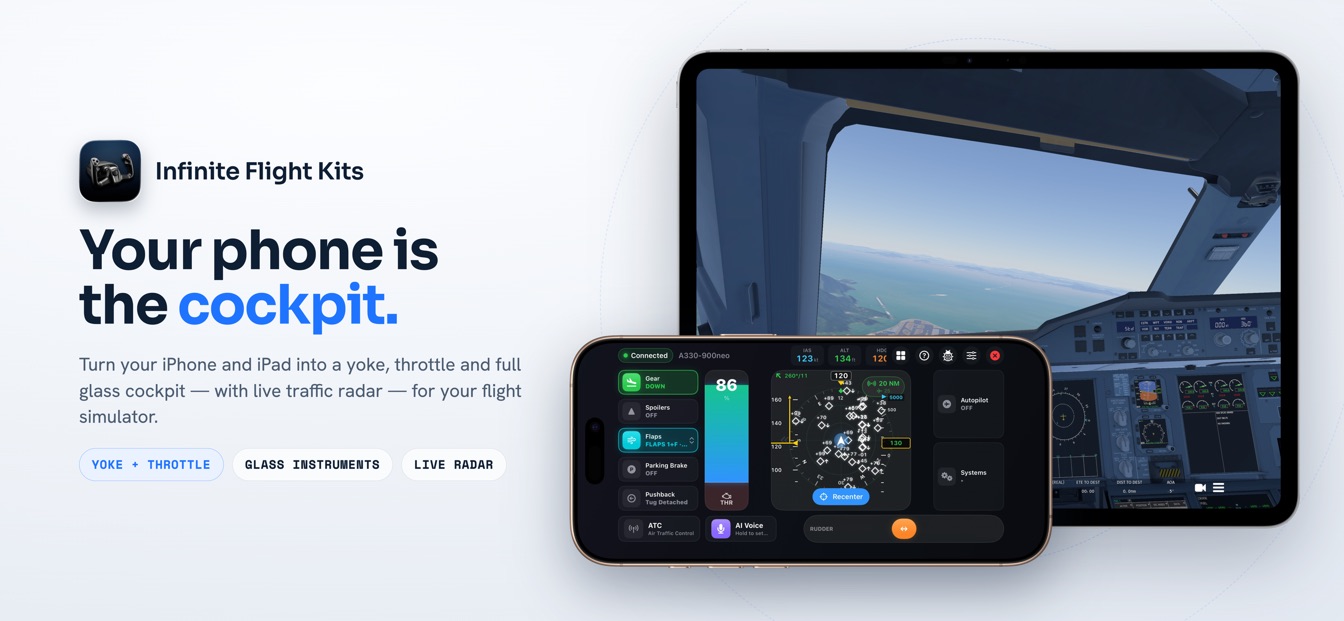
SkyYoke's answer is to stop replacing the hardware and start replacing the function. The app — available now on the App Store — turns an iPhone into a wireless flight controller for a simulator running on another device on the same Wi-Fi network. Both Infinite Flight and Microsoft Flight Simulator 2024 are supported today.
The stick comes in two flavors. Motion control reads the phone's gravity sensor against a neutral point you choose, so it works held upright like a fighter grip or resting flat on your lap — there's no gimbal lock, the tilt range is configurable from 15° to 60°, and one tap recenters it whenever you shift position. Prefer to keep the phone still? The touch joystick is a self-centering on-screen pad that follows your thumb 1:1 and snaps back to neutral the instant you release it.
The feel is yours to define. Every axis — pitch, roll, yaw and brake — carries its own sensitivity, dead zone, expo curve, inversion, trim and smoothing, the kind of tuning a hardware stick usually borrows from third-party software. Inputs stream to the simulator through a 60 Hz control loop with change-detection and rate limiting, and a link watchdog reconnects automatically if your network blips.
The throttle is a genuine lever rather than a slider afterthought — the context-aware design we cover in depth on the remote throttle page. Forward travel commands 0–100% thrust; pull into the red zone while rolling out at 40 knots or more and the lever holds reverse thrust for you; below 40 knots that same zone becomes proportional wheel braking. In the air, reverse is blocked outright with a warning. The rudder is a self-centering bar along the bottom edge of the screen for taxi steering and crosswind corrections.
And then there is everything a joystick never had built in:
AP master plus ALT, V/S, SPD and HDG targets with swipe-to-scrub strips, VNAV, LNAV and approach modes.
Lights, APU, external power, engine start, autobrake and cabin signs — showing only what your aircraft actually has.
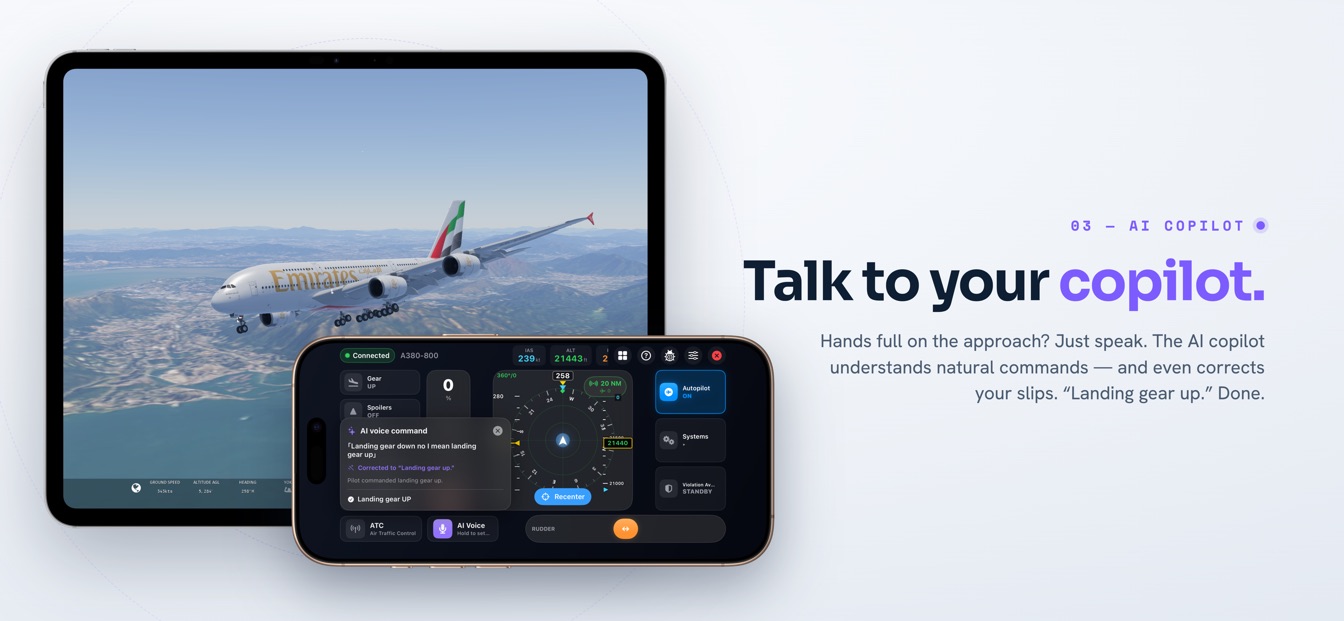
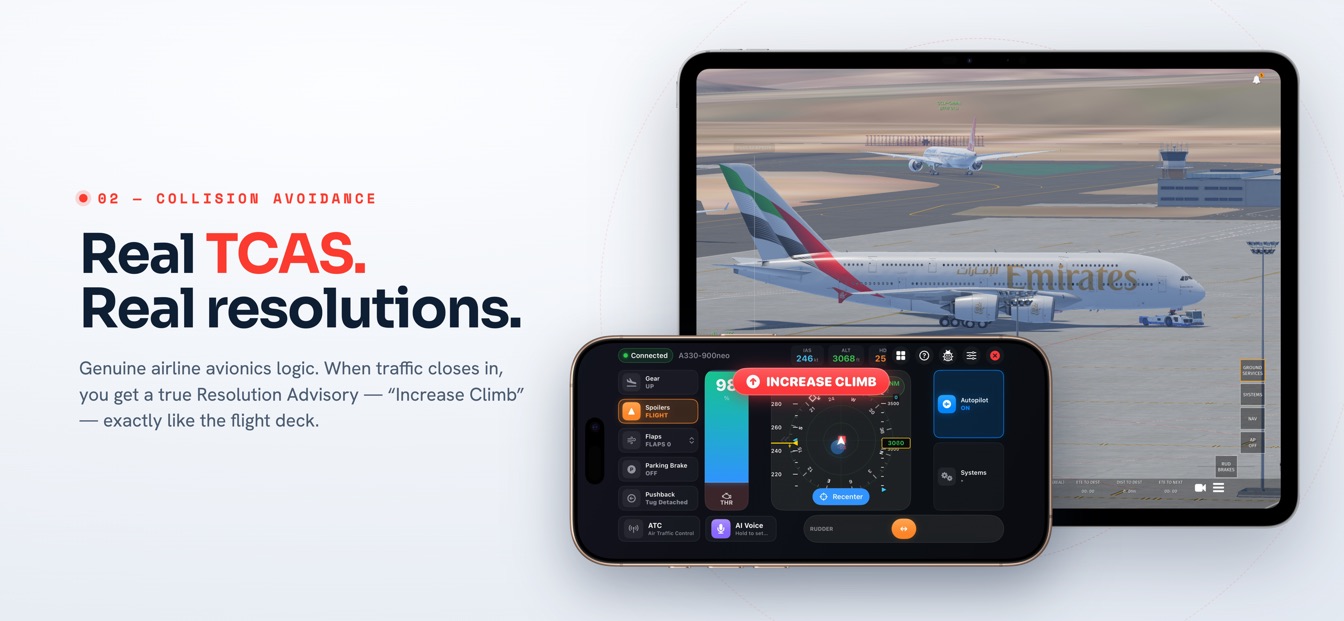
An Airbus-style traffic display drawn over the stick, fed by Infinite Flight's live multiplayer traffic.
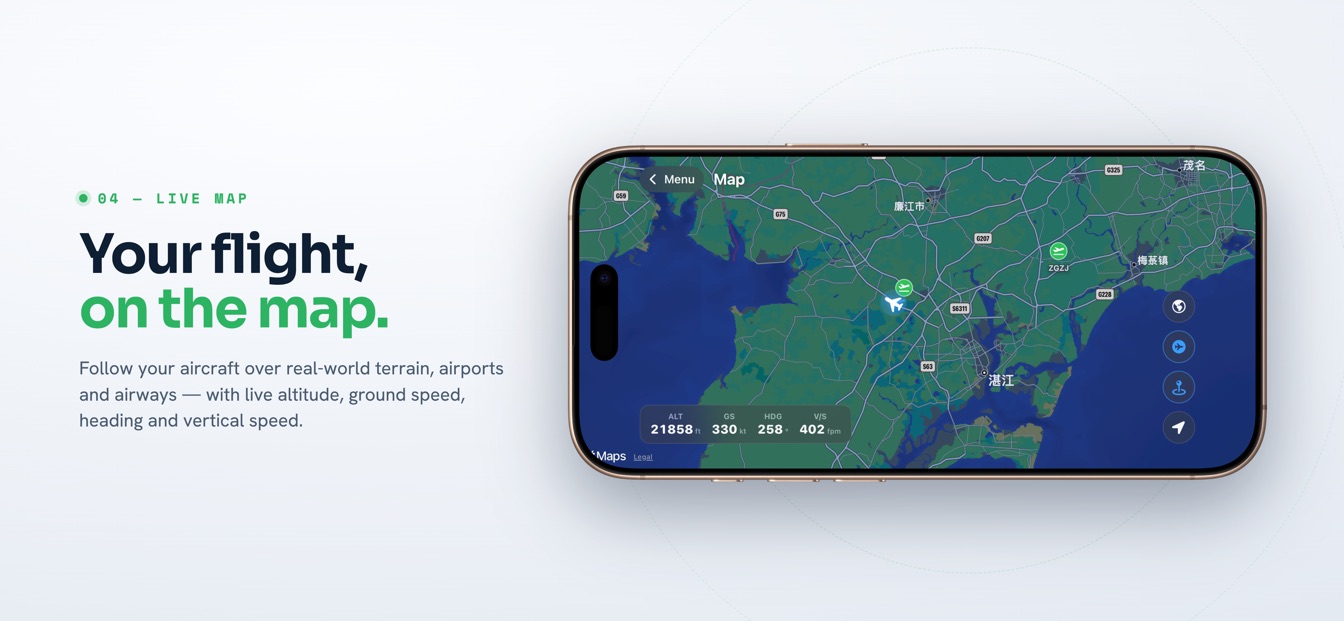
The TCAS scope, ATC keypad and moving map are Infinite Flight features, and they share one cockpit screen with the stick — the full remote cockpit tour walks through all of it. The traffic display is a simulator aid, not certified avionics.
No comparison is useful if it pretends one side has no case. Here is how the two paths actually stack up:
| What you're weighing | Dedicated hardware joystick | SkyYoke on your iPhone |
|---|---|---|
| Price | An upfront purchase — and a repeat one when parts wear out | No new hardware; it runs on the iPhone you already own |
| Force feel | Real spring resistance and physical travel — the benchmark | Haptic detents and ticks, but no physical spring force |
| Portability | Desk-bound; clamps, cables and a bag won't make it mobile | Pocket-sized; flies anywhere your phone and Wi-Fi go |
| Works with tablet sims | Generally no — desktop USB sticks assume a PC host | Yes; built for Infinite Flight on iPad over Wi-Fi |
| Extra panels | Mappable buttons and hats, but no displays or instruments | Autopilot, systems, ATC and a TCAS scope on the same screen |
| Maintenance and drift | Potentiometers wear; drift and dead-zone creep arrive with use | No moving parts; software curves behave the same every session |
Honesty cuts both ways. A spring-loaded gimbal pushes back against your hand, and that physical resistance is something no phone can fake — haptics mark events, they don't load your wrist. If you fly aerobatics or hand-fly heavy metal on a PC and you love that tension, a quality replacement stick remains the right purchase.
The same goes for a permanent setup. If your simulator lives on a dedicated desk with pedals, a quadrant and a monitor at eye level, a bolted-down stick is part of the furniture in the best sense. SkyYoke isn't trying to dismantle that cockpit; it's the path for everyone who never had one — tablet pilots, travelers, and anyone whose sim space doubles as the kitchen table.
There are no drivers, no calibration wizard and no screws on this path. Once you have the app, the first flight goes like this:
Straight answers on swapping a hardware joystick for the phone in your pocket.
For tablet-based simming, yes — and for many casual PC setups too. SkyYoke turns the iPhone into a precision stick with motion or touch control, per-axis dead zones, expo curves and sensitivity, plus a throttle lever and rudder bar on the same screen. It flies both Infinite Flight and Microsoft Flight Simulator 2024 over Wi-Fi today — MSFS through a free Windows companion app. What it can't reproduce is physical spring force — dedicated hardware still wins there.
No. Stick drift in hardware joysticks comes from physical potentiometers wearing down until the sensor reports movement that isn't there. SkyYoke has no potentiometers: motion control reads the phone's gravity sensor against a center point you set, and the touch joystick springs back to a software-defined zero every time you let go. Dead zone, expo and sensitivity are settings rather than parts, so they behave the same on day one and day one thousand.
Infinite Flight is fully supported today: SkyYoke connects over your Wi-Fi network through Infinite Flight's Connect API and discovers the simulator on the network automatically. Microsoft Flight Simulator 2024 is supported too, via a free Windows companion app called IF Yoke Bridge that runs alongside the simulator and is auto-discovered by your phone — both simulators work today.
No — both live on the same screen as the stick. The smart throttle is a single lever covering 0–100% forward thrust; pulled into its red zone on the ground at speed it holds reverse thrust for you, and below 40 knots that same zone becomes proportional wheel braking. A self-centering rudder bar runs along the bottom of the screen for taxi steering and crosswind work, and a haptic tick marks the idle detent.
No. SkyYoke is an independent iPhone app with no connection to Guillemot Corporation, the company behind Thrustmaster products, nor to Infinite Flight LLC or Microsoft. The Thrustmaster name appears on this page only to identify the category of hardware people are looking to replace. SkyYoke is available now on the App Store.
SkyYoke is available now — download it on the App Store and turn your iPhone into a full flight-sim cockpit.
Download on the App Store Get it on Google Play