Airbus-style PFD tapes
A speed tape with a trend arrow and an altitude tape, with cyan bugs marking your selected targets.
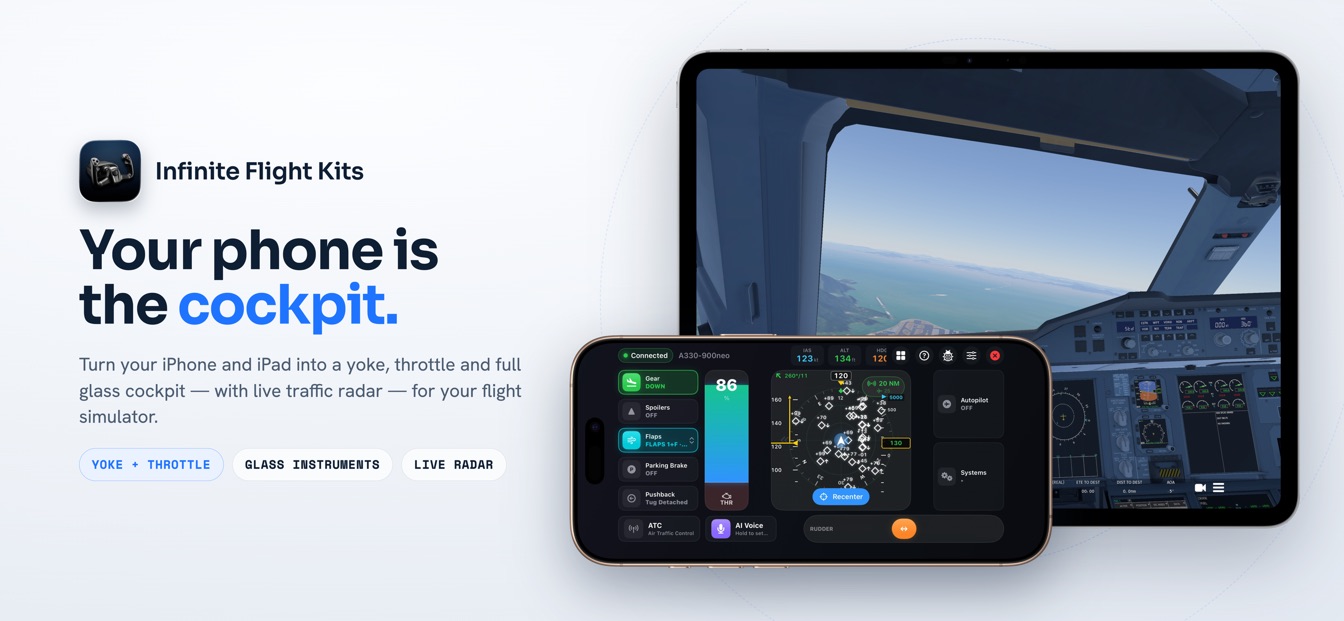
The Baby Bus flies best with a stick in your hand. SkyYoke makes your iPhone the A318 joystick for Infinite Flight — sidestick, gated Airbus throttle and rudder, streamed wirelessly over your own Wi-Fi.
An Airbus A318 joystick for Infinite Flight is what SkyYoke makes of your iPhone: a wireless sidestick that banks and pitches the smallest A320-family jet by tilt or touch, paired with a gated Airbus thrust lever and a rudder bar, all sent live to the simulator over your local Wi-Fi at 60 Hz.
Every Airbus fan keeps a soft spot for the runt of the family. The A318 is the A320 with the middle taken out — the shortest fuselage in the lineup, a cabin of roughly 107 to 132 seats, and a reputation for getting into airports its bigger siblings can only overfly. In Infinite Flight it is the kind of jet you hand-fly on purpose, which means the controls matter far more than they would on a ten-hour autopilot cruise. That is exactly where an Airbus A318 joystick for Infinite Flight earns its keep: SkyYoke turns the iPhone you already own into a wireless sidestick, a gated Airbus thrust lever and a rudder bar for the simulator running on your other device. Nothing to buy, nothing to plug in — two devices on the same Wi-Fi is the whole rig.
Pilots and spotters call the A318 the Baby Bus, and the nickname has stuck for a reason. It is the smallest member of the A320 family, built for short, dense city pairs and powered by two underwing turbofans. Its party trick is genuinely famous: the type is certified for the steep approach into London City Airport, a descent profile most airliners are simply not approved to fly. What matters most for our purposes, though, sits up front — the A318 carries the very same sidestick fly-by-wire flight deck as the A320 and the rest of its siblings, so it flies like a familiar Airbus that happens to be lighter on its feet. In Infinite Flight's fleet, that makes it a favorite for pilots who would rather fly an approach than monitor one.
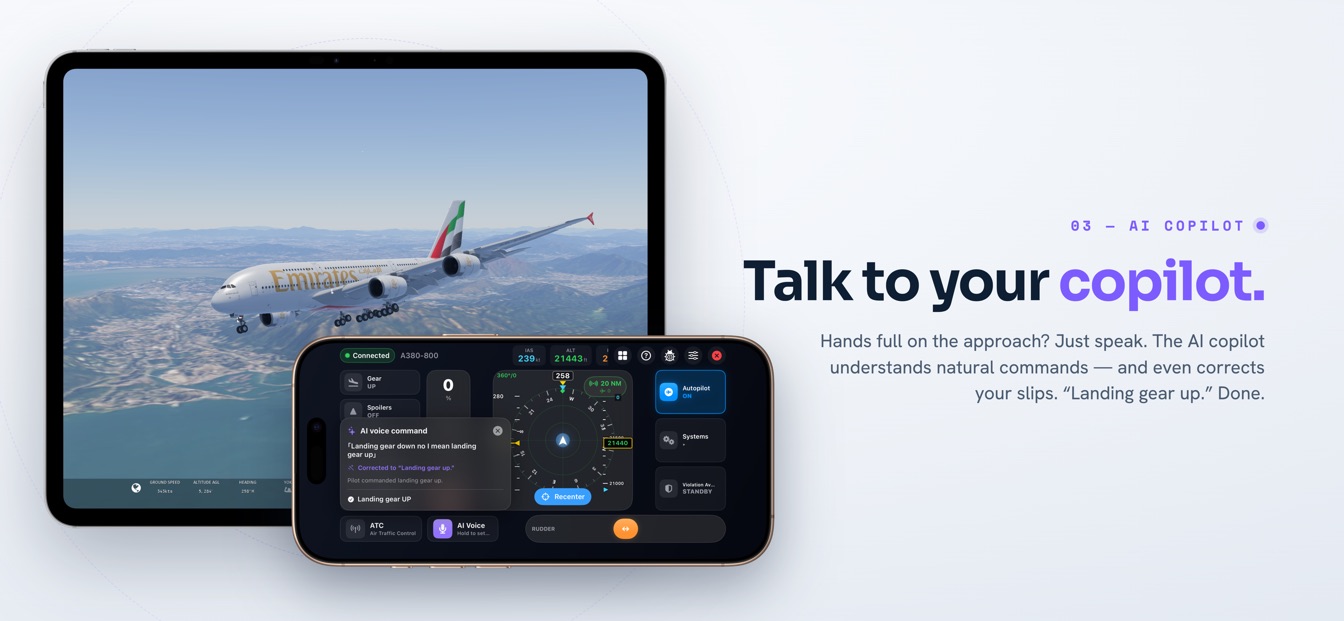
There is a reason this pairing feels right. Nobody wrestles a yoke in an A318; the pilot rests one hand on a small sidestick and makes deliberate, economical inputs. A phone held in one hand is far closer to that picture than any desk-mounted column. SkyYoke's Motion Yoke mode reads the gravity vector against a neutral you set — not raw rotation angles — so it is grip-independent: rest the phone flat on your lap like a sidestick on an armrest, or hold it upright, and both work without gimbal lock ever biting. You decide how far the phone leans for full deflection (anywhere from 15° to 60°), and a one-tap recenter captures a fresh neutral whenever you shift in your seat. Prefer glass to gravity? The Touch Joystick is an on-screen, self-centering pad that maps 1:1 and springs back the instant your thumb lifts.
Every axis then passes through its own conditioning chain, so the stick can be as docile or as direct as you want:
Underneath, a 60 Hz control loop with change-detection and rate limiting keeps inputs flowing without flooding the network, and a link watchdog reconnects automatically if your Wi-Fi hiccups mid-descent.
The real jet's thrust levers click through gates, and so does SkyYoke's. Because the A318 is an Airbus type, the app automatically swaps its smart throttle for a gated quadrant — REV FULL, REV, IDLE, CLIMB, FLX·MCT and TOGA — with a haptic tick each time the lever crosses a gate. Push to FLX·MCT or TOGA for departure, pull back into CLIMB when it is time, and confirm every detent by feel while your eyes stay on the flying.
The lever also stays smart about context. On the ground at 40 knots or more, pulling into the red zone engages held reverse thrust — Infinite Flight requires reverse to be held, so the lever holds it for you. Below 40 knots the same zone becomes proportional wheel braking for the rollout, and in the air reverse is blocked outright, with a warning banner and a repeating haptic so it can never happen by accident. The lever even recolors by role: blue and green for forward thrust, amber for braking, red for reverse.
One table, everything that matters about the airframe and how SkyYoke maps it:
| Manufacturer | Airbus |
|---|---|
| Family | A320 family — the shortest member, nicknamed the Baby Bus |
| Control style | Sidestick fly-by-wire, shared with its larger siblings |
| Engines | Two underwing turbofans |
| Typical role | Short-haul city pairs, roughly 107–132 seats; certified for the steep approach into London City |
| SkyYoke mapping | Stick: motion tilt or touch joystick for pitch and roll · Throttle: gated Airbus detent lever · Rudder: self-centering bar along the bottom of the screen |
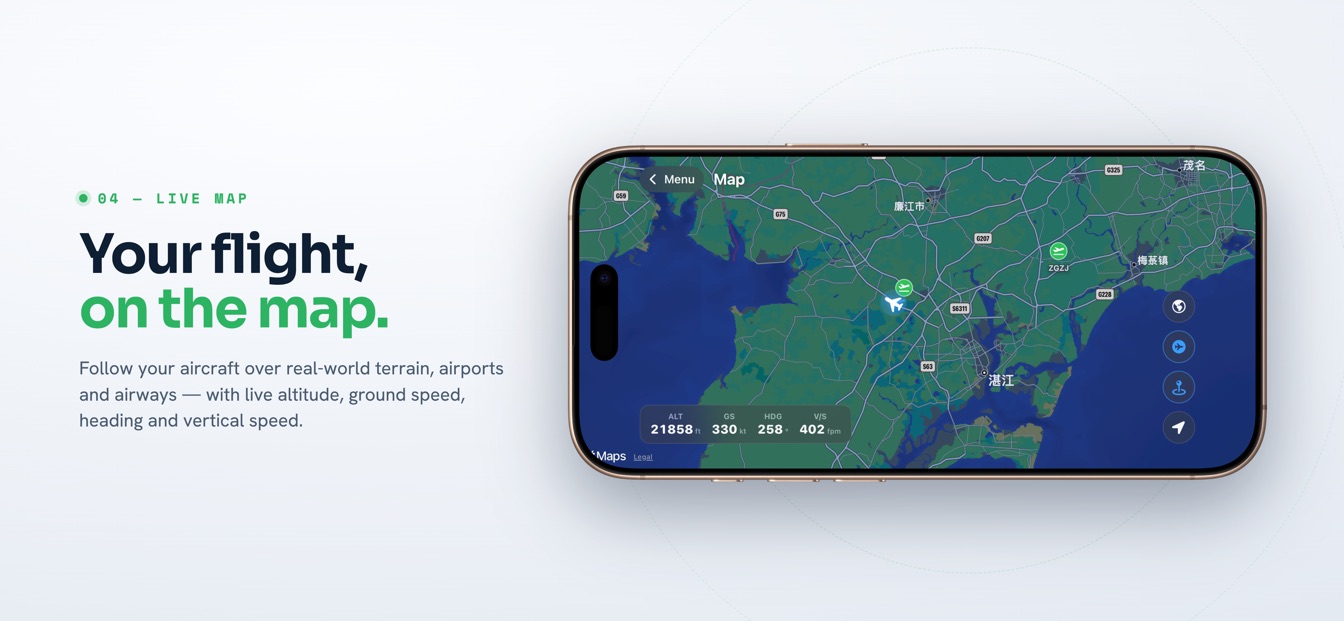
A jet built for city hops spends its whole life climbing, descending and threading terminal airspace — exactly where you want information close to your thumbs. SkyYoke draws live IAS, altitude, heading and vertical-speed chips right above the controls, alongside a ground/air phase chip and a spoiler annunciator, so the numbers you would normally glance across the room for are already in your hand.
A speed tape with a trend arrow and an altitude tape, with cyan bugs marking your selected targets.
A navigation-display-style scope over the yoke pad, fed by live multiplayer traffic, with spoken advisories.
Watches the 250-knot limit below 10,000 ft while the autopilot flies and protects your speed target.
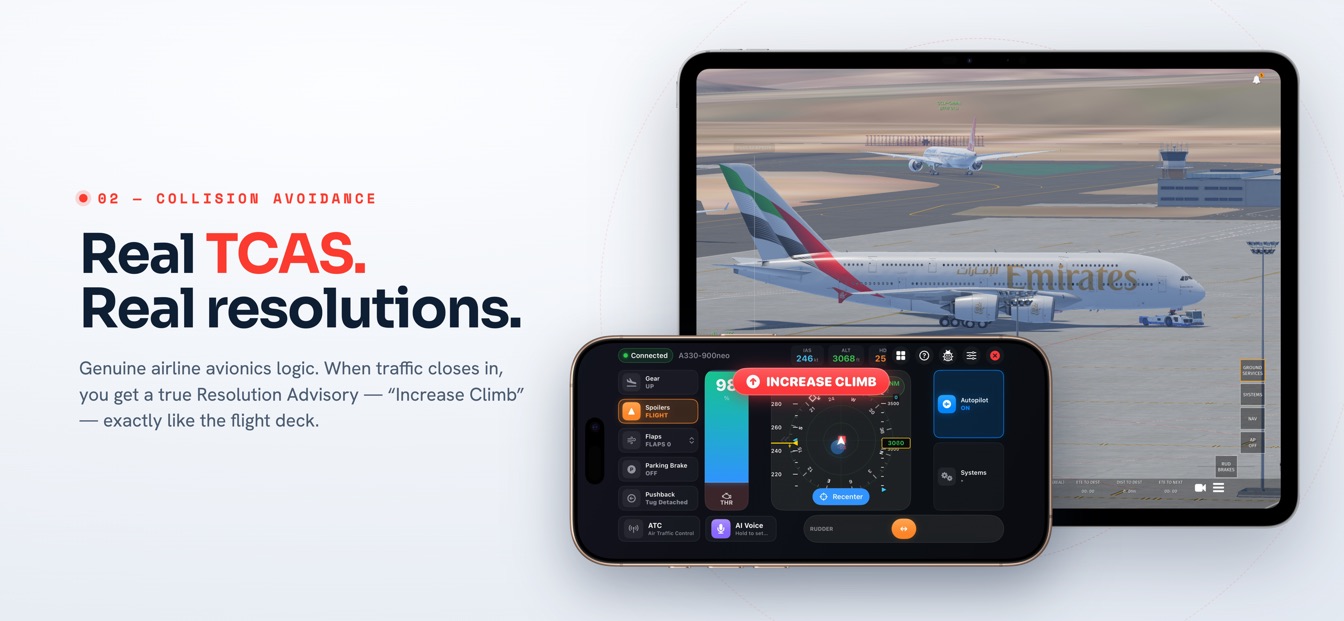
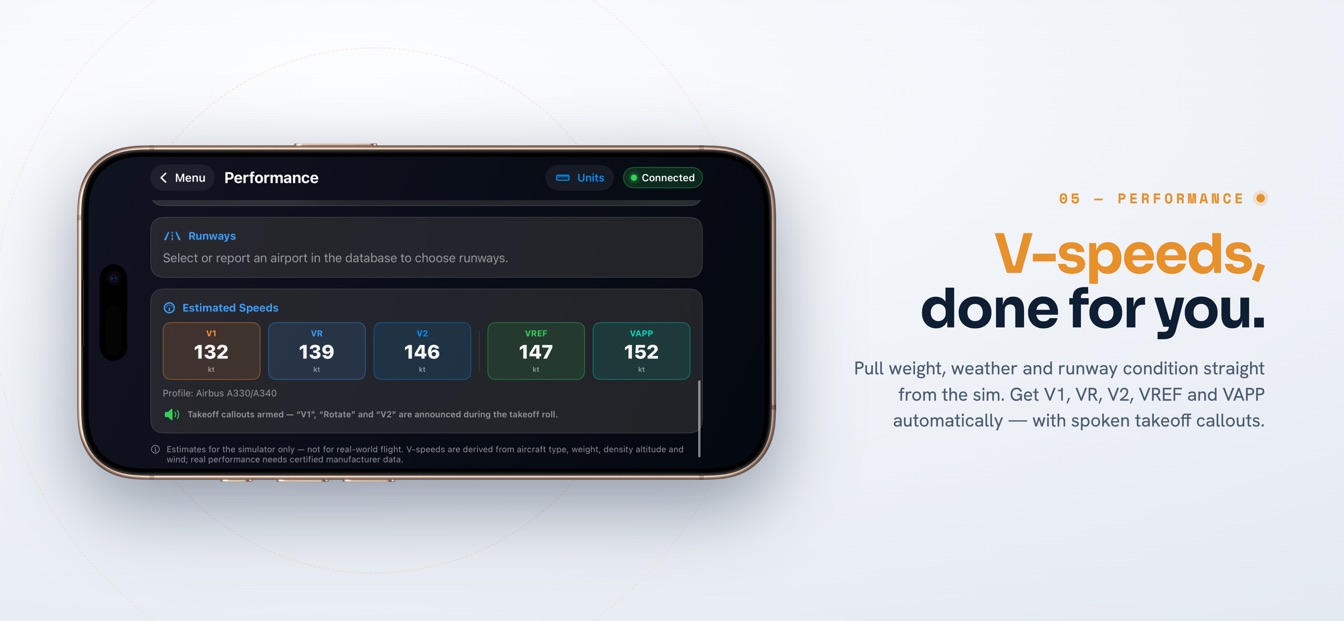
Before departure, the Performance screen estimates V1, VR and V2 for your actual weight and the day's density altitude, checks your runway, and arms spoken callouts so "V1" and "rotate" sound at the right moments on the roll. Climbing out of a busy hub, the TCAS scope keeps multiplayer traffic categorized and visible, while the Violation Avoidance System stands guard over the 250-knot band whenever the autopilot is engaged — clamping the speed target or managing energy on a fast descent. Every one of these is a simulator aid built on estimates: helpful in Infinite Flight, never a substitute for real avionics and never a guarantee.
Quick answers about flying the A318 with your iPhone as the stick.
Yes. SkyYoke connects to Infinite Flight over your home Wi-Fi through the Connect API and streams sidestick-style pitch and roll from your iPhone — either by tilting the phone or with an on-screen self-centering joystick. It also drives throttle, rudder, autopilot and systems, so the A318 can be flown gate to gate without touching the simulator screen. No physical hardware is required.
It does, automatically. Because the A318 is an Airbus type, SkyYoke replaces the plain throttle with a gated quadrant — REV FULL, REV, IDLE, CLIMB, FLX·MCT and TOGA — and plays a haptic tick each time the lever crosses a gate. You can set CLIMB by feel instead of by sight, which keeps your eyes on the flying rather than on the lever.
SkyYoke's motion control reads the gravity vector against a neutral point you set, so small, deliberate inputs become small control deflections. Per-axis sensitivity, dead zone and an exponential response curve let you soften the center of the stick for fine pitch corrections on a steep final, and a one-tap recenter resets your neutral whenever you shift in your seat. If you prefer, the on-screen touch joystick is always available instead.
An iPhone on iOS 17.2 or later for SkyYoke, plus a second device on the same Wi-Fi network running Infinite Flight with Infinite Flight Connect enabled in its settings. You bind the control axes once in Infinite Flight's Controllers menu — the in-app setup guide walks through each axis — then select the A318 from Infinite Flight's fleet and connect.
No. SkyYoke is an independent app with no affiliation to Airbus, Infinite Flight LLC or any hardware maker. It works through Infinite Flight's public Connect API, and aircraft names are used only to describe compatibility. Aircraft availability, modeling and features inside the simulator are decided entirely by Infinite Flight.
SkyYoke is available now — download it on the App Store and turn your iPhone into a full flight-sim cockpit.
Download on the App Store Get it on Google Play