V1 · Rotate · V2
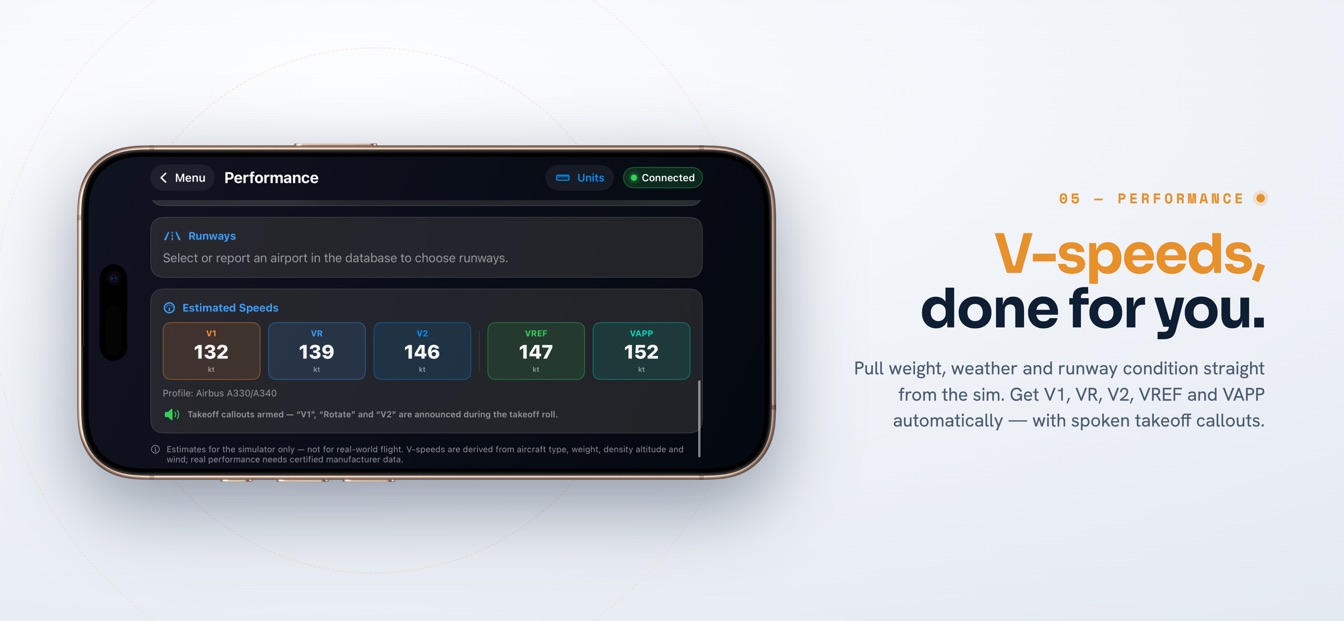
Arm the departure on the Performance screen and the speeds are spoken during the roll — estimated for your weight, runway and density altitude.
SkyYoke turns your iPhone into a wireless 747-400 yoke for Infinite Flight — tilt to bank, pull to rotate, and fly the Queen of the Skies over your own Wi-Fi with no hardware to buy.
A Boeing 747-400 yoke for Infinite Flight is a control column for the simulator's 747-400 that lives on a device you already own: your iPhone. SkyYoke links to Infinite Flight over local Wi-Fi and converts the phone's tilt into the jumbo's roll and pitch at 60 Hz — roll your wrists to bank, pull back to rotate, exactly the inputs a Boeing column expects.
Every 747 departure starts the same way: brakes held, four engines spooling in unison, then a slow, gathering acceleration that seems to borrow the whole runway. In Infinite Flight, that drama usually has to squeeze through a touchscreen slider. A Boeing 747-400 yoke for Infinite Flight restores the missing half of the experience — the controls. SkyYoke makes the iPhone you already own the jumbo's control column: hold it in both hands, roll your wrists and the big Boeing banks with you; at rotate speed, draw the top of the phone toward your chest and the nose rises the way a heavy's should — unhurried, deliberate, certain.
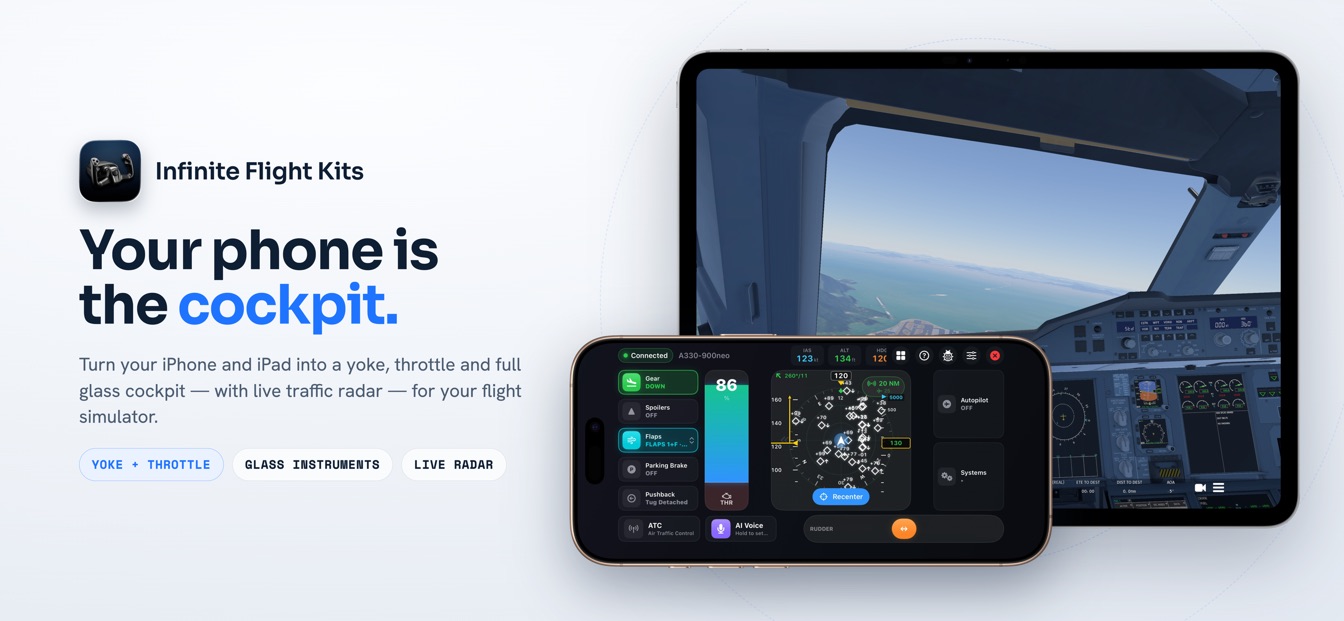
Your iPad stays a clean window onto the flight. The phone is where the flying happens. Nothing is plugged in, paired or purchased; two devices on the same Wi-Fi is the entire rig.
The 747-400 is the definitive jumbo. It is the most-produced 747 of them all — the variant that retired the flight engineer's station in favor of a two-crew glass cockpit, hung winglets on the wingtips and stretched the type to true intercontinental range. Through the 1990s and 2000s it effectively was long-haul flying: if a route crossed an ocean, the odds were good a -400 flew it.
That heritage is exactly why it remains a favorite of virtual pilots everywhere. In Infinite Flight's fleet it sits between the classic 747-200 and the stretched 747-8, and it flies like the era it defined: four engines to manage, a stately response to every input, and arrivals that reward the pilot who starts planning twenty miles out. It is, in short, an aircraft that deserves a yoke.
SkyYoke's Motion Yoke senses gravity relative to a neutral attitude you set, rather than reading raw device angles. That one design choice matters across a long-haul flight: the phone can lie flat across your knees in cruise or stand upright in your hands like a genuine Boeing column, and the controls behave identically either way, with no gimbal lock at the extremes. Tap Recenter after you shift in your seat and your new hold becomes the new neutral. A configurable tilt range — anywhere from 15° to 60° — decides how far you lean for full deflection, so the jumbo can have wide, gentle control throws or quick, compact ones.
Every axis then runs through its own tuning chain, which is where you build a 747's feel:
Prefer to keep the phone perfectly still? Switch to the Touch Joystick instead: an on-screen, self-centering pad that follows your thumb 1:1 and springs back to center the instant you let go.
A loaded jumbo asks a lot of the throttle hand, and SkyYoke answers with one smart lever that understands the whole arc of a 747 flight. Slide it forward for 0–100% thrust on the takeoff roll. After touchdown, pull it down into the red zone at 40 kts or above and the app engages held reverse thrust — Infinite Flight expects you to keep holding reverse, so the lever holds it for you while you steer the rollout. As the speed decays below 40 kts, the very same red zone hands over to proportional wheel braking, letting you bleed the last of the energy and roll long to a distant exit, the way a 747 actually vacates a runway.
In the air the red zone is locked out entirely — a warning banner and a repeating haptic make sure nobody deploys reverse at altitude — and a haptic tick marks the idle detent so your thumb can find it without looking. The lever even recolors by role: blue and green for forward thrust, amber for braking, red for reverse.
| Manufacturer | Boeing |
|---|---|
| Family | 747 |
| Flight controls | Conventional yoke (control column) |
| Engines | Four high-bypass turbofans |
| Typical role | Long-haul, intercontinental wide-body airliner |
| SkyYoke yoke | Motion Yoke (tilt) or on-screen Touch Joystick for roll and pitch |
| SkyYoke throttle | Single smart lever — forward thrust, held reverse, proportional braking below 40 kts |
| SkyYoke rudder | Self-centering rudder bar along the bottom of the screen |
Boeing designed the -400's flight deck so two pilots could do the work of three, mostly by putting better information in front of them. SkyYoke takes the same approach to flying a four-engine heavy alone. A HUD strip keeps live IAS, altitude, heading and vertical-speed chips in view, while PFD-style speed and altitude tapes — complete with a trend arrow and cyan selected-value bugs — read like proper glass. The systems panel covers the flows: beacon before push, landing lights and signs on schedule, autobrake armed for the arrival — and it only ever shows controls the aircraft you are flying actually exposes.
Arm the departure on the Performance screen and the speeds are spoken during the roll — estimated for your weight, runway and density altitude.
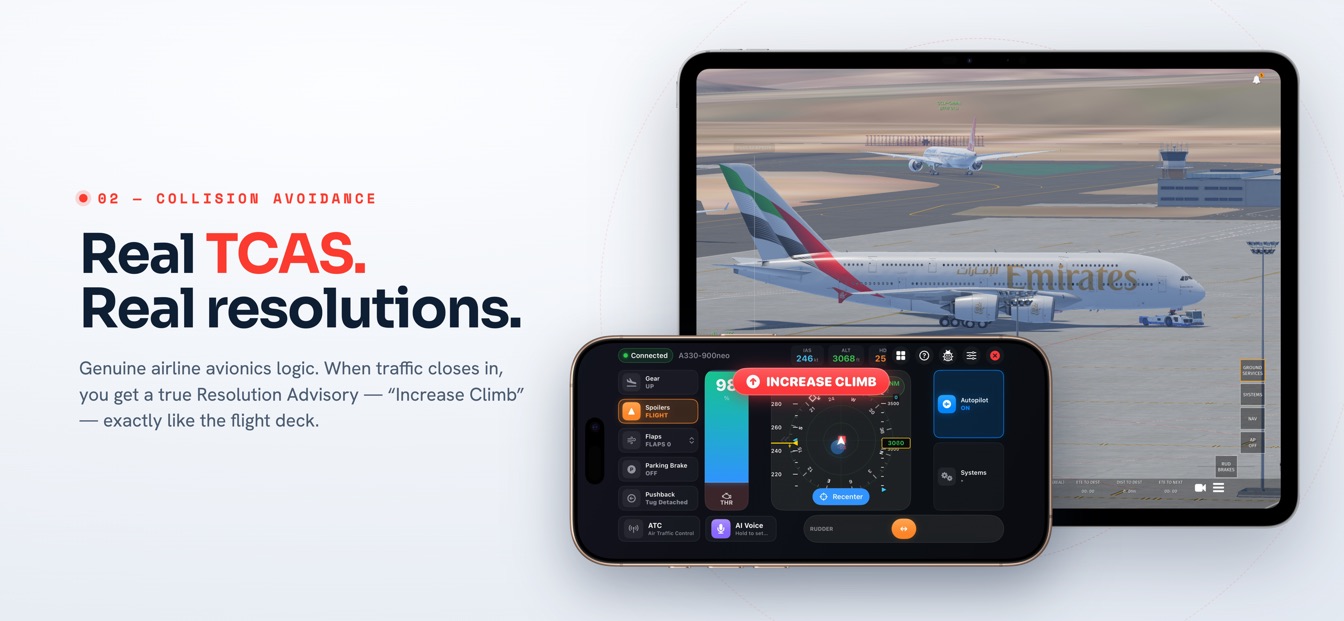
A navigation-display-style scope over the yoke pad tracks live multiplayer traffic, with TCAS II-style advisories and spoken callouts.
The Violation Avoidance System watches the 250 kt limit below 10,000 ft and manages the autopilot to keep a fast, slippery heavy legal.
Both safety aids run deeper than a card can say. The TCAS traffic scope grades contacts from open diamonds to red squares and adds spoken advisories, while the Violation Avoidance System arms itself roughly 2,000 ft above the speed-limit band, then clamps your dialed speed or manages descent energy until the threat passes. Both are simulator aids — helpful, never guaranteed, and never certified avionics.
The short answers on flying the Queen of the Skies from an iPhone.
It is a control column for Infinite Flight's 747-400 that runs on an iPhone instead of dedicated hardware. SkyYoke connects to Infinite Flight over your local Wi-Fi network and converts the phone's tilt into roll and pitch at 60 Hz, so you bank by rolling your wrists and rotate by pulling back — the same inputs a Boeing yoke expects. An on-screen touch pad is available if you would rather not tilt.
Yes — the 747-400 rewards smooth, measured inputs, and SkyYoke's per-axis tuning is built for exactly that feel. Turn the sensitivity down, add an expo curve for fine corrections near neutral, and let low-pass smoothing damp out hand jitter. Because the Motion Yoke reads gravity rather than raw angles, it works in any grip without gimbal lock, and a one-tap recenter resets neutral whenever you shift in your seat.
Once the aircraft is on the runway at 40 kts or faster, pull the throttle lever into the red zone and SkyYoke engages held reverse thrust. Infinite Flight normally requires you to keep holding reverse, and the lever holds it for you. As the rollout slows below 40 kts, the same red zone becomes proportional wheel braking, so you can manage the last of the jumbo's energy down to taxi speed.
An iPhone on iOS 17.2 or later running SkyYoke, plus a second device — typically an iPad — running Infinite Flight with Infinite Flight Connect enabled. Put both devices on the same Wi-Fi network and SkyYoke discovers the simulator automatically. You bind the control axes once in Infinite Flight's Controllers settings, and the built-in setup guide walks you through every step.
No. SkyYoke is an independent app built on Infinite Flight's public Connect API, and it is not affiliated with, sponsored by, or endorsed by Boeing or Infinite Flight LLC. Aircraft availability and behavior in the simulator are determined by Infinite Flight itself, and SkyYoke's callouts, V-speeds and protections are simulator estimates — never for real-world flight.
SkyYoke is available now — download it on the App Store and turn your iPhone into a full flight-sim cockpit.
Download on the App Store Get it on Google Play