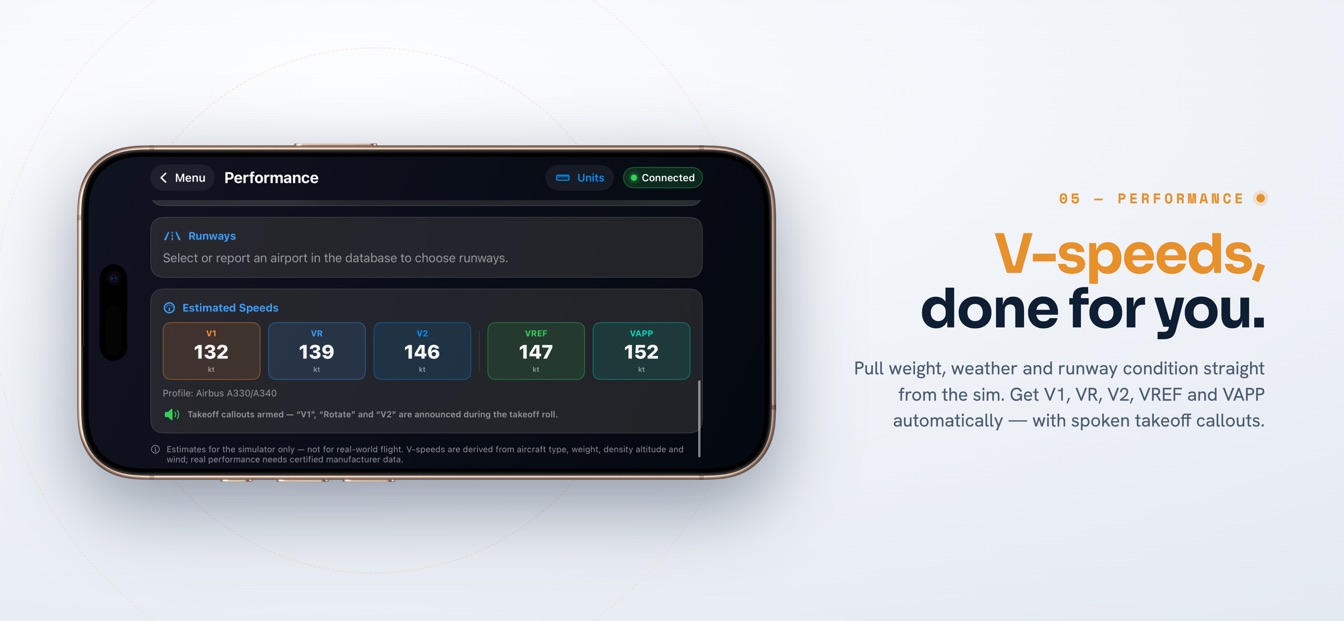
V1, Rotate, V2 — spoken
Arm callouts from the Performance screen and the cockpit voices the takeoff roll, with V-speeds estimated from your weight and the density altitude. Estimates for the sim only.
The flying pencil deserves more than a thumb on a touchscreen. SkyYoke turns your iPhone into a wireless 757-200 yoke for Infinite Flight — bank with your wrists, rotate with a pull, and let all that famous thrust do the rest.
A Boeing 757-200 Yoke for Infinite Flight turns your iPhone into a wireless control column for the 757-200 flying in Infinite Flight on another device: tilt the phone to bank and pitch, pull it back to rotate, with throttle, rudder and autopilot on the same screen. SkyYoke links the two over your local Wi-Fi and streams your inputs to the simulator at 60 Hz — no cables, no extra hardware.
Line a 757-200 up on the centerline, stand the power up and count to three: the speed tape sprints, the nose wants to fly before you ask, and a lightly loaded departure pitches into a climb that embarrasses jets twice its size. Infinite Flight captures that eagerness — which is precisely why a Boeing 757-200 yoke for Infinite Flight changes the airplane. The real -200 is flown through a classic Boeing control column, and an airplane this responsive rewards inputs you make with your hands, not a fingertip skating across a flat screen.
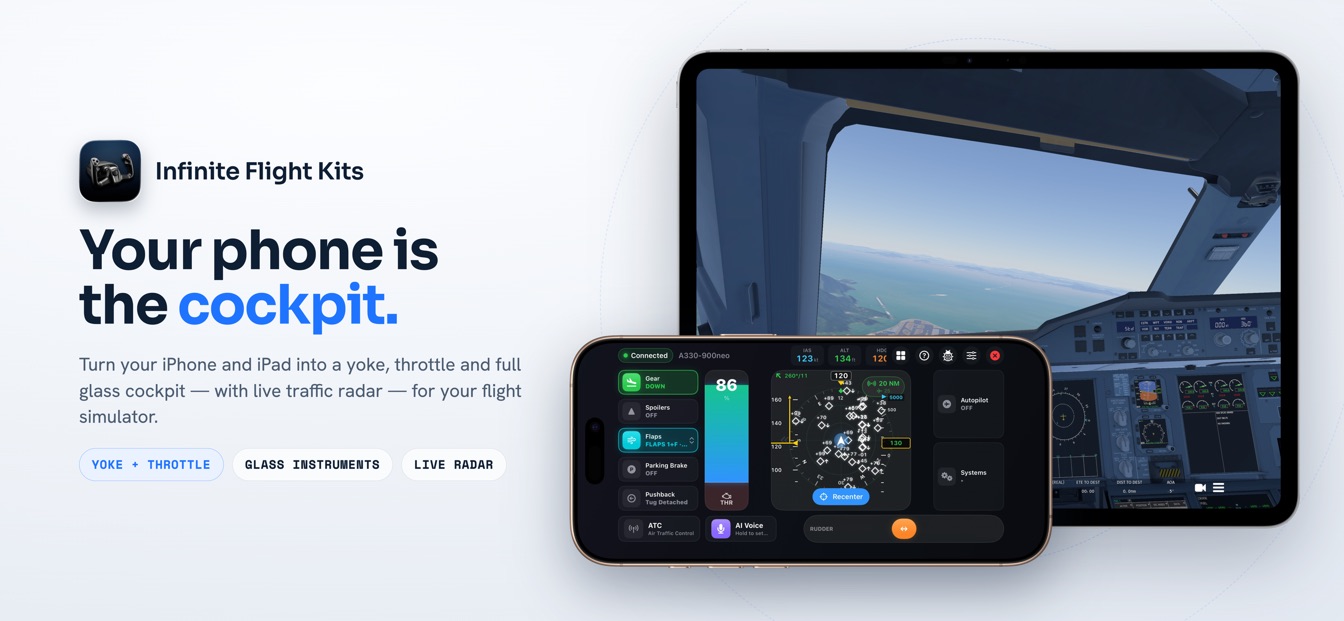
SkyYoke supplies the missing hardware without any hardware at all. The iPhone in your hands becomes the column; the device running Infinite Flight becomes the windshield. Roll your wrists left and the long fuselage rolls with you. Ease the phone back at VR and you feel the rotation as a motion you made, not a gesture you drew.
The 757-200 is long, slim and famously overpowered — a narrowbody with the silhouette of a sharpened pencil and a pair of underwing turbofans that give it thrust to spare. Crews loved it for the same reasons simmers do:
You will find the 757-200 in Infinite Flight's fleet, and it carries that whole personality with it — the spring-loaded acceleration, the brisk rotation, the cruise that arrives sooner than you planned for.
SkyYoke's Motion Yoke does not read raw device angles. It measures the gravity vector against a neutral point you choose, which makes the control grip-independent: rest the phone flat on your lap like a desktop yoke, or hold it upright like the column itself — both produce identical commands, and there is no gimbal lock to wander into. Tap Recenter whenever you shift in your seat and the neutral follows you.
How far you lean for full deflection is yours to decide, with a tilt range configurable from 15° to 60°. From there, every axis runs through its own conditioning chain — sensitivity, dead zone, expo curve, inversion, trim and smoothing — so the pitch response that suits a brisk -200 rotation and the roll rate you want on final can each be dialed in separately. Prefer the phone to stay still? Switch to the Touch Joystick, an on-screen self-centering pad that maps 1:1 and springs back to neutral the instant you release it.
An overpowered jet makes the throttle the second flight control, and SkyYoke gives it a single intelligent lever — the same one behind the dedicated remote throttle for Infinite Flight. Push it up for 0–100% forward thrust and let the -200 do what it is famous for. The clever part comes after touchdown:
Pull the lever down into its red zone while you are on the runway at 40 kts or above and SkyYoke engages held reverse thrust — Infinite Flight expects you to keep holding reverse, so the lever holds it for you while you steer the rollout. As the jet decelerates below 40 kts, that same red travel hands over to proportional wheel braking, letting you trail the deceleration smoothly down to taxi speed. In the air the red zone is locked out entirely, with a warning banner and a repeating haptic if you reach for it, and a haptic tick marks the idle detent so you can find it without looking. The lever even recolors by role — blue and green for forward thrust, amber for braking, red for reverse — so a glance tells you what your hand is commanding.
| Manufacturer | Boeing |
|---|---|
| Family | 757 — the long, slender twin-engine narrowbody nicknamed the flying pencil |
| Control style | Classic Boeing yoke: a conventional control column |
| Engines | 2 × underwing turbofans with a famously generous thrust margin |
| Typical role | Short hops to transatlantic crossings on the same airframe |
| Yoke in SkyYoke | iPhone motion tilt (grip-independent, 15–60° range) or on-screen touch pad → roll and pitch |
| Throttle in SkyYoke | Smart single lever: forward thrust, held reverse on the rollout, proportional braking below 40 kts |
| Rudder in SkyYoke | Self-centering rudder bar along the bottom of the screen |
While your hands fly, the screen keeps watch. Live IAS, altitude, heading and vertical-speed chips sit beside a ground/air phase chip and a spoiler annunciator, and PFD-style speed and altitude tapes — complete with a trend arrow and cyan selected-value bugs — track every knot of the -200's enthusiasm. The systems panel covers the housekeeping a long sector demands: battery, APU and external power, the full set of exterior lights, autobrake from OFF to MAX, engine start and the cabin signs, showing only the controls the aircraft you are flying actually exposes.
Arm callouts from the Performance screen and the cockpit voices the takeoff roll, with V-speeds estimated from your weight and the density altitude. Estimates for the sim only.
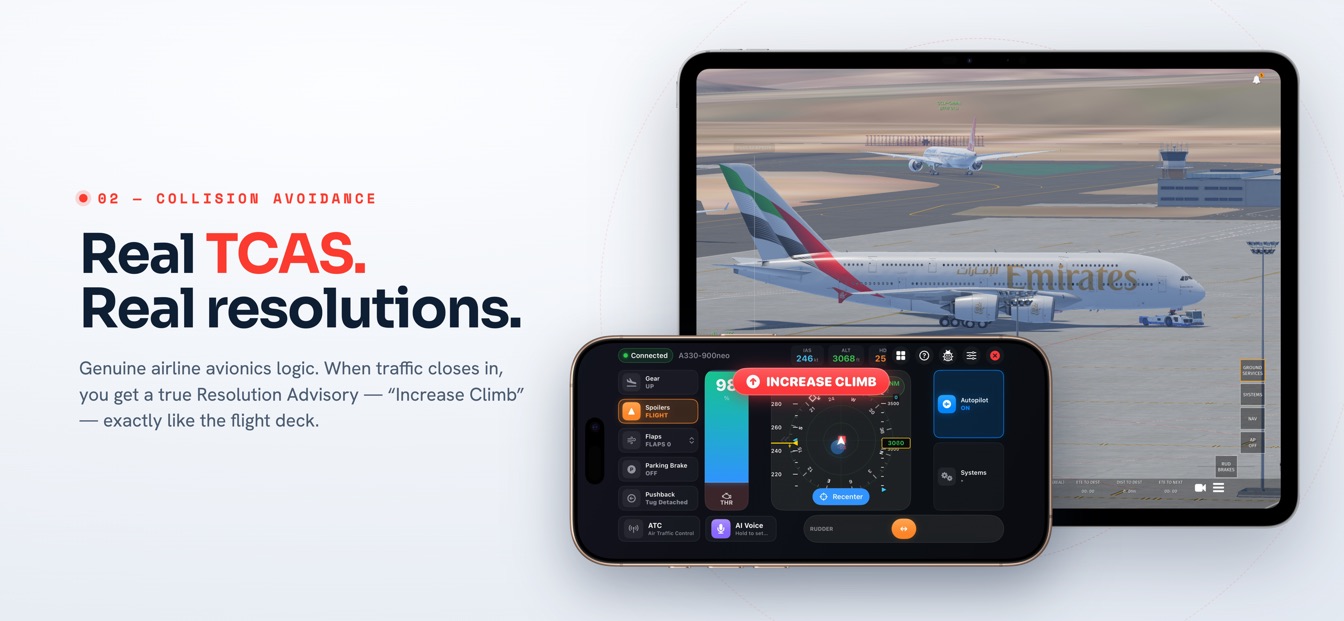
An Airbus-ND-style scope over the yoke pad paints live multiplayer traffic with TCAS II v7.1-style categories and speaks advisories aloud — a display aid, not certified avionics.
A jet this quick reaches 250 kts before you notice. With the autopilot engaged, the Violation Avoidance System arms above 10,000 ft and manages speed on the way down.
That last one matters more on this airframe than most: the -200 accelerates so willingly in a descent that Infinite Flight's 250-kt limit below 10,000 ft sneaks up fast. The Violation Avoidance System clamps your autopilot speed target or trades descent rate to hold the line, announces what it is doing, and hands your dialed speed back afterwards — an aid, never a guarantee. The TCAS scope follows the same philosophy: real logic, spoken advisories, zero pretension of being the real box.
Flying Infinite Flight's 757-200 with your iPhone as the yoke.
It is a way to fly Infinite Flight's 757-200 with a physical-feeling control column instead of taps on glass. SkyYoke turns an iPhone into that yoke: the phone links to Infinite Flight over your home Wi-Fi, and tilting it commands roll and pitch in real time, alongside a throttle, rudder bar and autopilot panel on the same screen.
Closer than you might expect. The Motion Yoke reads gravity relative to a neutral point you set, so rolling your wrists banks the jet and pulling the phone toward you raises the nose — the same gestures a 757 crew makes with the real column. The tilt range adjusts from 15 to 60 degrees, a one-tap recenter resets neutral, and each axis has its own sensitivity, dead zone and response curve.
One lever handles the whole rollout. Touch down, pull the lever into its red zone at 40 knots or above, and SkyYoke holds reverse thrust for you — Infinite Flight normally requires you to keep holding it yourself. As the jet slows below 40 knots, the same travel becomes proportional wheel braking, so a single smooth input carries you from touchdown to taxi speed.
An iPhone on iOS 17.2 or later running SkyYoke, plus a second device on the same Wi-Fi running Infinite Flight with Infinite Flight Connect enabled. You bind the control axes once in Infinite Flight's Controllers settings — an in-app guide walks you through it — then load the 757-200 from Infinite Flight's fleet and fly. No cables, adapters or extra hardware are involved.
No. SkyYoke is an independent, unofficial app and is not affiliated with, sponsored by, or endorsed by Boeing or Infinite Flight LLC. Aircraft names appear only to describe compatibility, and aircraft availability and behavior inside Infinite Flight are determined by Infinite Flight itself. The app's performance figures, callouts and traffic advisories are simulator aids and estimates, never for real-world use.
SkyYoke is available now — download it on the App Store and turn your iPhone into a full flight-sim cockpit.
Download on the App Store Get it on Google Play