TCAS traffic scope
An Airbus-style navigation-display scope over the yoke pad, painting live multiplayer traffic with TCAS II v7.1-style categories and spoken advisories.
The long-fuselage A330 deserves better than taps on glass. SkyYoke turns your iPhone into a wireless A330-300 joystick for Infinite Flight — sidestick, Airbus thrust quadrant and rudder, all flying the widebody over your own Wi-Fi.
An Airbus A330-300 joystick for Infinite Flight is a controller that flies the long-fuselage A330 from a device other than the one running the simulator. SkyYoke builds that controller from your iPhone: tilt the phone — or drag an on-screen stick — to bank and pitch, set thrust through a gated Airbus detent lever, and steer with a rudder bar, all over local Wi-Fi at 60 Hz with no hardware to buy.
Every airliner in Infinite Flight's fleet asks something of your hands, and the A330-300 asks for calm. It is long, heavy and beautifully damped — a jet that rewards small inputs made early and resents big ones made late. That temperament is exactly why an Airbus A330-300 joystick for Infinite Flight is worth choosing deliberately, and why SkyYoke builds one from the most precise instrument you already own: the iPhone in your pocket.
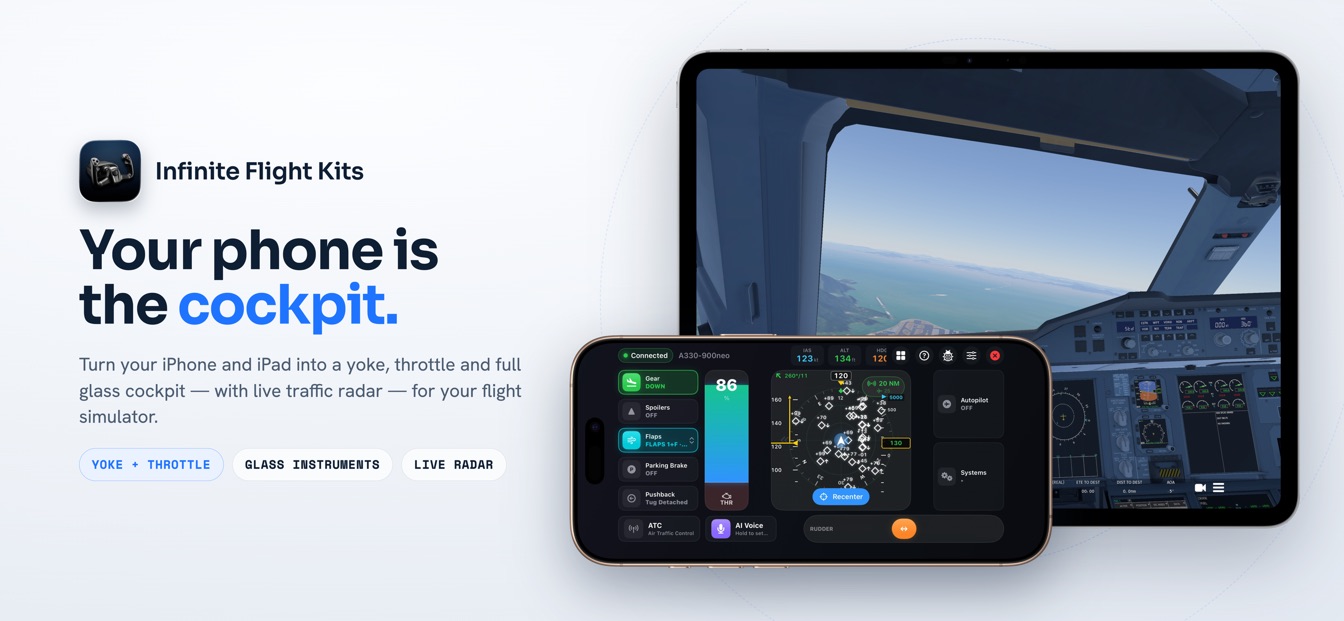
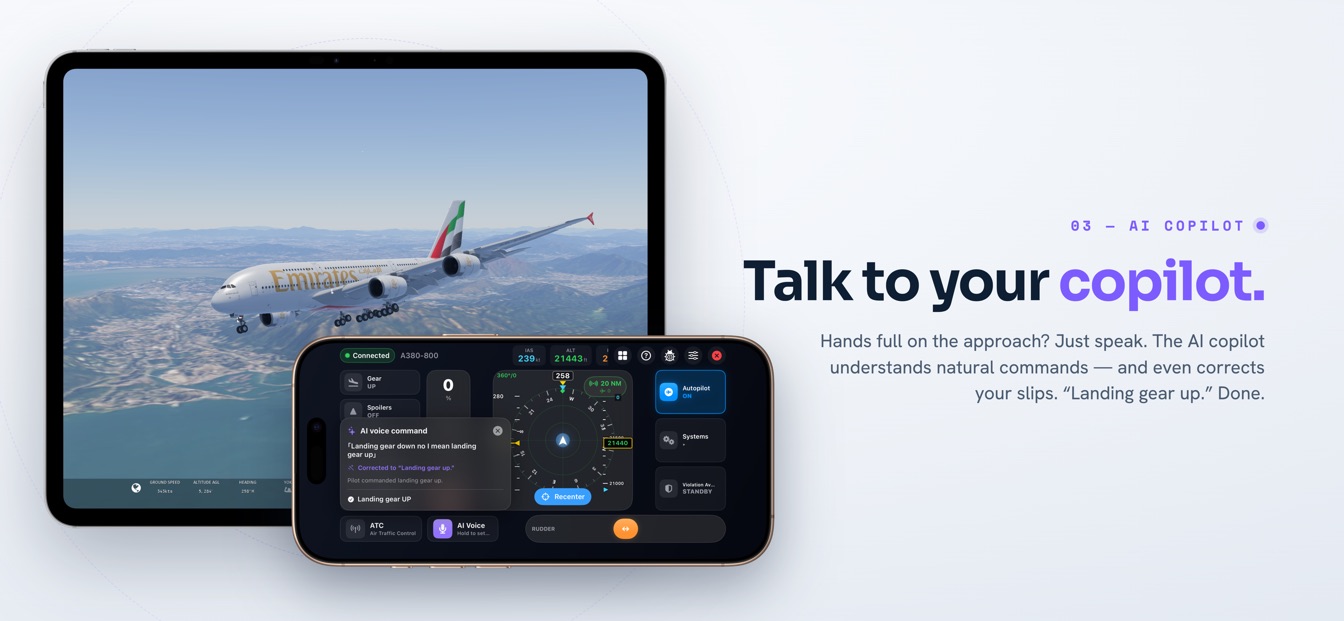
The arrangement is simple. Infinite Flight keeps running on your iPad or other device as the window and the panel, while the phone in your hand becomes the sidestick, the thrust lever and the rudder. The two find each other automatically over your home network through Infinite Flight's Connect API — nothing to pair, nothing to clamp to a desk, nothing extra to charge.
Before the neo generation arrived, there was this: the A330-300, the stretched, high-capacity original of Airbus's big-twin line. Carriers across Asia, Europe and North America made it a fixture of their medium- and long-haul trunk routes, moving dense loads between major hubs behind two large wing-mounted turbofans — airlines ordered theirs with General Electric CF6, Pratt & Whitney PW4000 or Rolls-Royce Trent 700 power. Crews came to prize the qualities passengers never notice: docile handling, honest stability and a forgiving nature when the day goes sideways.
That character survives the trip into the simulator. In Infinite Flight's fleet, the -300 is the widebody you pick when you want a flight to feel stately rather than frantic — and the model whose shorter sibling, the A330-200, trades cabin length for range. Flying the -300 well is mostly an exercise in restraint, which places unusual weight on the quality of whatever is in your hands.
The real A330 is a fly-by-wire Airbus, flown one-handed from a compact sidestick rather than a yoke. A phone held in one hand is far closer to that arrangement than any desk-bolted column — the same logic that makes SkyYoke a natural fit across the family, from the A320 on up. You get two interchangeable stick models:
Whichever you choose, every axis — pitch, roll, yaw and brake — carries its own sensitivity, dead zone, expo curve, inversion, trim and smoothing. For the -300, a touch of expo with some smoothing is the difference between sawing at the stick and the long, patient corrections a stretched widebody actually wants. Underneath it all, a 60 Hz control loop with change detection and rate limiting keeps inputs immediate without flooding the network, and a link watchdog reconnects on its own if your Wi-Fi blinks mid-flight.
Setting thrust on a real Airbus is not about sliding a lever to a percentage — it is about clicking the lever into a gate. SkyYoke recreates that, and it does so automatically: load any Airbus type, the A330-300 included, and the smart throttle becomes a gated quadrant — REV FULL, REV, IDLE, CLIMB, FLX·MCT and TOGA — with a haptic tick each time the lever crosses a gate. Push up to FLX·MCT for a reduced-thrust takeoff, ease back into CLIMB as you clean up, and feel each detent land in your palm without ever glancing down at the phone.
Beneath the gates, the lever keeps its ground sense. Rolling out at 40 knots or faster, pulling into the red zone engages reverse thrust and holds it for you — Infinite Flight normally requires reverse to be held manually. Below 40 knots, the same travel becomes proportional wheel braking for the taxi in. Airborne, reverse is simply blocked, with a warning banner and a repeating haptic so it cannot happen by accident, and the whole lever recolors by role: blue and green for forward thrust, amber for braking, red for reverse.
The essentials of the aircraft, and how SkyYoke maps itself onto them:
| Manufacturer | Airbus |
|---|---|
| Family | A330 — the long-fuselage original of the line |
| Control style | Fly-by-wire sidestick, flown one-handed |
| Engines | Two wing-mounted turbofans (GE CF6, Pratt & Whitney PW4000 or Rolls-Royce Trent 700) |
| Typical role | High-capacity widebody twin on medium- and long-haul trunk routes |
| Stick in SkyYoke | Motion Yoke (gravity tilt) or Touch Joystick, tuned per axis |
| Throttle in SkyYoke | Airbus detent lever — REV FULL / REV / IDLE / CLIMB / FLX·MCT / TOGA with haptic gates |
| Rudder in SkyYoke | Self-centering rudder bar along the bottom of the screen |
A widebody flight is mostly cruise, and cruise is mostly monitoring — so SkyYoke keeps a glass-cockpit layer on the phone while you fly. Live HUD chips track IAS, altitude, heading and vertical speed beside a ground/air phase chip and a spoiler annunciator, while an Airbus-style PFD pairs a speed tape with a trend arrow against an altitude tape, both wearing cyan bugs for your selected targets.
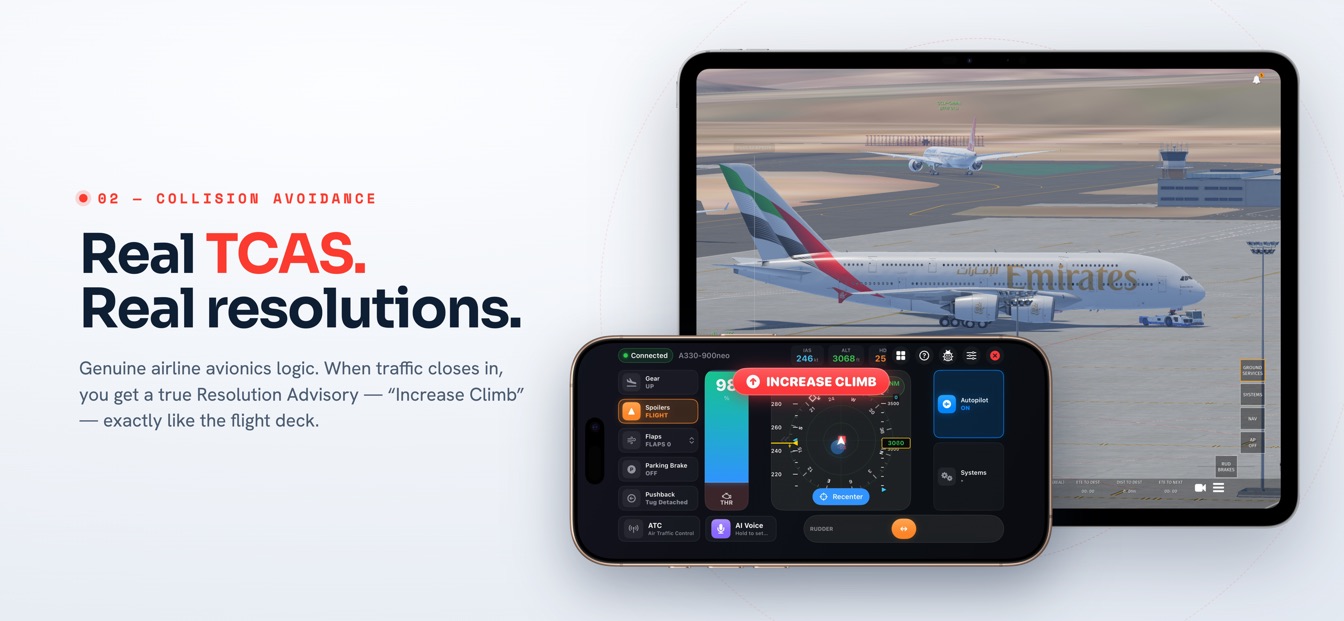
An Airbus-style navigation-display scope over the yoke pad, painting live multiplayer traffic with TCAS II v7.1-style categories and spoken advisories.
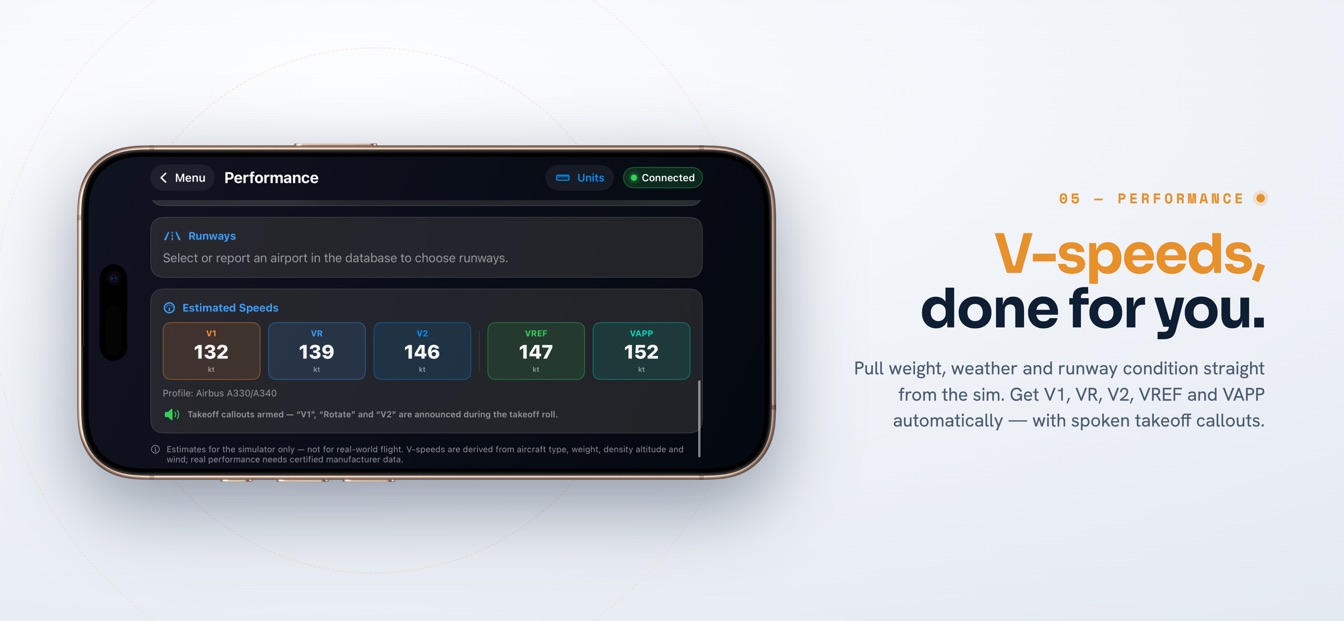
Spoken "V1", "Rotate" and "V2" during the takeoff roll, armed from the Performance screen and re-armed automatically for the next departure.
Watches the 250-knot restriction below 10,000 ft while the autopilot flies, clamping the speed target before the simulator issues a violation.
The scope is the full TCAS for Infinite Flight experience — range rings, relative-altitude tags and "Traffic, traffic" in your ears — while the callouts arm from a Performance screen that holds live weights with an editable what-if loadout, an offline airport database, runway wind components from in-sim weather, and V-speed estimates scaled by weight and density altitude. The Violation Avoidance System stands guard whenever the autopilot is flying an airliner like the -300, clamping the speed target — or trading descent rate for energy — and narrating what it is doing with spoken alerts. Every one of these is a simulator aid built on estimates, not certified avionics.
Flying the A330-300 in Infinite Flight with an iPhone joystick, explained.
It is a controller that flies the A330-300 from outside the device running the simulator. SkyYoke turns an iPhone into that controller: the phone connects over your local Wi-Fi through Infinite Flight's Connect API and acts as a sidestick-style joystick, thrust lever and rudder. You bank and pitch by tilting the phone or with an on-screen pad, with no physical hardware to buy.
Yes. SkyYoke applies its Airbus quadrant automatically when you fly an Airbus type. The throttle becomes a gated lever with REV FULL, REV, IDLE, CLIMB, FLX·MCT and TOGA positions, and a haptic tick fires at every gate crossing, so you can set takeoff or climb thrust by feel without looking away from the simulator.
The real A330 is a fly-by-wire Airbus flown one-handed from a compact sidestick, so a controller you hold in one hand is closer in spirit to its flight deck than any desk-mounted yoke. The A330-300's calm, deliberate handling also rewards SkyYoke's per-axis tuning: add expo and smoothing, and small wrist movements become the smooth, early inputs a long widebody likes best.
Two devices on the same Wi-Fi network: an iPhone on iOS 17.2 or later running SkyYoke, and a second device running Infinite Flight with Infinite Flight Connect enabled. You bind the control axes once in Infinite Flight's Controllers settings, guided by the in-app setup walkthrough, and SkyYoke discovers the simulator automatically. No cables, adapters or extra hardware are involved.
Yes, while the autopilot is engaged. The Violation Avoidance System arms about 2,000 feet above the 250-knot limit that applies below 10,000 feet, then clamps the autopilot speed target or, in a steep descent, idles the throttle and manages the descent rate to keep the A330-300 inside the limit. It explains itself with spoken alerts and a colored annunciator, and it is an aid, never a guarantee.
SkyYoke is available now — download it on the App Store and turn your iPhone into a full flight-sim cockpit.
Download on the App Store Get it on Google Play