Airbus PFD tapes
Speed and altitude tapes with a trend arrow, plus cyan bugs that track your selected targets.
Airbus built the A350-900 around a sidestick; SkyYoke builds the sidestick out of your iPhone. Fly the carbon-fiber XWB in Infinite Flight with a wireless A350-900 joystick — motion or touch control, a gated Airbus thrust quadrant and a live panel, all over your own Wi-Fi.
An Airbus A350-900 joystick for Infinite Flight is what SkyYoke turns your iPhone into: a wireless sidestick for the carbon-fiber XWB flying on another device. Over local Wi-Fi it converts motion tilt or an on-screen pad into pitch and roll, adds a gated Airbus thrust lever, rudder bar and autopilot panel, and needs no extra hardware at all.
Lay a ruler across a globe and pick the city pair that looks unflyable — that is A350-900 territory. Airbus's carbon-fiber XWB flagship operates some of the longest routes on Earth, and its ULR variant links Singapore and New York with no stop in between. In Infinite Flight, that pedigree makes it the aircraft you choose when you want a flight that means something, and SkyYoke gives it a proper set of controls: an Airbus A350-900 joystick for Infinite Flight made from the iPhone already in your pocket, talking to the simulator over your own Wi-Fi.
A leg that long is mostly autopilot, which is precisely why the few minutes you do fly by hand carry so much weight. The rotation out of a heavy departure, the last thousand feet of a dawn approach — these moments want fingertip pressure, not thumb swipes on the same pane of glass that is busy rendering the scenery. Holding a separate controller changes how those minutes feel, and on this aircraft the right controller is not a yoke at all.
The -900 is the founding member of the XWB family and its flagship: a widebody twin built around composite structure and hauled along by a pair of Rolls-Royce Trent XWB turbofans. Up front, the flight deck is famously serene and ultra-modern, its instruments consolidated onto six large displays — an office designed for crews who measure duty days in double digits.
That calm carries into how the airplane is flown. Like every Airbus of its generation, the A350-900 is commanded from a compact sidestick — small deflections, smooth responses, no control column in sight. Find it in Infinite Flight's fleet and that character is yours to explore; if you would rather go even bigger, the four-engine A380-800 gets the same SkyYoke treatment.
Because the real airplane is a sidestick design, your phone is not a compromise here — it is a scale model of the actual control. SkyYoke offers two interchangeable ways to fly it:
Each axis — pitch, roll, yaw and brake — carries its own sensitivity, dead zone, expo curve, inversion, trim and smoothing, so you can give the XWB a soft, damped center for cruise nudges and keep crisp authority at the stops for a gusty flare. A 60 Hz control loop with change-detection and rate limiting keeps inputs immediate without flooding the network, and a link watchdog reconnects automatically if the Wi-Fi hiccups.
Select any Airbus — the A350-900 included — and SkyYoke's single thrust lever automatically reshapes itself into a gated Airbus quadrant: REV FULL / REV / IDLE / CLIMB / FLX·MCT / TOGA. Every gate crossing lands as a haptic tick in your palm, so you can set a takeoff detent or push through to TOGA entirely by feel, eyes on the runway on your other screen, then come back one gate to CLIMB once you are established in the climb-out.
The bottom of the quadrant is just as considered. Infinite Flight wants reverse thrust held, so on the rollout at 40 knots or faster, pulling into the red zone holds reverse for you; once you slow below 40 knots the same travel becomes proportional wheel braking. Airborne, reverse is simply refused — a warning banner and a repeating haptic make sure you know — and the lever recolors by role: blue and green for forward thrust, amber for braking, red for reverse. The whole system is unpacked on the remote throttle page.
| Manufacturer | Airbus |
|---|---|
| Family | A350 XWB — the carbon-fiber widebody twin family; the -900 is its flagship |
| Control style | Sidestick — echoed by SkyYoke's motion tilt or on-screen touch joystick |
| Engines | Two Rolls-Royce Trent XWB turbofans |
| Typical role | Ultra-long-haul flagship routes; the ULR variant flies Singapore–New York nonstop |
| Stick mapping | Phone tilt or touch pad → pitch and roll, tuned per axis |
| Throttle mapping | Gated Airbus quadrant — REV FULL / REV / IDLE / CLIMB / FLX·MCT / TOGA — with haptic gates |
| Rudder mapping | Self-centering rudder bar along the bottom edge of the screen |
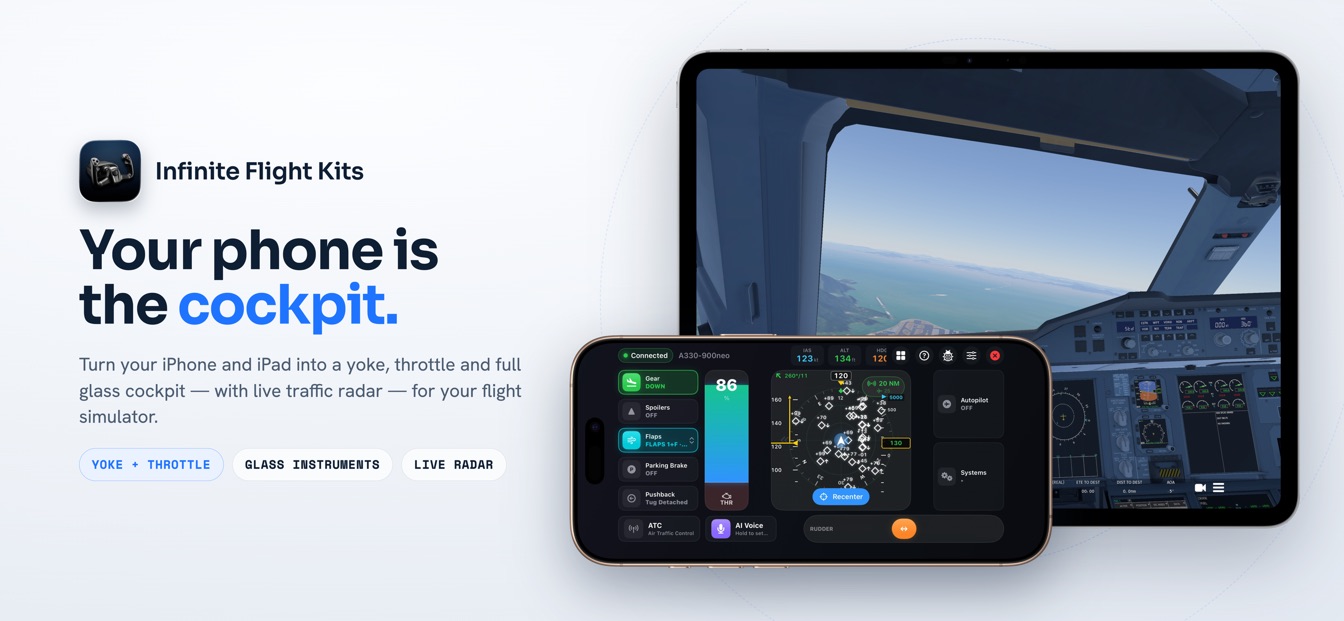
An airplane this clean is flown by its numbers, and SkyYoke keeps them in your peripheral vision while both hands stay on the controls: live IAS, altitude, heading and vertical-speed chips, a ground/air phase chip and a spoiler annunciator, with Airbus-style PFD speed and altitude tapes — trend arrow, cyan selected-value bugs — speaking the same visual dialect as the panel in the real jet.
Speed and altitude tapes with a trend arrow, plus cyan bugs that track your selected targets.
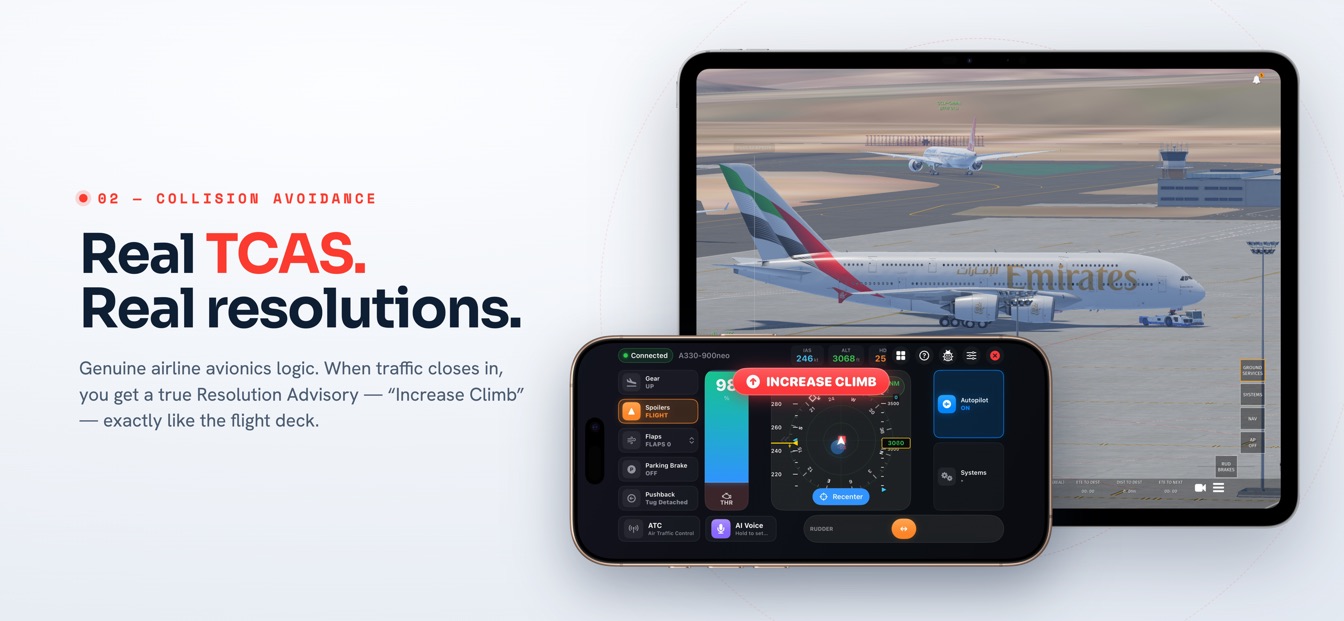
A navigation-display-style scope over the stick pad, drawing live multiplayer traffic in TCAS II-style categories.
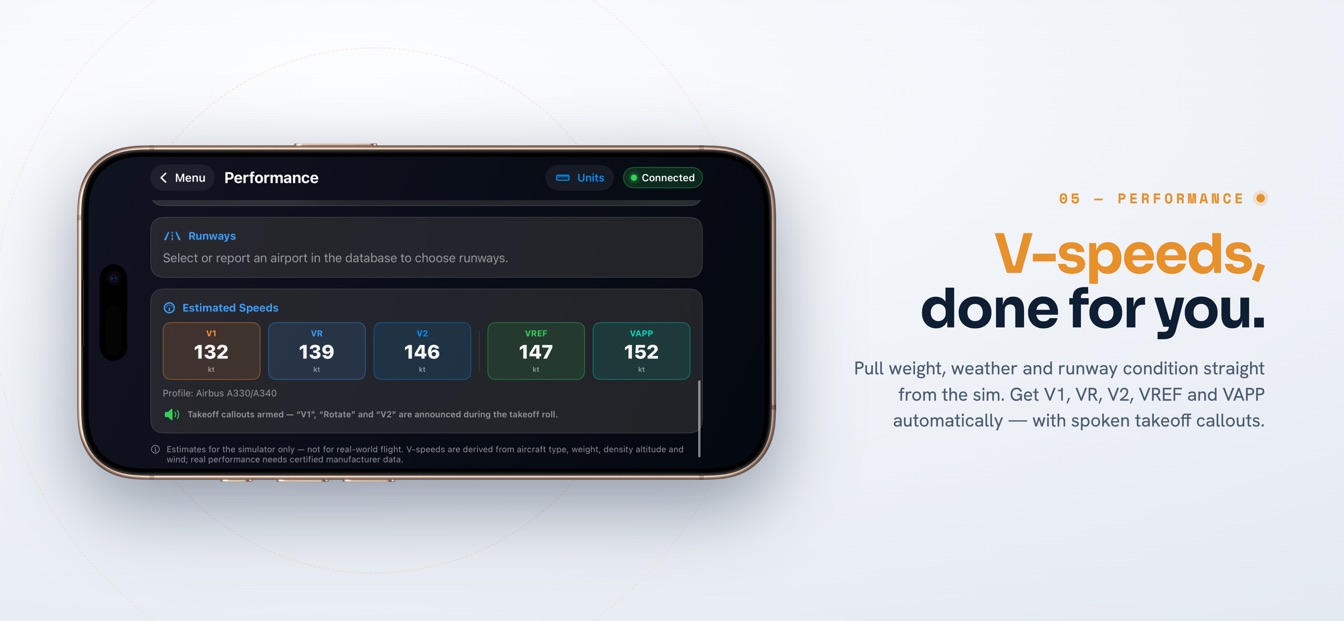
Arm them from the Performance screen and the app calls V1, Rotate and V2 aloud during the roll.
Long descents into busy airspace are where Infinite Flight's overspeed rules catch people out, so the Violation Avoidance System stands watch on airliners like this one: it arms itself roughly 2,000 ft above the 250-knot band and, with the autopilot engaged, either clamps the speed target to 250 knots — remembering what you had dialed — or manages energy by idling the throttle and adjusting the descent until the limit holds. The TCAS scope, the spoken callouts and every V-speed are simulator aids and estimates, never certified avionics, and the protection is an assist rather than a promise.
What simmers ask about flying the XWB from a phone.
It is an iPhone app that becomes a wireless sidestick for the Airbus A350-900 running in Infinite Flight on another device. SkyYoke connects over your local Wi-Fi, sends pitch and roll from motion tilt or an on-screen joystick pad, and adds an Airbus-gated thrust lever, rudder bar and autopilot panel — no physical hardware, just two devices on the same network.
Because the real A350-900 is flown with a compact sidestick rather than a yoke, small wrist inputs are exactly how its pilots command it. A phone held in your hand reproduces that input style naturally: tilt for pitch and roll, with per-axis sensitivity, dead zone, expo, trim and smoothing so the widebody answers with the smooth, measured response the type is known for.
When you load an Airbus type such as the A350-900, SkyYoke's throttle automatically becomes a gated quadrant: REV FULL, REV, IDLE, CLIMB, FLX·MCT and TOGA, with a haptic tick at every gate crossing. You can push to a takeoff detent by feel and pull back to CLIMB at acceleration height, just as the procedure flows on the real flight deck.
While you fly, SkyYoke shows live IAS, altitude, heading and vertical-speed chips plus Airbus-style PFD speed and altitude tapes with cyan selected-value bugs. A TCAS-style traffic scope paints Infinite Flight's live multiplayer traffic, spoken V1, Rotate and V2 callouts can be armed from the Performance screen, and a Violation Avoidance System helps protect against overspeed violations. All of these are simulator aids and estimates, not certified avionics.
No. SkyYoke needs nothing beyond an iPhone on iOS 17.2 or later and the device running Infinite Flight, both on the same Wi-Fi network. It is an independent, unofficial app built on Infinite Flight's public Connect API and is not affiliated with, sponsored by, or endorsed by Infinite Flight LLC or Airbus.
SkyYoke is available now — download it on the App Store and turn your iPhone into a full flight-sim cockpit.
Download on the App Store Get it on Google Play