Live HUD chips
IAS, altitude, heading and vertical speed at a glance, with a ground/air phase chip and a spoiler annunciator.
Infinite Flight's double-deck flagship deserves more than a thumb on glass. With SkyYoke, your iPhone becomes a wireless A380-800 joystick — sidestick, gated thrust quadrant and rudder — flying the superjumbo over your own Wi-Fi.
An Airbus A380-800 joystick for Infinite Flight is an app-based sidestick that lets you hand-fly the double-deck superjumbo from your iPhone while Infinite Flight runs on another device. SkyYoke links the two over local Wi-Fi, turning phone tilt or an on-screen pad into roll and pitch — with a gated Airbus thrust lever to manage all four engines.
Nothing on an Infinite Flight ramp announces itself like the A380-800. Two full-length passenger decks, four engines spread across an enormous wing, a tail rising high above everything parked nearby — the largest passenger airliner ever built simply occupies a different scale. It flies on a different rhythm, too. The superjumbo answers your inputs with calm, unhurried authority, rolling into turns the way a ship changes course and settling onto final with a stateliness no narrowbody can imitate. An Airbus A380-800 joystick for Infinite Flight ought to respect that character, and tapping a flat pane of glass on the same tablet that is busy drawing the scenery sells it short.
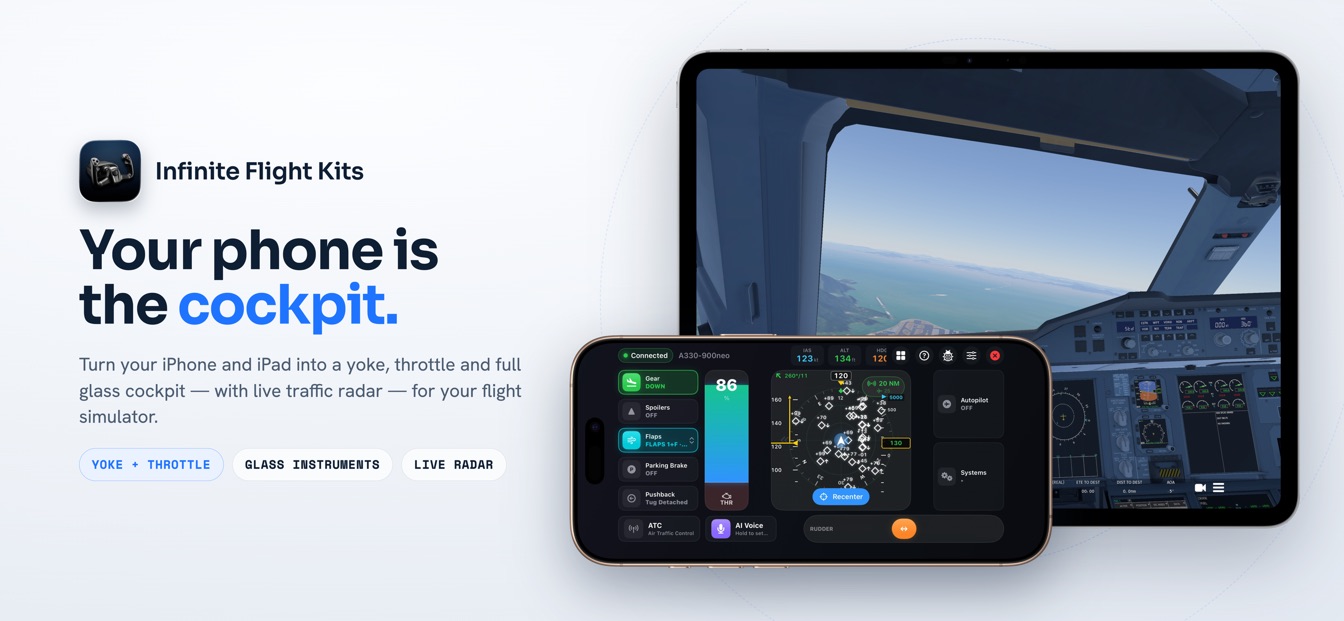
SkyYoke moves the controls into your hand instead. Your iPhone becomes a wireless sidestick, thrust quadrant, rudder and systems panel for Infinite Flight running on another device — talking over your own Wi-Fi, with nothing to plug in and nothing to pair.
The A380-800 is Airbus's grandest idea made real: a double-deck airliner with room for more than 500 passengers, built for flagship long-haul routes where demand outgrows every other airframe. Four turbofans haul all of that mass, and the payoff in any flight deck — real or simulated — is an aircraft that moves with deliberate, almost ceremonial grace. That is what puts it on every simmer's bucket list. Not speed, not agility: presence. In Infinite Flight's fleet, it is the type whose departures get watched and whose landings get judged.
Crucially for this page, it is also a sidestick Airbus. The crews who fly the real one do it one-handed, with a compact stick beside them rather than a yoke in front of them — and that single design decision is why a phone makes such a convincing controller for it. (Prefer Airbus's big twin instead? There is a dedicated A350-900 joystick page, and an overview of the whole lineup on Real Airbus for Infinite Flight.)
SkyYoke gives you two ways to hold the superjumbo, swappable at any time:
Both inputs run through a per-axis tuning chain — sensitivity, dead zone, expo curve, inversion, trim and smoothing for pitch, roll, yaw and brakes — and that chain earns its keep on this aircraft more than on almost any other. A 500-seat airliner rewards small, smooth corrections; dial in a soft expo curve and a touch of smoothing, and your wrist movements reach the flight controls the way a superjumbo captain's would: measured and damped. A 60 Hz control loop with change-detection keeps everything feeling instant on ordinary home Wi-Fi, and a link watchdog reconnects automatically if the network blips.
A real Airbus quadrant is not a smooth slider — it is a row of gates. SkyYoke recreates that automatically whenever you fly an Airbus type: the throttle becomes a gated quadrant with REV FULL / REV / IDLE / CLIMB / FLX·MCT / TOGA positions, and a haptic tick fires each time the lever crosses a gate. Setting takeoff thrust on a heavy A380 departure becomes a physical gesture: push through the clicks to FLX·MCT or TOGA, feel each one land, rotate, then pull back into the CLIMB gate without ever looking down.
The detents are honest about safety as well. After touchdown, the reverse gates hold reverse thrust for you — Infinite Flight expects reverse to be held, so the lever does the holding. In the air, reverse is blocked outright, with a warning banner and a repeating haptic, so a slip of the thumb can never deploy it at altitude.
| Manufacturer | Airbus |
|---|---|
| Family | A380 — the double-deck superjumbo, the largest passenger airliner ever built |
| Control style | Sidestick fly-by-wire — mirrored by a one-handed iPhone in motion or touch mode |
| Engines | Four wing-mounted turbofans |
| Typical role | Flagship long-haul routes carrying 500+ passengers across two decks |
| Stick mapping | Motion tilt (15–60° range, one-tap recenter) or 1:1 touch joystick → roll and pitch, with per-axis tuning |
| Throttle mapping | Gated Airbus quadrant — REV FULL / REV / IDLE / CLIMB / FLX·MCT / TOGA, haptic tick at every gate |
| Rudder mapping | Self-centering rudder bar along the bottom of the screen |
An aircraft this large is flown on numbers and anticipation, so SkyYoke keeps the essentials in front of you while both hands stay on the controls:
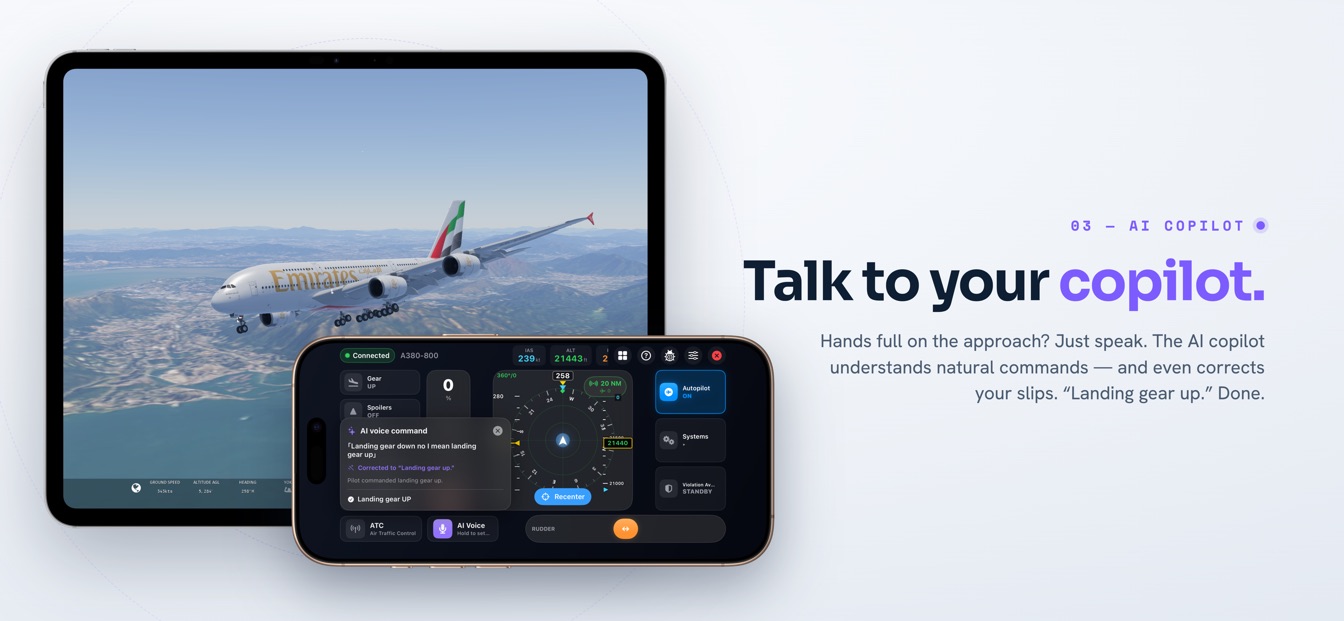
IAS, altitude, heading and vertical speed at a glance, with a ground/air phase chip and a spoiler annunciator.
A speed tape with a trend arrow and an altitude tape, with cyan bugs marking the values you have selected.
An Airbus navigation-display-style scope over the stick pad, painting live multiplayer traffic by TCAS II-style category.
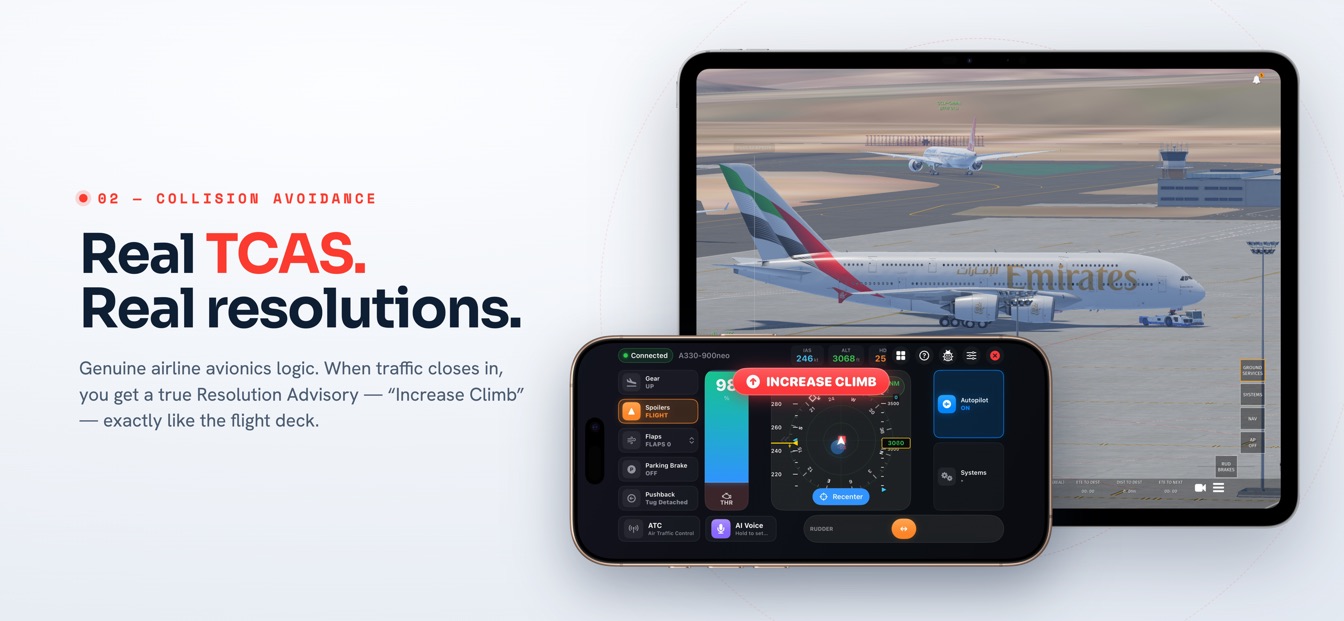
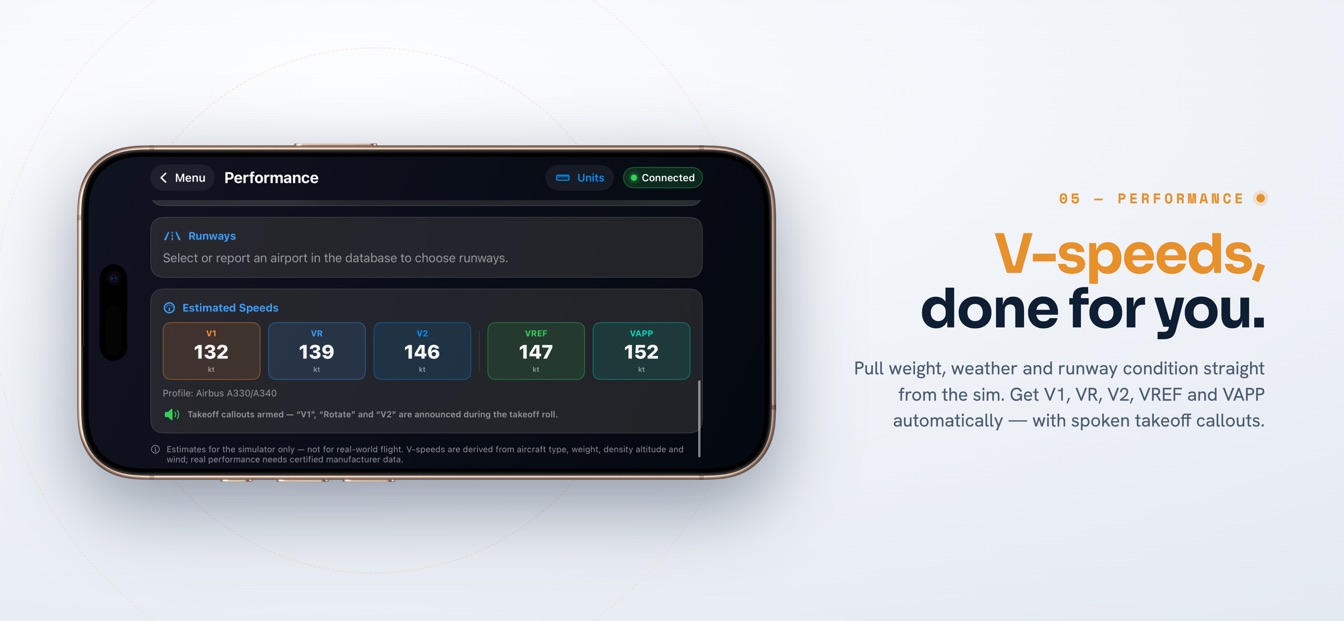
Two more aids matter on a jet this heavy. Estimated V-speeds — computed on the Performance screen from 17 aircraft profiles that run from the Cessna 172 all the way up to the A380, scaled by weight and density altitude — arm automatic spoken "V1", "Rotate" and "V2" callouts for the takeoff roll. And once you descend toward the terminal area, the Violation Avoidance System stands watch over Infinite Flight's 250-knot limit below 10,000 feet while the autopilot flies, clamping the speed target or managing descent energy so a long, heavy descent does not end in an overspeed violation. Both are simulator aids built on estimates, never guarantees — and the traffic logic behind the scope is explained in full on the TCAS for Infinite Flight page.
The superjumbo, your iPhone, and how the two connect.
It is an app that puts the flight controls for Infinite Flight's A380-800 on your iPhone while the simulator runs on another device. SkyYoke links the two over your local Wi-Fi: tilting the phone or dragging an on-screen pad commands roll and pitch on the superjumbo in real time, alongside a gated Airbus-style thrust lever, a rudder bar and an autopilot panel. No physical joystick is needed.
Because the real A380 is flown with a sidestick rather than a yoke, a one-handed controller is the natural match. SkyYoke's Motion Yoke reads gravity, so small wrist movements become smooth, measured inputs — exactly what a large, stately airliner rewards — and per-axis sensitivity, dead zone, expo and smoothing let you soften the response further for heavy-jet handling. A 1:1 touch joystick is available if you prefer the screen.
SkyYoke detects Airbus types automatically and converts its throttle into a gated quadrant with REV FULL, REV, IDLE, CLIMB, FLX·MCT and TOGA detents. A haptic tick fires at every gate crossing, so you can push to TOGA for takeoff or pull back to CLIMB entirely by feel, without taking your eyes off the runway. On the ground, the reverse gates hold reverse thrust for you; in the air, reverse is blocked.
Yes, as an aid. The Violation Avoidance System watches Infinite Flight's 250-knot limit below 10,000 feet for Airbus and Boeing airliners while the autopilot is engaged. It arms about 2,000 feet above the band, then clamps the autopilot speed target to 250 knots — or, in a fast descent, manages energy by idling thrust and adjusting the descent rate — with spoken alerts at each phase. It is a helper, never a guarantee.
No. You need an iPhone on iOS 17.2 or later running SkyYoke, plus a second device on the same Wi-Fi running Infinite Flight with the Connect API enabled. Bind the control axes once in Infinite Flight's Controllers settings — an in-app guide walks you through it — then load the A380-800 from Infinite Flight's fleet and fly. There is nothing to buy, plug in or pair.
SkyYoke is available now — download it on the App Store and turn your iPhone into a full flight-sim cockpit.
Download on the App Store Get it on Google Play