Spoken V-speed callouts
Set weights and runway on the Performance screen and the app calls “V1”, “Rotate” and “V2” aloud during the roll — estimates scaled by weight and density altitude.
Boeing built the 737-900 long; SkyYoke gives it a yoke to match. Your iPhone becomes the control column for Infinite Flight's stretched narrowbody — roll your wrists to bank, pull back to rotate, all live over your own Wi-Fi.
A Boeing 737-900 yoke for Infinite Flight is what SkyYoke makes of your iPhone: a wireless control column for the longest 737NG, connected over your own Wi-Fi. Roll the phone and the jet banks; ease it back at rotation and the stretched fuselage lifts off — with thrust, held reverse, brakes and rudder managed from the same screen.
Taxi a 737-900 to the hold-short line in Infinite Flight and you are sitting at the front of a very long airplane: the final stretch of the 737NG, with rows of seats trailing far behind the wing and a rotation that wants patience rather than muscle. SkyYoke turns the iPhone in your hand into a Boeing 737-900 yoke for Infinite Flight — a control column you actually hold. Roll your wrists and the jet rolls with you; ease the phone back as the speed tape passes VR and that long fuselage follows your hands into the climb.
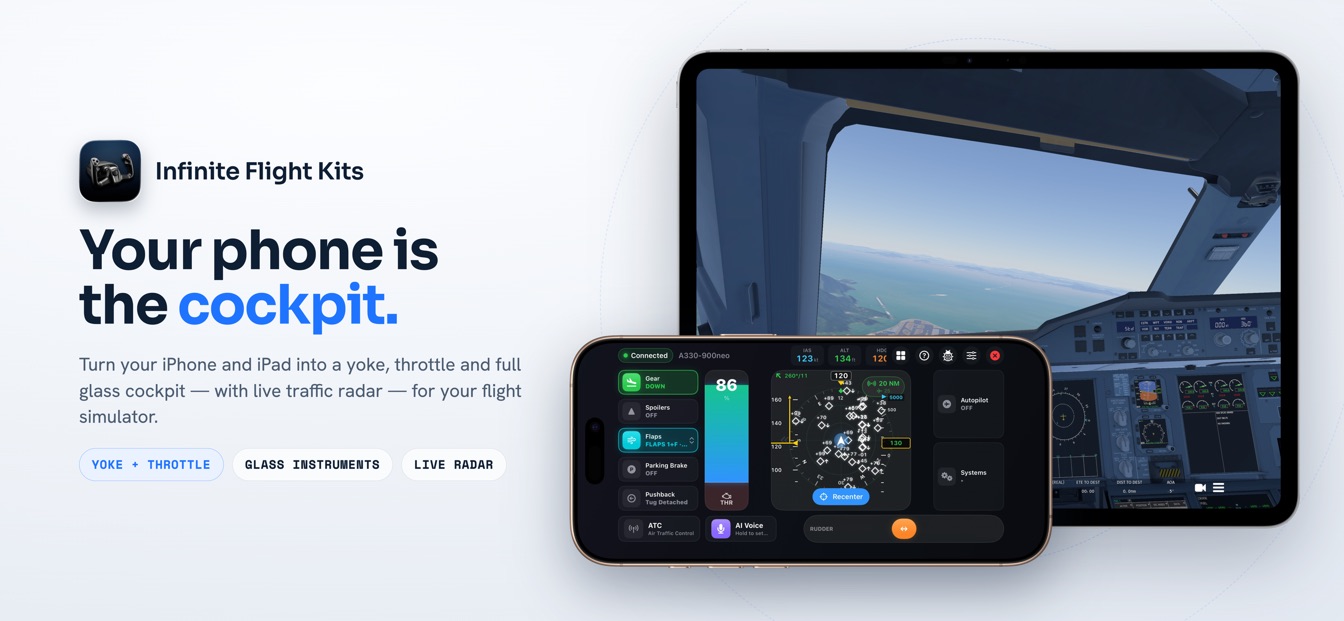
There is nothing to buy and nothing to plug in. Your iPhone and the device running Infinite Flight simply share a Wi-Fi network; SkyYoke discovers the simulator on its own and links up with a tap. The tablet keeps doing what it does best — scenery and instruments — while the flying itself moves into your hands.
The real -900 is the 737NG family taken to its limit, stretching Boeing's single-aisle workhorse toward 180–220 seats. Carriers like Alaska, Delta and United fly it hard on dense domestic trunk routes — the city pairs that need near-widebody capacity at narrowbody economics — behind two wing-mounted CFM56 turbofans and a traditional Boeing control column up front.
All that length is also the airplane's personality. A long fuselage leaves less room between a smooth touchdown and an over-flared one, so the -900 has earned a reputation for rewarding finesse: a deliberate rotation on departure, a shallow and disciplined flare at the other end. It is precisely the sort of airplane that punishes clumsy inputs — and precisely the sort that makes a real yoke feel essential. You will find it in Infinite Flight's fleet alongside its shorter siblings; if the 737-800 is more your length, the same controls carry straight over.
SkyYoke's Motion Yoke never reads raw device angles. It measures the gravity vector against a neutral you define, which makes it grip-independent: hold the phone upright like a Boeing column or leave it flat on your lap, and bank and pitch behave identically, with no gimbal lock anywhere in the envelope. One tap on Recenter captures a fresh neutral whenever you shift position — a habit worth building just before you turn final in the -900.
Every axis then runs through its own tuning chain, so the yoke can be as docile or as crisp as you like:
Rather keep the phone still? Switch to the Touch Joystick: an on-screen, self-centering pad that maps 1:1 and springs back to center the instant you release it. Either way, a self-centering rudder bar runs along the bottom of the screen for crosswind work and taxi steering, and the whole yoke-and-throttle layout lives on a single screen.
The -900's mission is short legs flown often, which means a lot of takeoffs and a lot of rollouts. SkyYoke condenses all of it into one smart lever. Push it forward and you command 0–100% thrust, with a haptic tick marking the idle detent on the way back. After touchdown, at 40 knots or above, pulling into the red zone engages held reverse thrust — Infinite Flight expects you to keep holding reverse, so the lever holds it for you while you steer. As the rollout decays below 40 knots, the same red travel hands over to proportional wheel braking, letting you judge exactly how hard to slow for the high-speed exit.
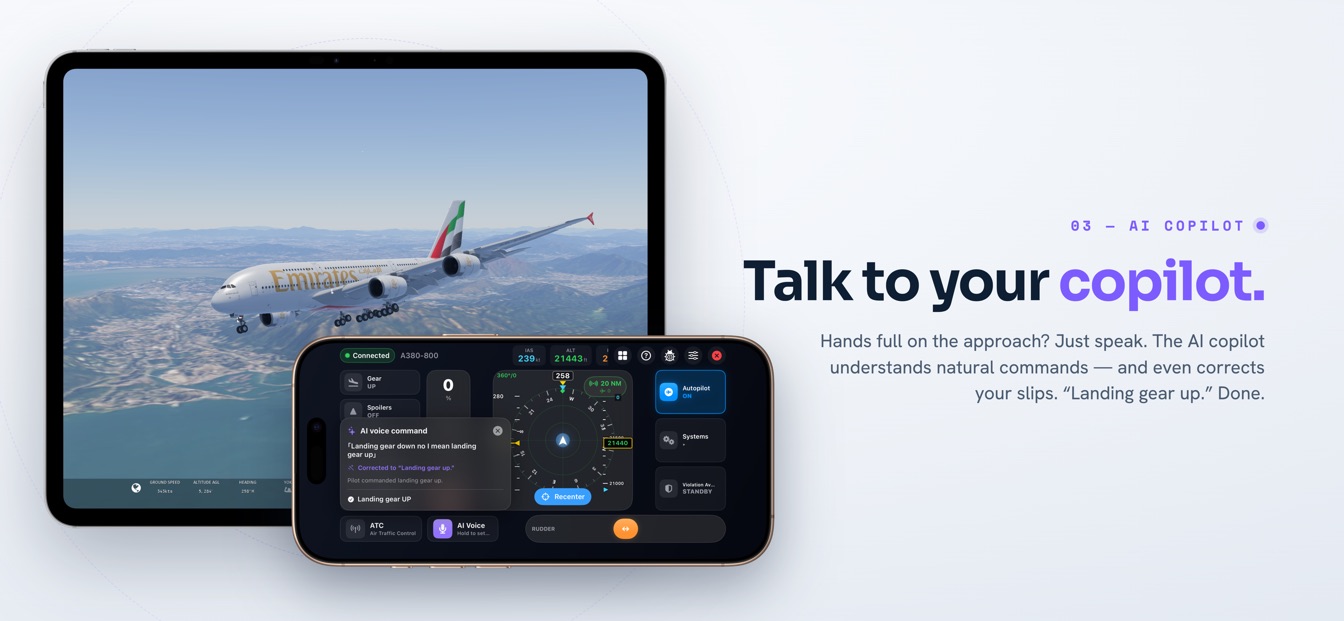
The lever recolors as its role changes — blue and green for forward thrust, amber for braking, red for reverse — and in the air, reverse is simply blocked, with a warning banner and a repeating haptic if you try. One hand, one lever, the whole arrival.
| Manufacturer | Boeing |
|---|---|
| Family | 737 Next Generation — the longest NG variant |
| Control style | Yoke — a traditional Boeing control column |
| Engines | 2 × wing-mounted CFM56 turbofans |
| Typical role | Dense domestic trunk routes, roughly 180–220 seats |
| Yoke in SkyYoke | Motion Yoke tilt (grip-independent gravity sensing) or on-screen touch pad |
| Throttle in SkyYoke | Single smart lever: forward thrust, held reverse, proportional braking below 40 kts |
| Rudder in SkyYoke | Self-centering rudder bar for yaw, crosswinds and taxi steering |
Flying the -900 the way the airlines do means several takeoffs a day, several descents through the 250-knot band and several arrivals into crowded airspace. SkyYoke keeps the supporting cast on the same screen as the yoke:
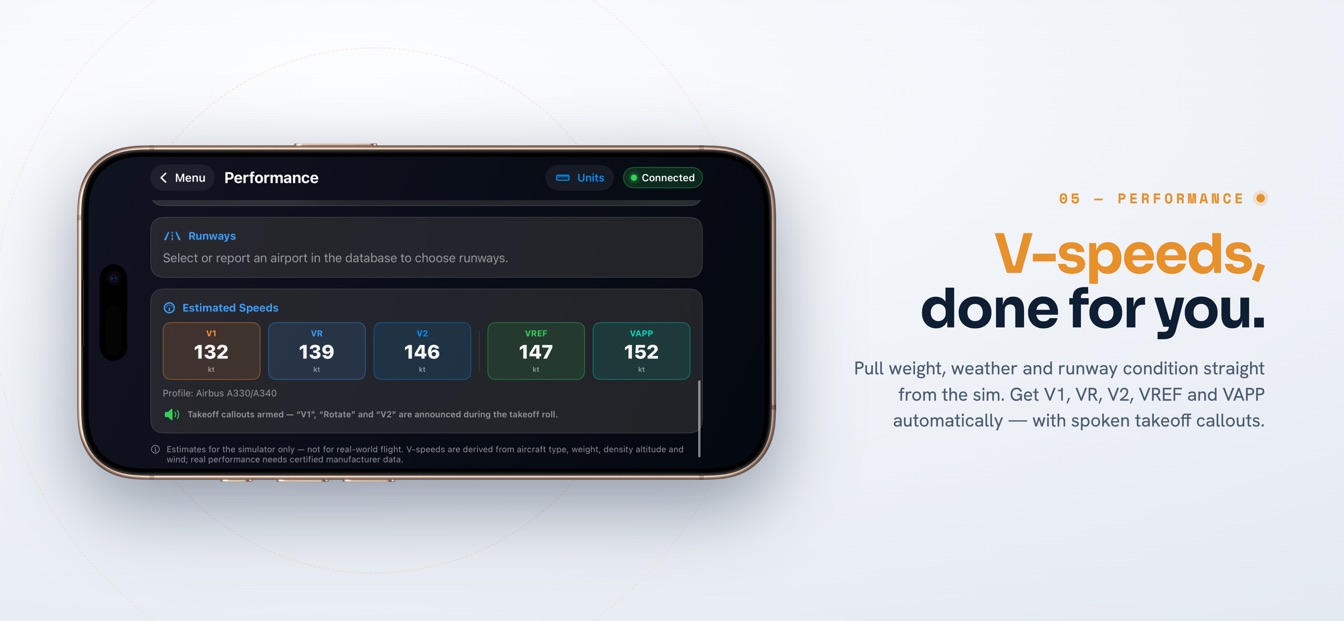
Set weights and runway on the Performance screen and the app calls “V1”, “Rotate” and “V2” aloud during the roll — estimates scaled by weight and density altitude.
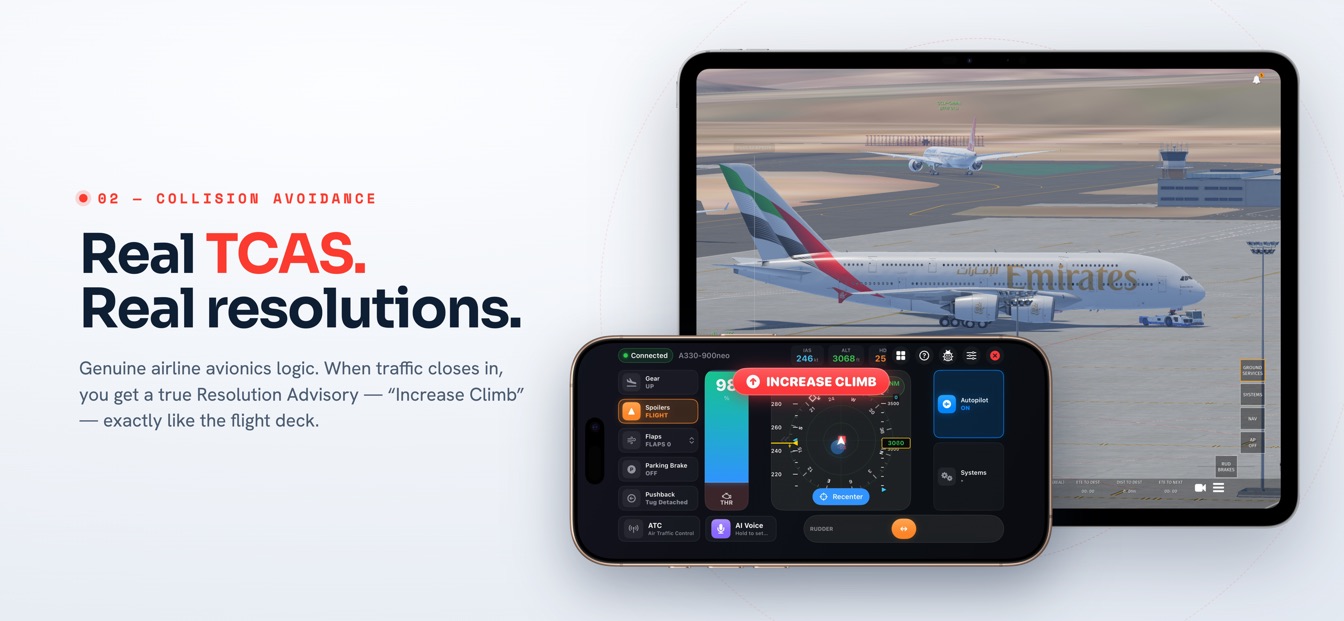
A navigation-display-style scope over the yoke pad tracks Infinite Flight's live multiplayer traffic, from open diamonds to amber advisories and red resolution alerts.
While the autopilot flies, VAS arms ahead of the 250-knot band below 10,000 ft and clamps the speed target — or idles and levels off — with spoken alerts.
On the glass itself, live IAS, altitude, heading and vertical-speed chips ride above the controls, with PFD-style speed and altitude tapes, a trend arrow and cyan bugs for your selected targets. The systems panel handles the cockpit flow — battery, APU, exterior lights, seat-belt signs, autobrake, engine start — and only shows the controls the current aircraft actually exposes. The traffic scope and the violation avoidance system are simulator aids, not certified avionics — helpful eyes, never a guarantee.
Flying the Boeing 737-900 in Infinite Flight with your iPhone as the yoke.
It is an iPhone app — SkyYoke — that turns your phone into a wireless control column for the Boeing 737-900 in Infinite Flight running on another device. Over your own Wi-Fi, rolling the phone banks the jet and pulling it back raises the nose, while a smart throttle lever, rudder bar and autopilot panel cover the rest of the flight. No physical hardware is required.
The Motion Yoke reads the gravity vector relative to a center you choose, so it is grip-independent and never hits gimbal lock. For the stretched 737-900, whose long body rewards a gentle, measured flare, you can tighten pitch sensitivity, add an expo curve for fine control near neutral, and apply smoothing — then tap Recenter to capture a fresh neutral before every approach.
Yes. SkyYoke's smart throttle pushes from idle to full thrust for takeoff. After touchdown, at 40 knots or above, pulling the lever into the red zone engages held reverse thrust — Infinite Flight normally requires reverse to be held, and the lever holds it for you. Below 40 knots that same red zone becomes proportional wheel braking, so one hand manages the entire rollout.
Yes. On the Performance screen you set weights and pick a runway, and SkyYoke estimates V1, VR, V2, VREF and VAPP from aircraft profiles scaled by weight and density altitude. Arm the callouts and the app speaks “V1”, “Rotate” and “V2” during the takeoff roll, firing once per departure and re-arming automatically. The figures are simulator estimates only and never for real-world use.
No. SkyYoke is an independent, unofficial app built on Infinite Flight's public Connect API. It is not affiliated with, sponsored by, or endorsed by Boeing or Infinite Flight LLC. Aircraft availability and aircraft features inside Infinite Flight are determined by Infinite Flight itself; SkyYoke supplies the controls and flight-deck aids on your iPhone.
SkyYoke is available now — download it on the App Store and turn your iPhone into a full flight-sim cockpit.
Download on the App Store Get it on Google Play