Spoken V-speeds
Arm callouts on the Performance screen and the app calls "V1… Rotate… V2" during the roll — once per departure, re-armed automatically for the next leg.
The most popular Dreamliner deserves better than a slider. SkyYoke turns your iPhone into the 787-9 yoke for Infinite Flight — tilt to bank that long composite wing, pull to rotate, over your own Wi-Fi with nothing extra to plug in.
A Boeing 787-9 yoke for Infinite Flight is a way to hand-fly the simulator's most popular Dreamliner with a real control column instead of touchscreen sliders. SkyYoke builds that yoke from your iPhone: gravity-sensed tilt becomes roll and pitch at 60 Hz over your local Wi-Fi, so the 787-9 banks when you roll your wrists and rotates when you pull back — no hardware required.
Every 787-9 departure has the same tell. Halfway down the runway the long composite wing starts carrying the airplane before the wheels admit it — the raked tips rise, the span bows into its signature arc, and rotation follows almost gently for something this size. Infinite Flight renders that moment beautifully; what a touchscreen cannot give you is your part in it. A Boeing 787-9 yoke for Infinite Flight puts your hands back into the maneuver. With SkyYoke, the iPhone between your palms becomes the Dreamliner's control column: roll your wrists and the -9 rolls with you, ease the phone back at VR and that stretched fuselage rotates exactly as deliberately as you ask it to.
Stretched is the operative word. The -9 carries more airplane behind the main gear than the original Dreamliner did, and good 787 pilots rotate it with patience rather than a snatch. Fine, measured pitch input is precisely what a thumb on glass is worst at — and precisely what a motion yoke exists to restore.
Of the three Dreamliners, the -9 is the one the order books kept rewarding. It stretches the original -8 while flying farther on its fuel, and that combination — more cabin, longer legs, better economics — is the exact arithmetic that opens long, thin routes a bigger jet could never justify. The result is the modern long-haul default: dozens of operators, from ANA to United to Air New Zealand, reach for a 787-9 when a city pair needs a widebody that earns its keep.
Under that flexing wing sit two large turbofans — General Electric GEnx or Rolls-Royce Trent 1000, depending on the customer — pushing a carbon-fiber airframe shaped around efficiency. And up front, despite a flight deck that is fly-by-wire from nose to tail, Boeing kept the control column. The 787-9 is flown with a yoke in both hands, which makes it a natural partner for a controller you also hold in both hands. The same approach carries straight over to its shorter sibling, the original 787-8, and to the even longer 787-10.
SkyYoke's Motion Yoke does not care how you sit. Instead of reading raw rotation angles, it measures the gravity vector against a neutral you choose — so the phone behaves identically flat on a lap, propped on a tray table or held upright like the column itself, and it can never wander into gimbal lock. You decide how much lean equals full deflection, anywhere from a relaxed 60° to a razor-quick 15°, and a one-tap Recenter captures a fresh neutral the instant you shift in your seat.
Each axis then passes through its own conditioning chain, so the -9 can feel like the stately widebody it is:
Prefer zero motion? The Touch Joystick swaps tilt for an on-screen, self-centering pad: 1:1 response that springs back to center the instant your thumb lifts. Both controls draw the roll and pitch you are commanding live on the screen, and both pair with the self-centering rudder bar along the bottom edge for crosswind corrections and taxi steering.
A long-haul departure begins heavy and the rollout at the far end arrives fast, so the throttle has real work at both ends of the flight. SkyYoke gives the 787-9 a single smart lever — the same one behind the remote throttle. Slide it forward for 0–100% thrust, with a haptic tick marking the idle detent so your thumb finds it without looking, and watch the lever recolor by role: blue and green for forward thrust, amber for braking, red for reverse. Peripheral vision alone tells you what your hand is commanding.
Touchdown is where the lever earns its name. Pull through idle into the red zone at 40 knots or faster and the app engages held reverse thrust — Infinite Flight insists that reverse be held continuously, so SkyYoke holds it for you while you keep the big twin tracking the centerline. As the rollout decays below 40 knots, that same red travel hands off to proportional wheel braking, walking you down to taxi speed in one motion. Try the red zone in flight and nothing moves: in-air reverse is locked out by design, announced with a warning banner and a repeating haptic.
| Manufacturer | Boeing |
|---|---|
| Family | 787 Dreamliner — the most popular of its three variants |
| Control style | Yoke — a traditional Boeing control column on a fly-by-wire flight deck |
| Engines | 2 × General Electric GEnx or Rolls-Royce Trent 1000 turbofans |
| Typical role | Long-haul widebody; the modern long-haul default for dozens of airlines, from ANA to United to Air New Zealand |
| SkyYoke mapping | Motion Yoke (or Touch Joystick) for roll and pitch; one smart throttle lever for thrust, held reverse and proportional braking; bottom rudder bar for yaw and steering |
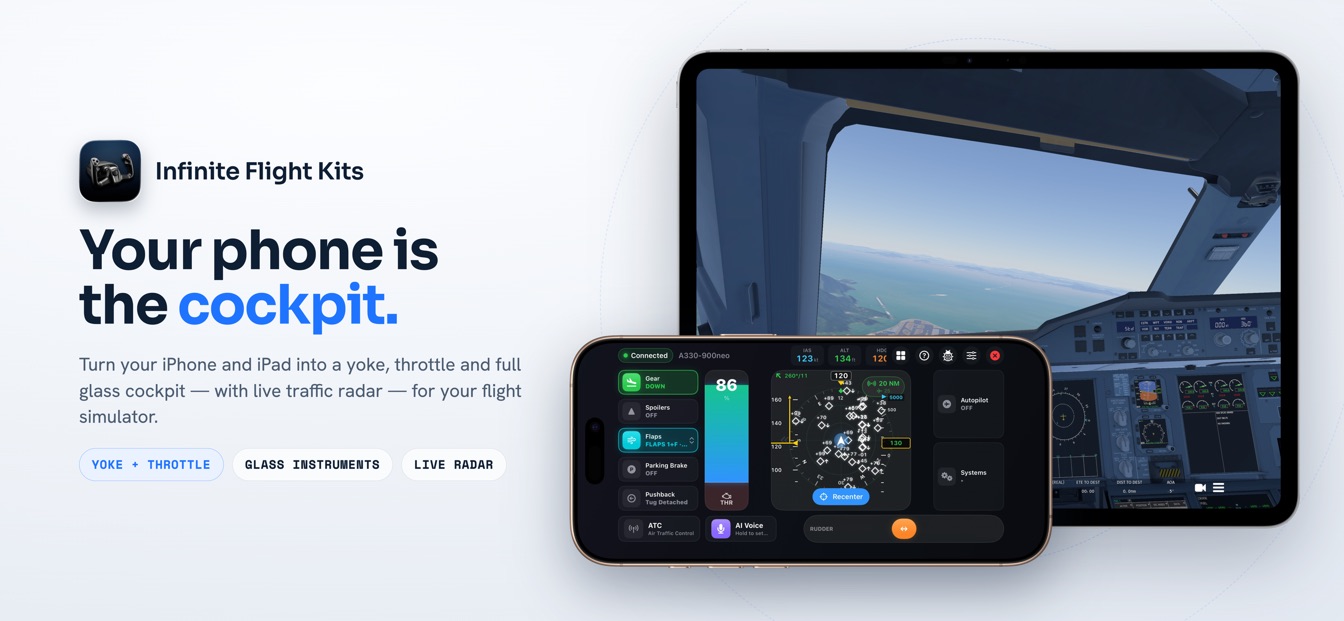
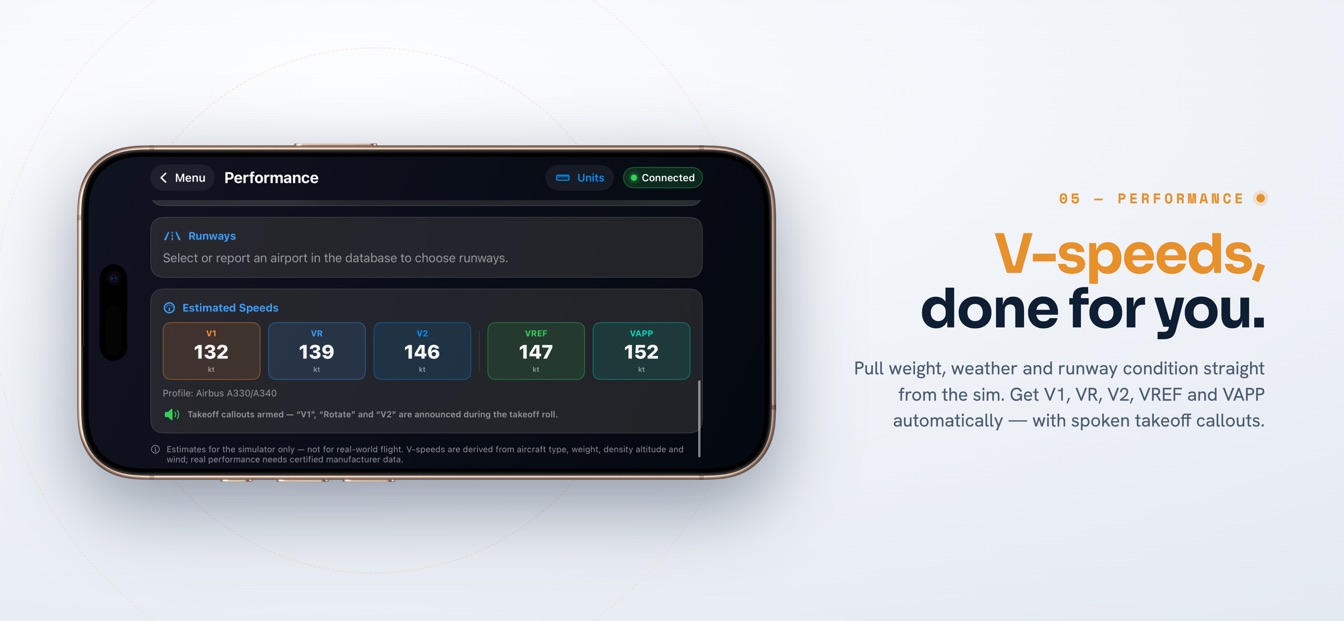
Hand-flying is the headline, but a widebody departure is briefed, not improvised. Open the Performance screen before you taxi and SkyYoke reads your weights live from the simulator, lets you run what-if loadouts against an MTOW bar, pulls headwind and crosswind components from in-sim weather for your chosen runway, and estimates V1, VR, V2, VREF and VAPP from its built-in aircraft profiles — scaled by weight and density altitude, with a runway-length adequacy check on top.
Arm callouts on the Performance screen and the app calls "V1… Rotate… V2" during the roll — once per departure, re-armed automatically for the next leg.
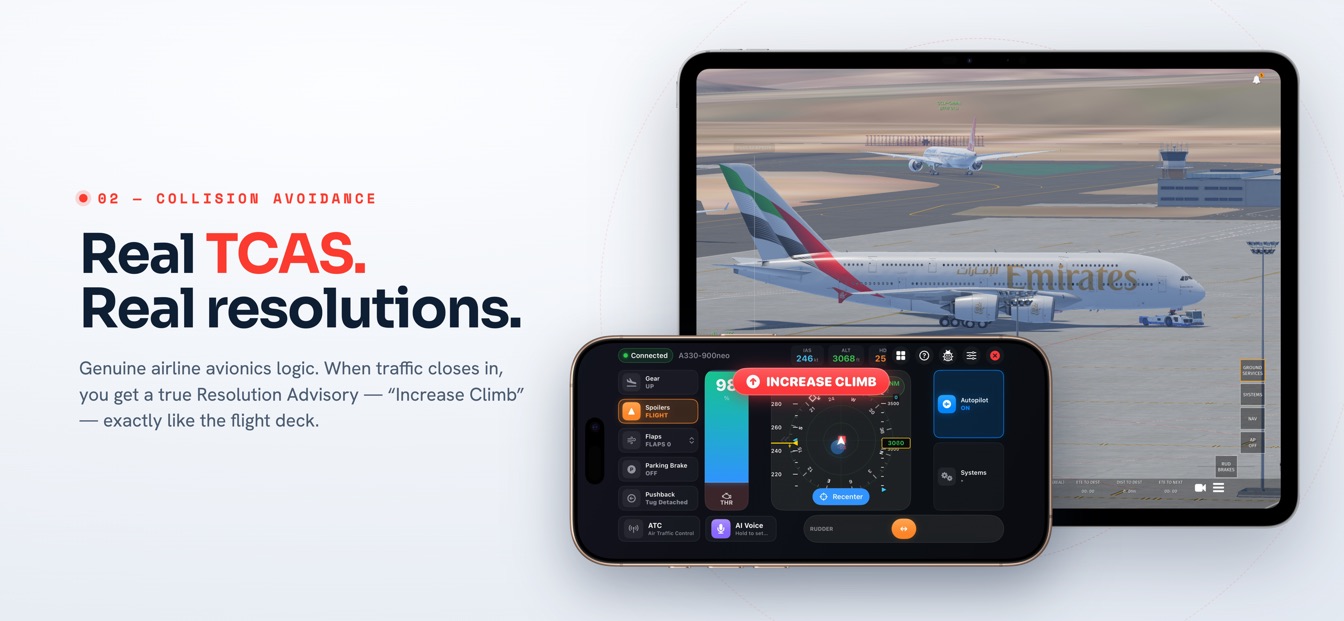
A navigation-display-style TCAS scope draws live multiplayer traffic over the yoke pad, classifies every contact and speaks advisories aloud.
While the autopilot flies, VAS watches the 250-knot limit below 10,000 ft and clamps the speed target or manages descent energy — an aid, never a guarantee.
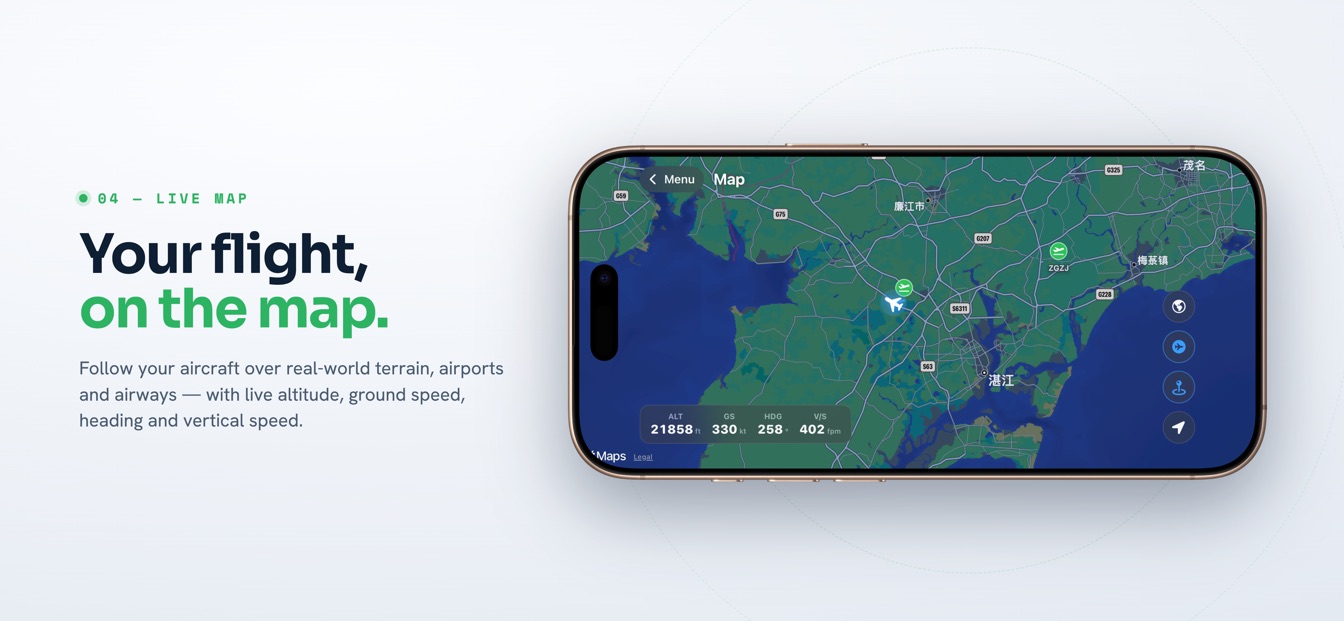
In the cruise, the HUD keeps IAS, altitude, heading and vertical speed in live chips while PFD-style tapes add a speed-trend arrow and cyan bugs at your selected values. The systems panel walks the flows a widebody deserves — battery, APU, engine start, exterior lights, autobrake, cabin signs — and hides any switch the current aircraft does not expose. And on descent into a busy hub, the Violation Avoidance System and the TCAS traffic scope are already watching the band before you reach it.
Quick answers about flying the 787-9 in Infinite Flight with an iPhone yoke.
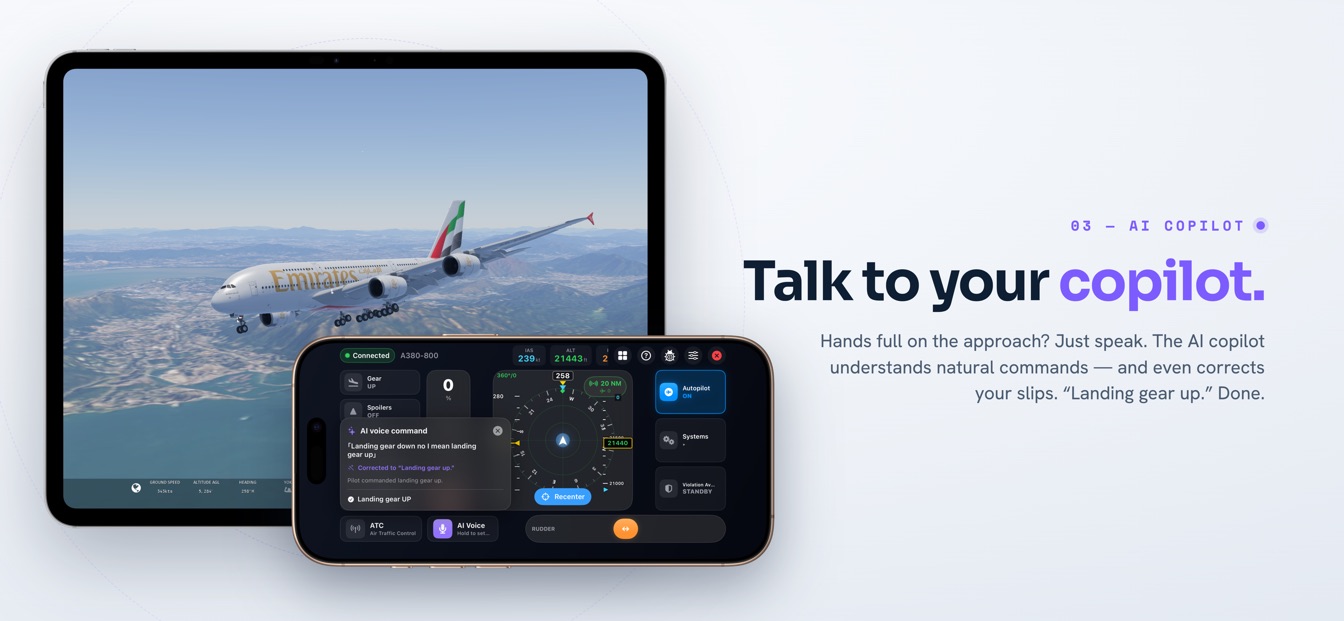
It is a control-column setup for hand-flying the 787-9 in Infinite Flight rather than steering it with on-screen sliders. SkyYoke creates one from your iPhone: gravity-based tilt becomes roll and pitch, sent to the simulator over your local Wi-Fi at 60 Hz, so the Dreamliner banks when you roll the phone and rotates when you pull back — with no physical hardware to buy.
A yoke. The 787 family is fly-by-wire from end to end, yet Boeing kept the traditional two-handed control column in the Dreamliner's flight deck. SkyYoke recreates that feel on the 787-9: hold the iPhone like the column, roll your wrists to bank, and tilt toward or away from you to pitch — with a one-tap Recenter whenever you change grip.
Through one lever. Pull the smart throttle into its red zone at 40 knots or above after touchdown and SkyYoke engages held reverse thrust — Infinite Flight requires reverse to be held, and the lever holds it for you. Below 40 knots the same travel becomes proportional wheel braking. In the air, reverse is blocked outright, with a warning banner and a repeating haptic so it can never fire by accident.
An iPhone on iOS 17.2 or later for SkyYoke, plus a second device on the same Wi-Fi running Infinite Flight with Infinite Flight Connect enabled. You bind the control axes once in Infinite Flight's Controllers settings — the in-app setup guide walks you through it — then choose the 787-9 from Infinite Flight's fleet and fly. The optional AI Voice Copilot additionally needs an Apple-Intelligence-capable iPhone on iOS 26.
No. SkyYoke is an independent, unofficial iPhone app built on Infinite Flight's public Connect API. It is not affiliated with, sponsored by, or endorsed by Boeing or Infinite Flight LLC; aircraft names appear only to describe compatibility. The app is available now on the App Store.
SkyYoke is available now — download it on the App Store and turn your iPhone into a full flight-sim cockpit.
Download on the App Store Get it on Google Play