Spoken V-speeds
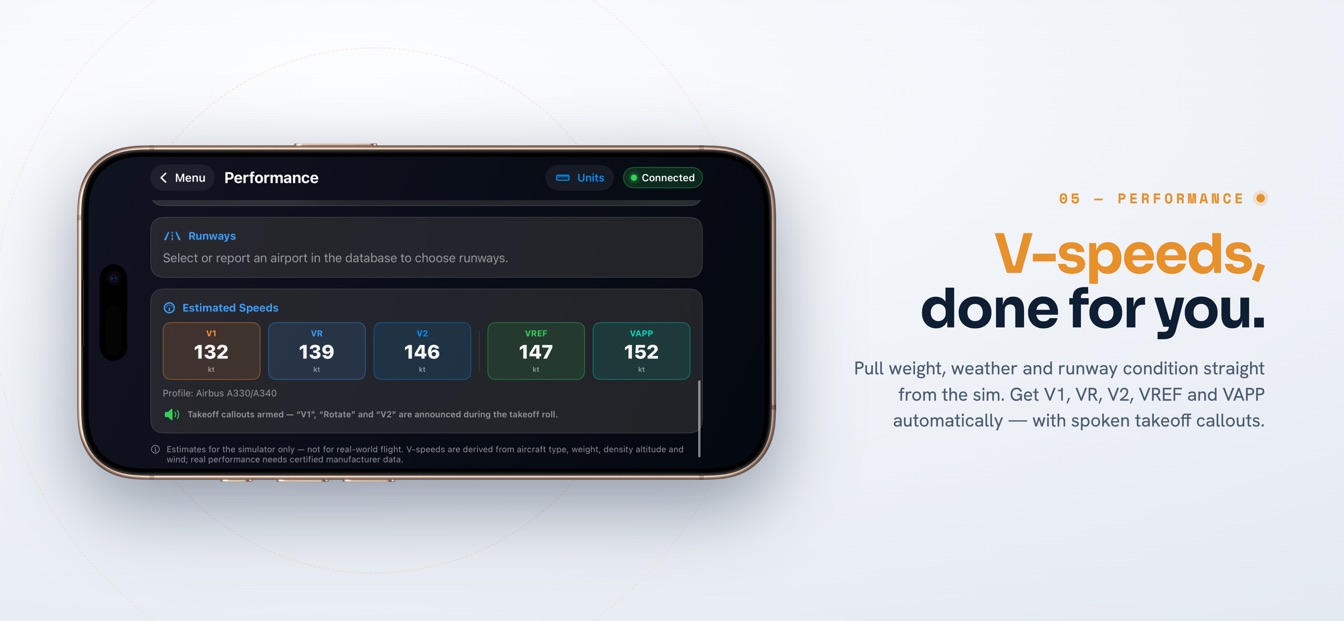
Arm callouts on the Performance screen and hear V1, Rotate and V2 during the roll, estimated from weight, runway and weather.
Infinite Flight's longest Dreamliner deserves better than a thumb on glass. SkyYoke makes your iPhone a wireless 787-10 yoke — roll your wrists to bank, pull to rotate, all over your own Wi-Fi with nothing to buy.
A Boeing 787-10 yoke for Infinite Flight is an iPhone that has taken over the control column: SkyYoke links to Infinite Flight across your local Wi-Fi and translates the phone's tilt — or a drag on its self-centering touch pad — into live roll and pitch for the largest Dreamliner, with a smart throttle, rudder bar and autopilot panel sharing the screen.
Line the Boeing 787-10 up on a long runway in Infinite Flight and you can sense the stretch behind you — the longest Dreamliner in the family, a composite wing flexing at the tips, a cabin sized to move serious numbers of people. A Boeing 787-10 yoke for Infinite Flight puts that airplane in your hands properly: SkyYoke turns your iPhone into the control column, so the slow, deliberate rotation this jet asks for comes from your wrists instead of a slider on a touchscreen.
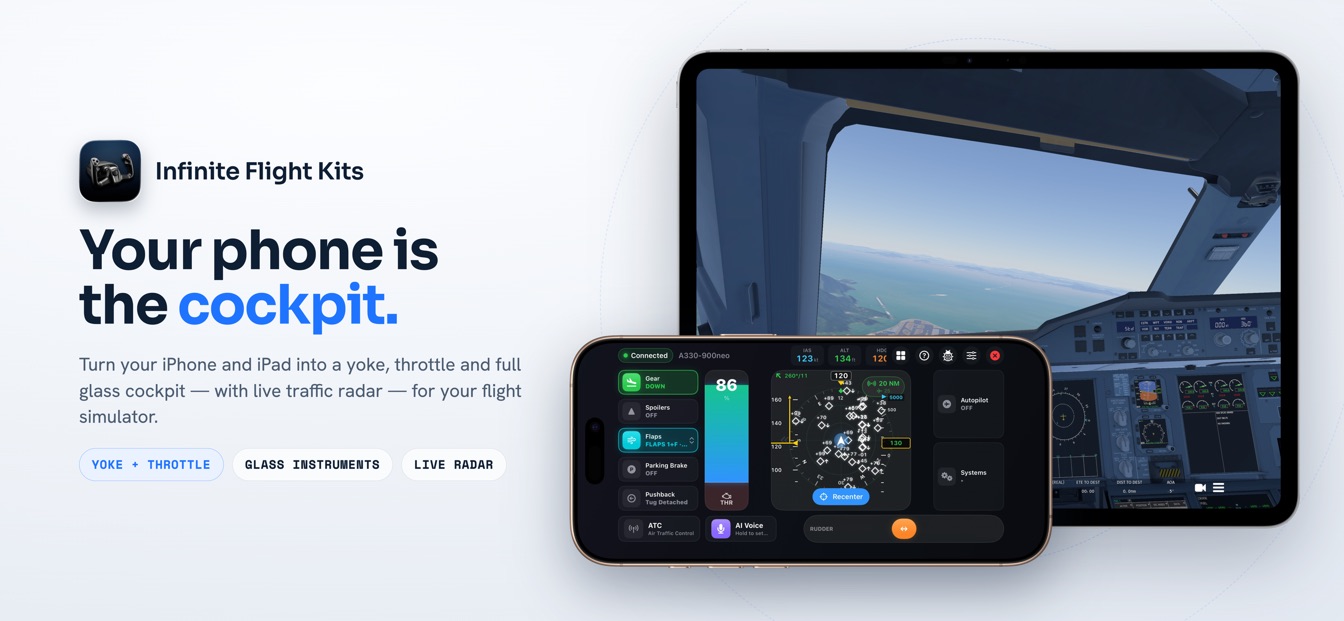
Everything travels over your own network. The phone carries the yoke, throttle, rudder and panel; the device running Infinite Flight stays a clean, full-screen view of that long fuselage tracking the centerline. And if you also fly the shorter 787-8 or the mid-size 787-9, the exact same setup carries straight across the family.
The 787-10 is the full-stretch member of the Dreamliner line, built for one very specific job: dense, medium-to-long-haul trunk routes where every seat counts. It delivers the best seats per gallon in the 787 family, which is why carriers on high-density Asian and transatlantic networks have made it a favorite — maximum cabin for the fuel burned, on routes flown again and again.
| Manufacturer | Boeing |
|---|---|
| Family | 787 Dreamliner — the longest of the three variants |
| Control style | Yoke (conventional Boeing control column) |
| Engines | 2 × high-bypass turbofans (GEnx-1B or Trent 1000 on the real aircraft) |
| Typical role | Dense medium-to-long-haul trunk routes |
| Yoke in SkyYoke | Motion Yoke (tilt) or Touch Joystick → roll and pitch |
| Throttle in SkyYoke | Smart lever → 0–100% thrust, held reverse, proportional brakes |
| Rudder in SkyYoke | Self-centering rudder bar → yaw and ground steering |
Rest the phone flat on your lap or hold it upright like a column — SkyYoke does not mind, because the Motion Yoke measures the gravity vector against a neutral you choose rather than raw device angles. That makes it grip-independent and free of gimbal lock. Roll your wrists and the long wing answers; ease the top of the phone toward you at rotation speed and the nose rises. Shift in your seat mid-flight? One tap on Recenter captures a fresh neutral wherever your hands ended up.
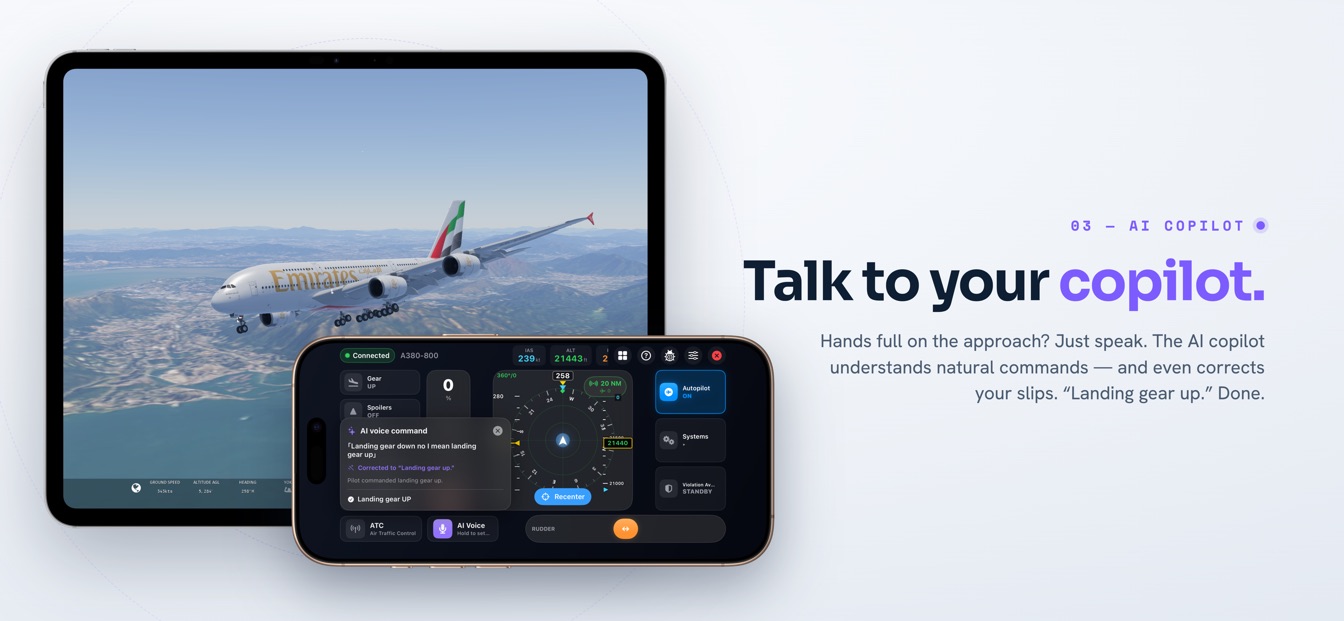
Feel is yours to shape, axis by axis. The tilt range runs from a sharp 15° to a relaxed 60° of lean for full deflection, and pitch, roll and yaw each carry independent sensitivity, dead zone, expo curve, inversion, trim and smoothing. On a long twinjet like this, a touch of expo around center is the difference between chasing the flight path and settling quietly onto it.
Prefer the phone stationary on a desk? Switch to the Touch Joystick: a self-centering on-screen pad that maps your thumb 1:1 and springs back to neutral the moment you let go. Same aircraft, different grip — swap between the two in Settings whenever you like.
A heavy stretch wants honest power management, so SkyYoke gives the 787-10 a single intelligent lever instead of a cluster of on-screen sliders. Slide it up for 0–100% forward thrust, with a haptic tick marking the idle detent so your finger finds it without your eyes leaving the runway. (Levers your favorite part? The remote throttle has a page of its own.)
The clever part lives at the bottom of the travel. On the runway at 40 knots or more, pulling into the red zone engages reverse thrust and holds it — Infinite Flight expects you to keep pressing for reverse, so the lever does the pressing while you steer the rollout. Once speed decays below 40 knots, that same red zone becomes proportional wheel braking for the taxi-speed finish. Try to grab reverse in the air and SkyYoke refuses outright: a warning banner, a repeating haptic, no reverser. The lever even recolors as its job changes — blue and green for thrust, amber for braking, red for reverse — so one glance tells you what your hand is commanding.
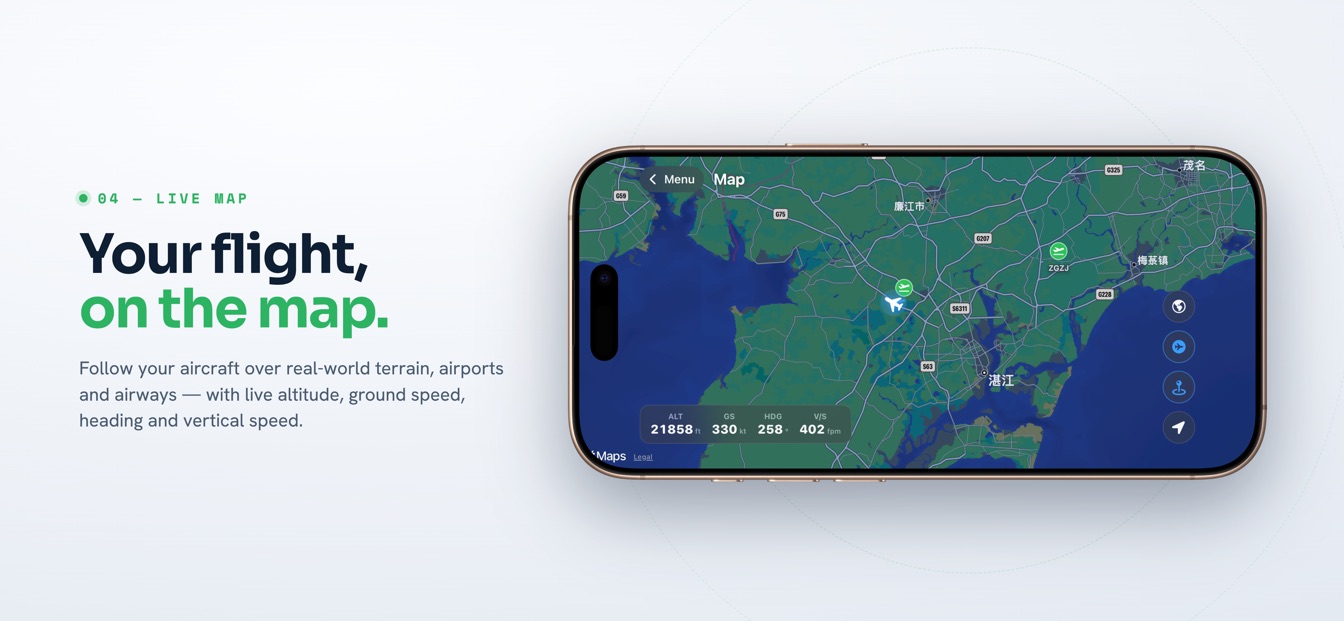
Trunk routes mean long stretches under automation, and SkyYoke keeps the rest of the flight deck within a thumb's reach. Live IAS, altitude, heading and vertical-speed chips ride above the controls, backed by a PFD-style speed tape with a trend arrow and an altitude tape with cyan bugs at your selected values. The systems panel covers the flows — main battery, APU, external power, exterior lights, cabin signs, autobrake, engine start — and only surfaces the switches the aircraft you are flying actually exposes.
Arm callouts on the Performance screen and hear V1, Rotate and V2 during the roll, estimated from weight, runway and weather.
An Airbus-ND-style scope over the yoke pad classifies live multiplayer traffic and speaks advisories. A simulator aid, not certified avionics.
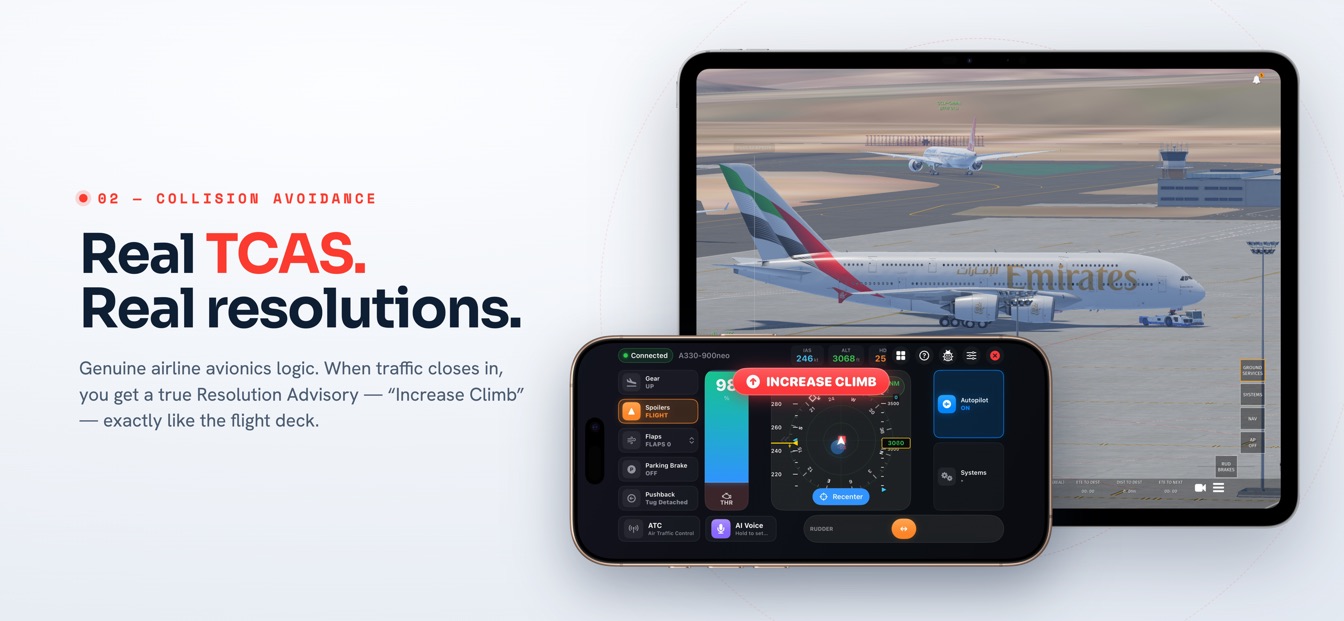
Below 10,000 feet, the autopilot speed target can be clamped to 250 knots — or energy managed in the descent — with spoken alerts.
That last one earns its keep in an airliner that descends as cleanly as the 787 does. The Violation Avoidance System arms about 2,000 feet above the limit band, works only while the autopilot is engaged, and hands back the speed you originally dialed once you are clear. Like the V-speed figures, it is an estimate-driven aid for the simulator — useful, never a guarantee.
Flying Infinite Flight's largest Dreamliner with an iPhone yoke, answered.
It is an iPhone app standing in for the 787-10's control column. SkyYoke connects to Infinite Flight over your home Wi-Fi and converts the way you tilt the phone — or drag an on-screen pad — into live roll and pitch for the largest Dreamliner, alongside a throttle with reverse thrust, a rudder bar and an autopilot panel. No physical hardware is involved.
The real 787 is flown with a conventional Boeing control column, so a yoke-style input maps naturally onto it. SkyYoke's Motion Yoke reads gravity rather than raw angles, which means smooth, grip-independent banking — useful for a long-bodied airliner that rewards small, deliberate corrections at rotation and in the flare. Narrow the tilt range and add expo to make inputs around neutral extra fine.
Touch down, pull the SkyYoke lever into the red zone, and the app holds reverse thrust for you — Infinite Flight normally requires you to keep pressing for reverse, but the lever maintains it on your behalf. As the rollout decays below 40 knots, the same zone hands over to proportional wheel braking. In the air, reverse is blocked entirely, with a warning banner and a repeating haptic.
Yes, while the autopilot is flying. The Violation Avoidance System arms roughly 2,000 feet above Infinite Flight's 250-knot-below-10,000-feet band, then either clamps your autopilot speed target to 250 knots — restoring the speed you dialed once clear — or idles the throttle and adjusts the descent to bleed energy. It announces what it is doing with spoken alerts. It is an aid, never a guarantee.
An iPhone on iOS 17.2 or later for SkyYoke, plus a second device running Infinite Flight with Infinite Flight Connect enabled, both on the same Wi-Fi network. You bind the control axes once in Infinite Flight's Controllers settings, guided by the in-app setup walkthrough. SkyYoke is available now — download it on the App Store / Google Play, free.
SkyYoke is available now — download it on the App Store and turn your iPhone into a full flight-sim cockpit.
Download on the App Store Get it on Google Play