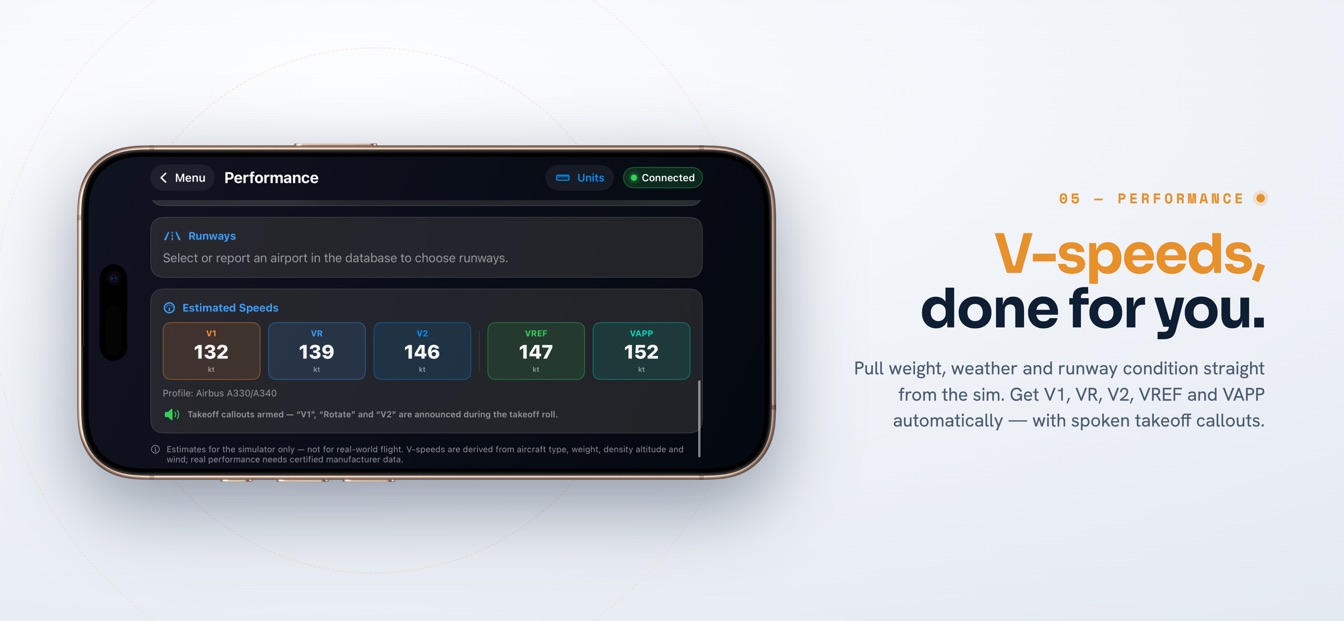
Takeoff callouts
Arm them on the Performance screen and the roll gets spoken "V1", "Rotate" and "V2" — estimates scaled by weight and density altitude.
Hold your iPhone the way Boeing meant the Dreamliner to be held. SkyYoke turns the phone into a wireless 787-8 yoke for Infinite Flight — bank with your wrists, rotate with a pull, and let that long composite wing do the rest.
A Boeing 787-8 yoke for Infinite Flight is your iPhone running SkyYoke: the phone becomes a wireless control column for the Dreamliner over your own Wi-Fi, banking the jet when you roll your wrists and rotating when you pull back — with a throttle, rudder bar and full panel on the same screen, and no hardware to buy.
Every 787-8 departure has one second that matters more than the rest. The jet gathers speed with the quiet, far-off rush only big high-bypass turbofans make, the composite wing flexes upward as it takes the load, and then the call comes: rotate. On a touchscreen, that second is a thumb sliding across glass. With a Boeing 787-8 yoke for Infinite Flight built from the iPhone already in your hand, it becomes the input the airplane was designed around — a smooth, two-handed pull that eases the nose skyward while the Dreamliner's wingtips bow upward and the runway falls away.
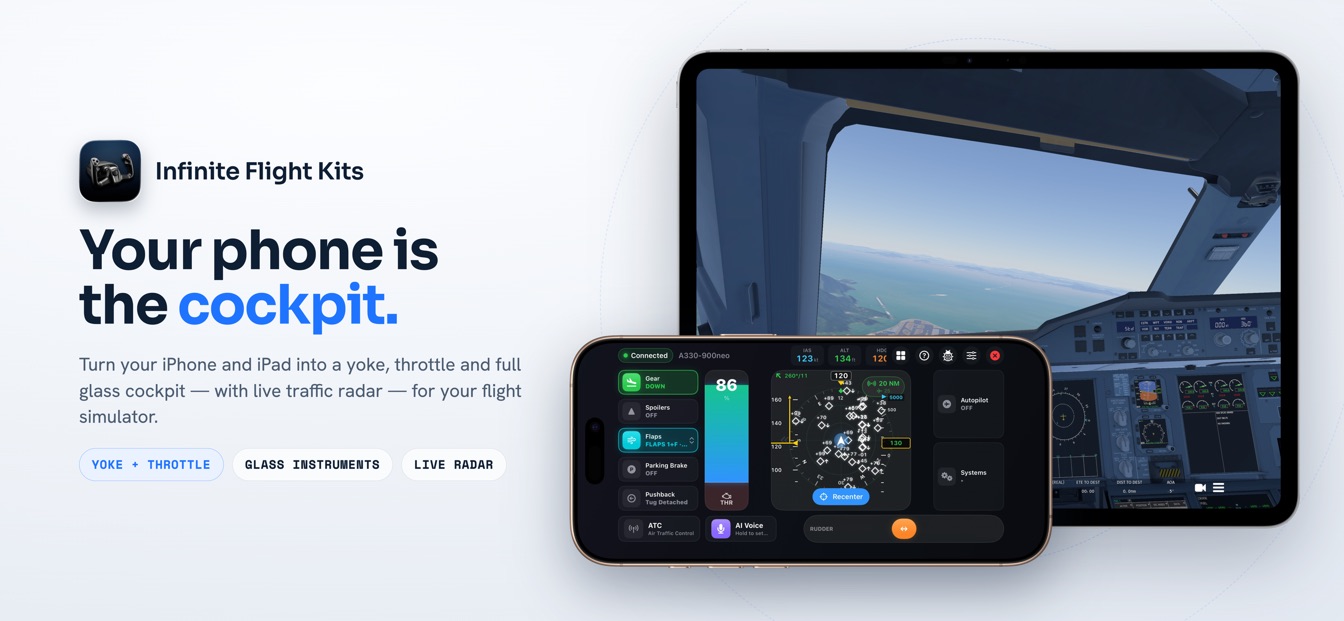
SkyYoke is how the phone gets there. It links over your home Wi-Fi to Infinite Flight running on an iPad or another device, discovers the simulator automatically, and streams your motion to the aircraft live. Choose the 787-8 from Infinite Flight's fleet, settle into your seat, and the slab of glass in your palm starts behaving like a control column.
The -8 is where the Dreamliner story begins — the first of the family, and the airplane that proved a composite airframe could carry the long-haul flag. Its real trick was economic as much as structural: big-jet range at mid-size capacity, which let airlines open thin long-haul routes between city pairs that could never fill a jumbo. Passengers remember the huge dimmable windows; pilots got a thoroughly modern flight deck that, unusually for so new a design, kept the traditional Boeing yoke in front of each seat.
That last detail is the soul of this page. The stretched 787-9 and 787-10 inherited the same column, but the -8 is the shortest, lightest member of the family — the one that started it all. If the airplane itself insists on a yoke, flying it in Infinite Flight with one in your hands feels less like a gimmick and more like respect.
SkyYoke's Motion Yoke does not read raw rotation angles; it reads the gravity vector relative to a neutral point you choose. The practical translation: grip does not matter. Rest the phone flat on your lap or hold it upright in both hands like the genuine article — either way, rolling your wrists banks the Dreamliner and pulling the top edge toward you raises the nose. There is no gimbal lock to fight, and a one-tap Recenter captures a fresh neutral whenever you shift in your seat.
A widebody rewards smoothness over twitch, so every axis is tunable to taste:
Prefer to keep the phone still? The Touch Joystick swaps motion for an on-screen, self-centering pad that maps 1:1 and springs back to neutral the moment you let go. Both modes feed the same 60 Hz control loop with change-detection, rate limiting and automatic reconnection if your Wi-Fi blinks. A self-centering rudder bar along the bottom of the screen handles taxi steering and crosswind work.
The smart throttle is shaped around exactly the rhythm of a 787-8 sector. Advance it for takeoff thrust; a haptic tick marks the idle detent on the way back down. The clever part begins at touchdown: pull the lever into its red zone at 40 knots or above and SkyYoke engages reverse thrust and holds it for you — Infinite Flight normally requires reverse to be held continuously, and the lever takes over that chore so you can watch the centerline instead of your thumb. As the rollout decays below 40 knots, the same red zone becomes proportional wheel braking, so one continuous pull walks the jet from reverse down to taxi speed.
Airborne, the red zone is locked out entirely — a warning banner and a repeating haptic make an accidental in-flight reverse impossible to miss. The lever even recolors by role: blue-green for forward thrust, amber while braking, red in reverse. There is a deeper dive on the remote throttle page.
| Manufacturer | Boeing |
|---|---|
| Family | 787 Dreamliner — the original, shortest variant of the composite widebody family |
| Control style | Yoke — a traditional Boeing control column on an otherwise state-of-the-art flight deck |
| Engines | 2 × wing-mounted high-bypass turbofans |
| Typical role | Long-haul, thin-route widebody: big-jet range at mid-size capacity |
| Yoke in SkyYoke | iPhone motion tilt (or on-screen touch pad) → roll and pitch |
| Throttle in SkyYoke | Smart lever: 0–100% thrust, held reverse on the rollout, proportional brakes below 40 kts |
| Rudder in SkyYoke | Self-centering rudder bar along the bottom of the screen |
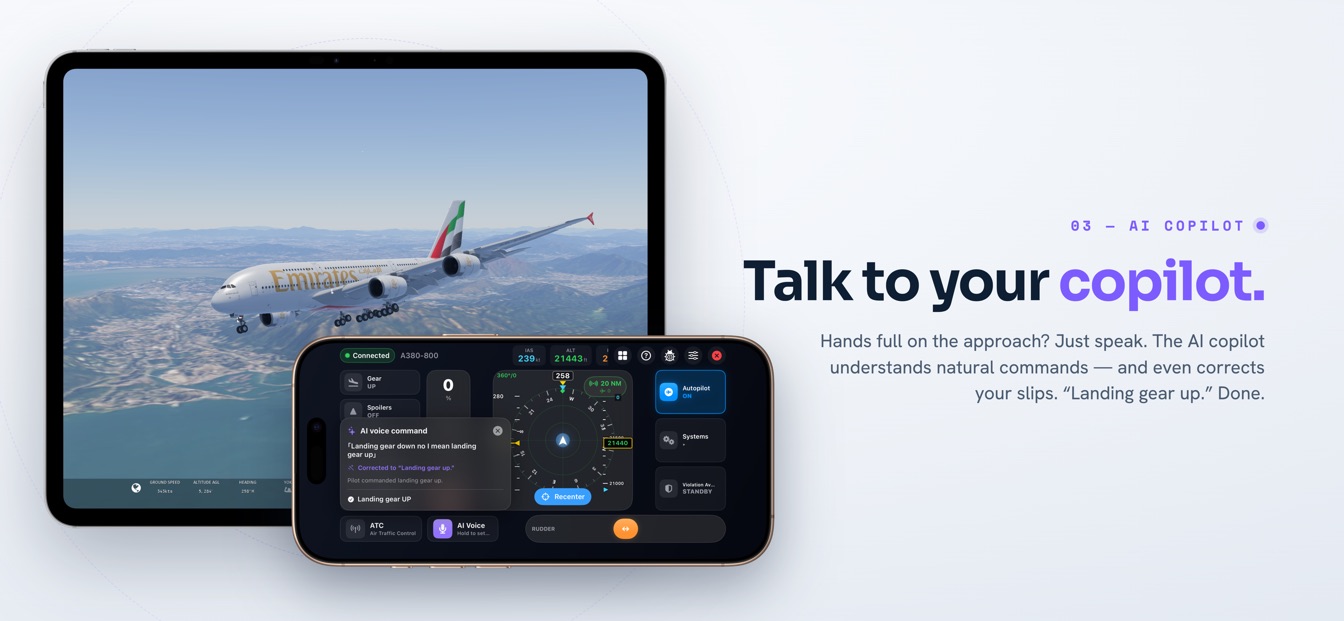
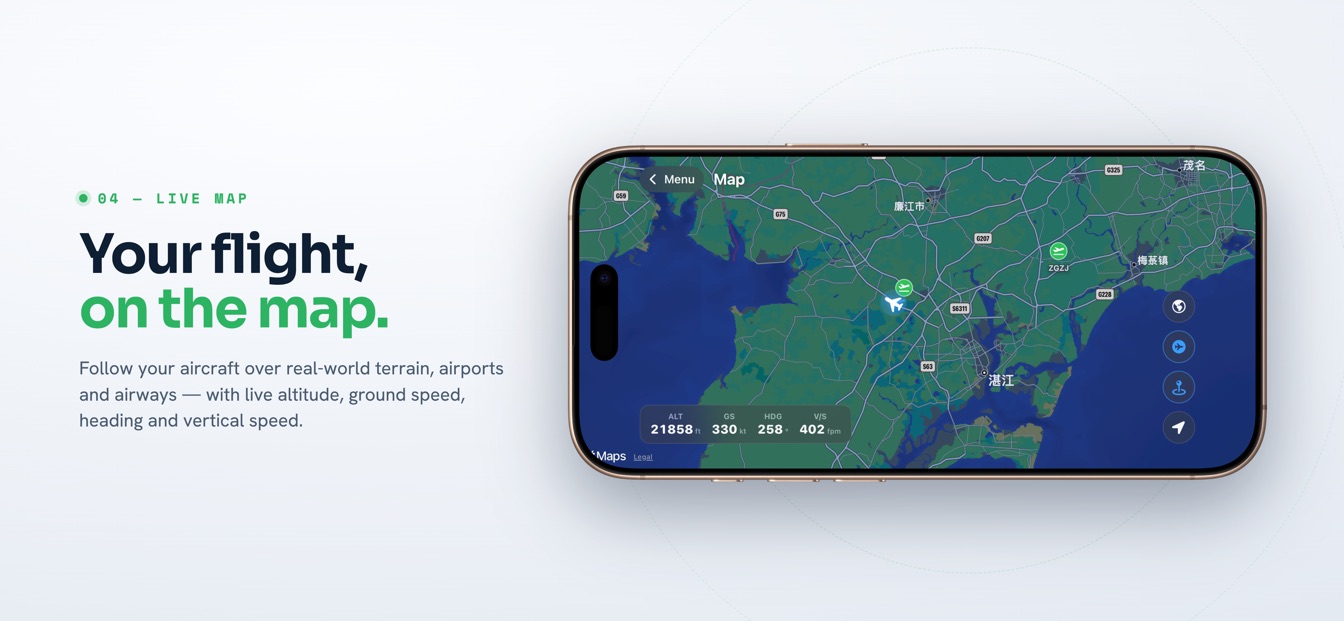
Long-haul flying is mostly monitoring, so SkyYoke keeps the monitoring on the same screen as the controls. Live IAS, altitude, heading and vertical-speed chips sit beside PFD-style speed and altitude tapes with cyan bugs marking your selected targets, plus a ground/air phase chip and a spoiler annunciator. The systems panel covers the flows — beacon and strobes, landing lights, cabin signs, autobrake, engine start, APU — and only shows controls the aircraft you are flying actually exposes.
Arm them on the Performance screen and the roll gets spoken "V1", "Rotate" and "V2" — estimates scaled by weight and density altitude.
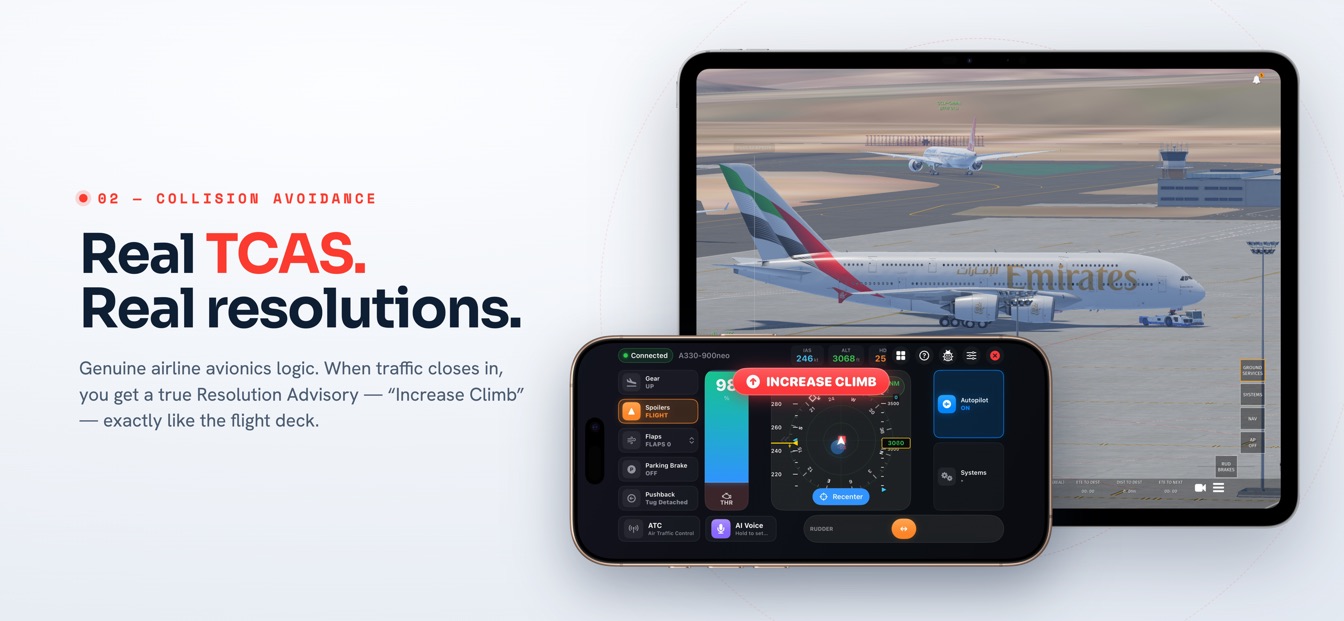
A navigation-display-style scope over the yoke pad paints live multiplayer traffic with TCAS II v7.1-style categories and spoken advisories.
While the autopilot flies, VAS watches the 250-knot limit below 10,000 ft and clamps speed or manages energy before a violation lands.
The last one earns its keep on a Dreamliner descent: a slick, heavy widebody gathers speed easily coming downhill, and the Violation Avoidance System arms itself about 2,000 ft above the restriction band, remembers the speed you dialed, and restores it once you are clear. Like the traffic scope and the V-speed callouts, it is a simulator aid — helpful and audible, but an estimate, never a guarantee.
From there the -8 does what it was built for: long, quiet hours westbound with the autopilot panel a thumb-swipe away, then a yoke in your hands again when the destination shows up on the scope.
Flying the Dreamliner from your iPhone, answered.
Yes. SkyYoke turns an iPhone into a wireless yoke for Infinite Flight running on another device on the same Wi-Fi. Pick the 787-8 from Infinite Flight's fleet, hold the phone like a control column, and roll or pull it to bank and pitch the Dreamliner in real time. A throttle, rudder bar, autopilot and systems panel share the same screen, so no extra hardware is involved.
The real 787-8 kept a traditional Boeing yoke despite its thoroughly modern flight deck, so deliberate wrist-and-forearm inputs feel right for it. SkyYoke's Motion Yoke reads the gravity vector relative to a neutral you set, works flat on a lap or held upright, never hits gimbal lock, and offers a 15–60 degree tilt range with one-tap recentering — wide, smooth travel that matches a widebody's measured handling.
Touch down and pull the single lever into its red zone: at 40 knots or faster on the ground it engages held reverse thrust — Infinite Flight normally requires reverse to be held continuously, and the lever holds it for you. As the rollout slows below 40 knots, the same red zone becomes proportional wheel braking, so one continuous motion takes the -8 from reverse thrust to a walking pace.
An iPhone on iOS 17.2 or later for SkyYoke, plus a second device running Infinite Flight, both on the same Wi-Fi network. Enable Infinite Flight Connect in the simulator's settings and bind the control axes once under Controllers — an in-app setup guide walks you through it. After that, SkyYoke discovers the simulator automatically each time you fly.
No. SkyYoke is an independent, unofficial app and is not affiliated with, sponsored by, or endorsed by Boeing or Infinite Flight LLC. Aircraft names are used only to describe compatibility, and which aircraft appear in Infinite Flight's fleet is determined by Infinite Flight itself. Performance figures and callouts in the app are simulator estimates, never real-world guidance.
SkyYoke is available now — download it on the App Store and turn your iPhone into a full flight-sim cockpit.
Download on the App Store Get it on Google Play